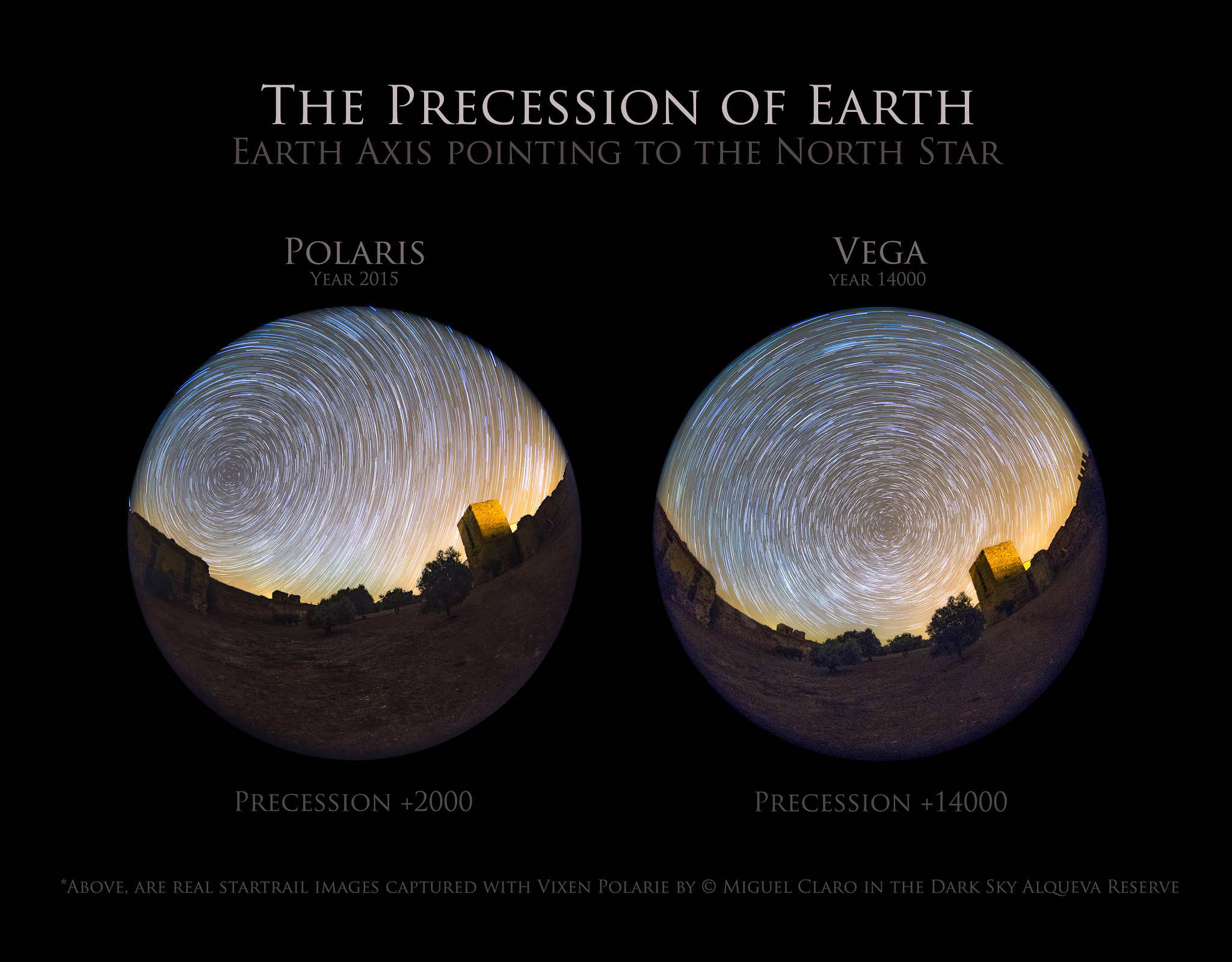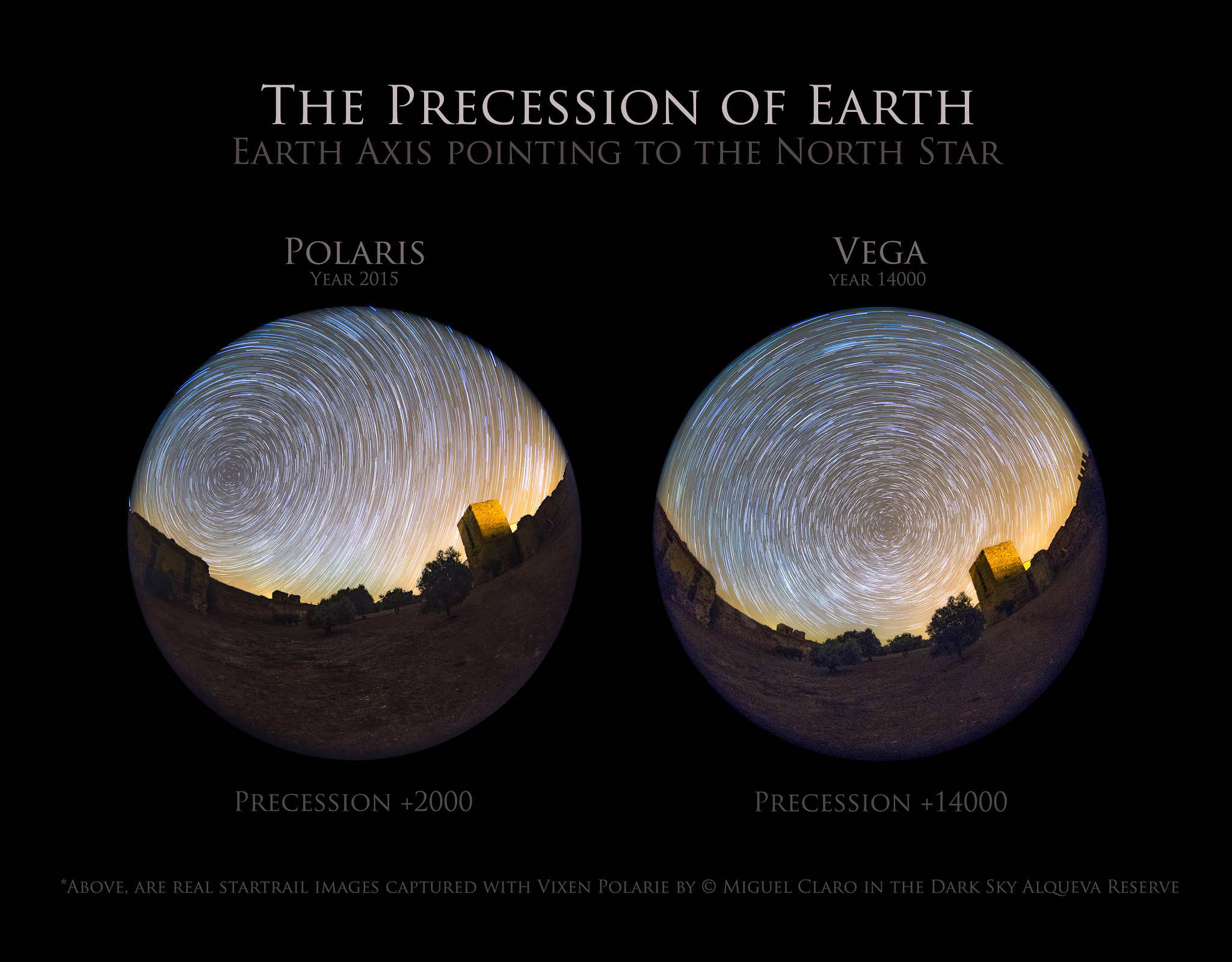
In only about 12,000 years Vega will be the North Star, the closest bright star to our fair planet's North Celestial Pole. By then, when you fix your camera to a tripod long exposures of the night sky will show the concentric arcs of star trails centered on a point near Vega as Earth rotates on its axis. Of course, presently the bright star conveniently near the North Celestial Pole is Polaris, but that will change as the Earth's axis of rotation precesses, like the wobble of a spinning top with a precession period of about 26,000 years. If your camera is ready now and you don't want to wait 12,000 years for Vega to be the North Star, consider this ingenious demonstration of contemporary star trails (left) versus star trails reminiscent of the year 14000 CE. Both were recorded this April at the Alqueva Dark Sky Reserve in Alentejo, Portugal. To produce the more Vega-centric star trails of the distant future, astronomer Miguel Claro combined the rotation of two startracking camera mounts to create the apparent shift in the North Celestial Pole. (Addendum: Thanks to APOD readers who note that when Vega is the North Star it will also appear near the same position that Polaris is now relative to the landscape.)
En aproximadamente 12 000 años, Vega será la Estrella Polar, la estrella brillante más cercana al Polo Celeste Norte de nuestro planeta. Para entonces, si fijas tu cámara a un trípode y realizas exposiciones largas de la noche, verás arcos concéntricos de trayectorias estelares centrados en un punto cercano a Vega, debido a la rotación de la Tierra sobre su eje. Por supuesto, actualmente la estrella brillante más cercana al Polo Celeste Norte es Polaris, pero esto cambiará a medida que el eje de rotación de la Tierra se precese, como el bamboleo de una peonza con un período de precesión de aproximadamente 26 000 años. Si tu cámara está lista ahora y no quieres esperar 12 000 años para que Vega sea la Estrella Polar, considera esta demostración ingeniosa de trayectorias estelares contemporáneas (izquierda) versus trayectorias estelares similares a las del año 14000 d.C. Ambas fueron capturadas este abril en la Reserva del Cielo Oscuro de Alqueva, en Alentejo, Portugal. Para producir las trayectorias estelares más centradas en Vega del futuro distante, el astrónomo Miguel Claro combinó la rotación de dos monturas de seguimiento de estrellas para crear el aparente desplazamiento del Polo Celeste Norte. (Adenda: Gracias a los lectores de APOD que señalan que cuando Vega sea la Estrella Polar, también aparecerá en una posición similar a la que actualmente ocupa Polaris en relación con el paisaje).