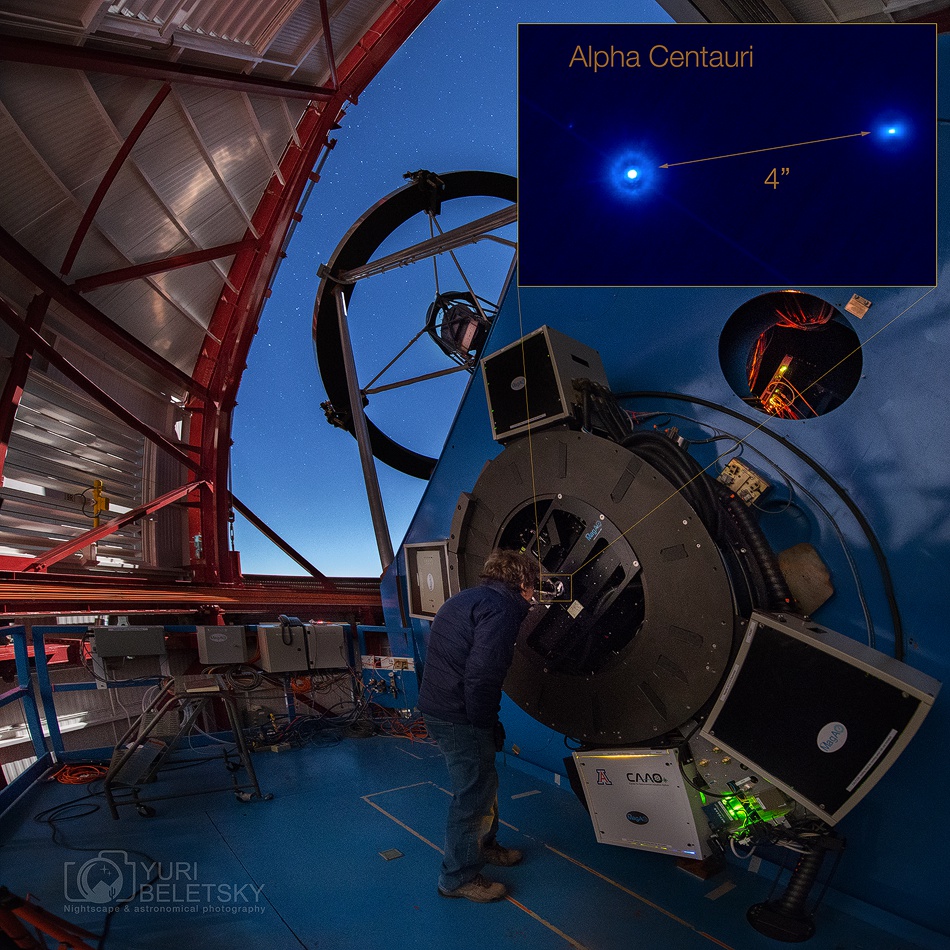
Did you ever want to just look through the eyepiece of a large telescope in space? If you could, you would see a sharp view that was diffraction limited. Unaffected by atmospheric blurring that ultimately plagues earthbound observers, the angular resolution of your diffraction limited view would be determined only by the wavelength of light and diameter of the telescope lens or mirror; the larger the diameter, the sharper the image. Still, in this working earth-based snapshot a new active adaptive optics system (MagAO) is being used to cancel out the atmospheric blurring in a visual observation of famous double star system Alpha Centauri. Testing the system at the eyepiece of the 6.5 meter diameter Magellan Clay Telescope at Las Campanas Observatory, astronomer Laird Close is enjoying a historic diffraction limited view (inset) and the wide apparent separation of the close binary star system ... without traveling to low earth orbit.
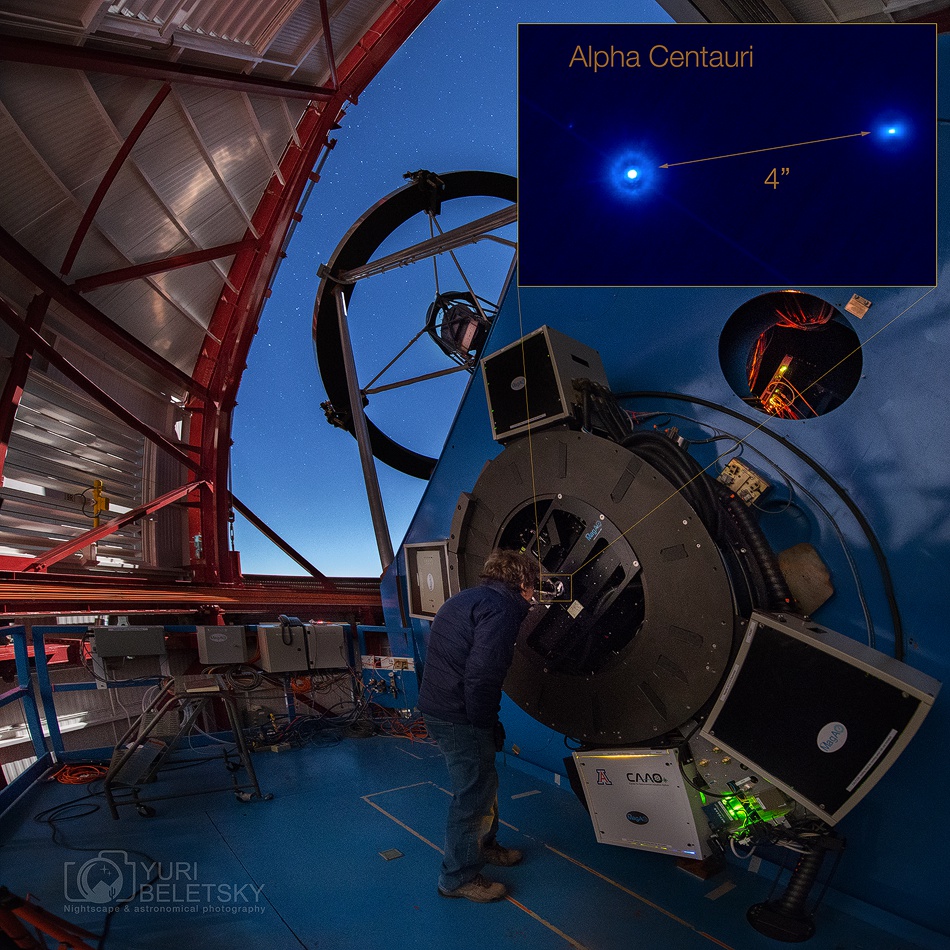
¿Alguna vez quiso mirar a través del ocular de un gran telescopio en el espacio? Si pudiera hacerlo, vería una imagen nítida limitada por la difracción. No afectada por el desenfoque atmosférico que finalmente afecta a los observadores en la Tierra, la resolución angular de su visión limitada por la difracción estaría determinada solo por la longitud de onda de la luz y el diámetro del lente o espejo del telescopio; cuanto mayor sea el diámetro, más nítida será la imagen. Sin embargo, en esta instantánea terrestre actual, se está utilizando un nuevo sistema de óptica adaptativa (MagAO) para cancelar el desenfoque atmosférico en una observación visual del famoso sistema estelar doble Alpha Centauri. Probando el sistema en el ocular del telescopio Magellan Clay de 6,5 metros de diámetro en el Observatorio Las Campanas, el astrónomo Laird Close está disfrutando de una visión histórica limitada por la difracción (inseto) y la gran separación aparente del sistema estelar binario cercano... sin necesidad de viajar a la órbita terrestre baja.