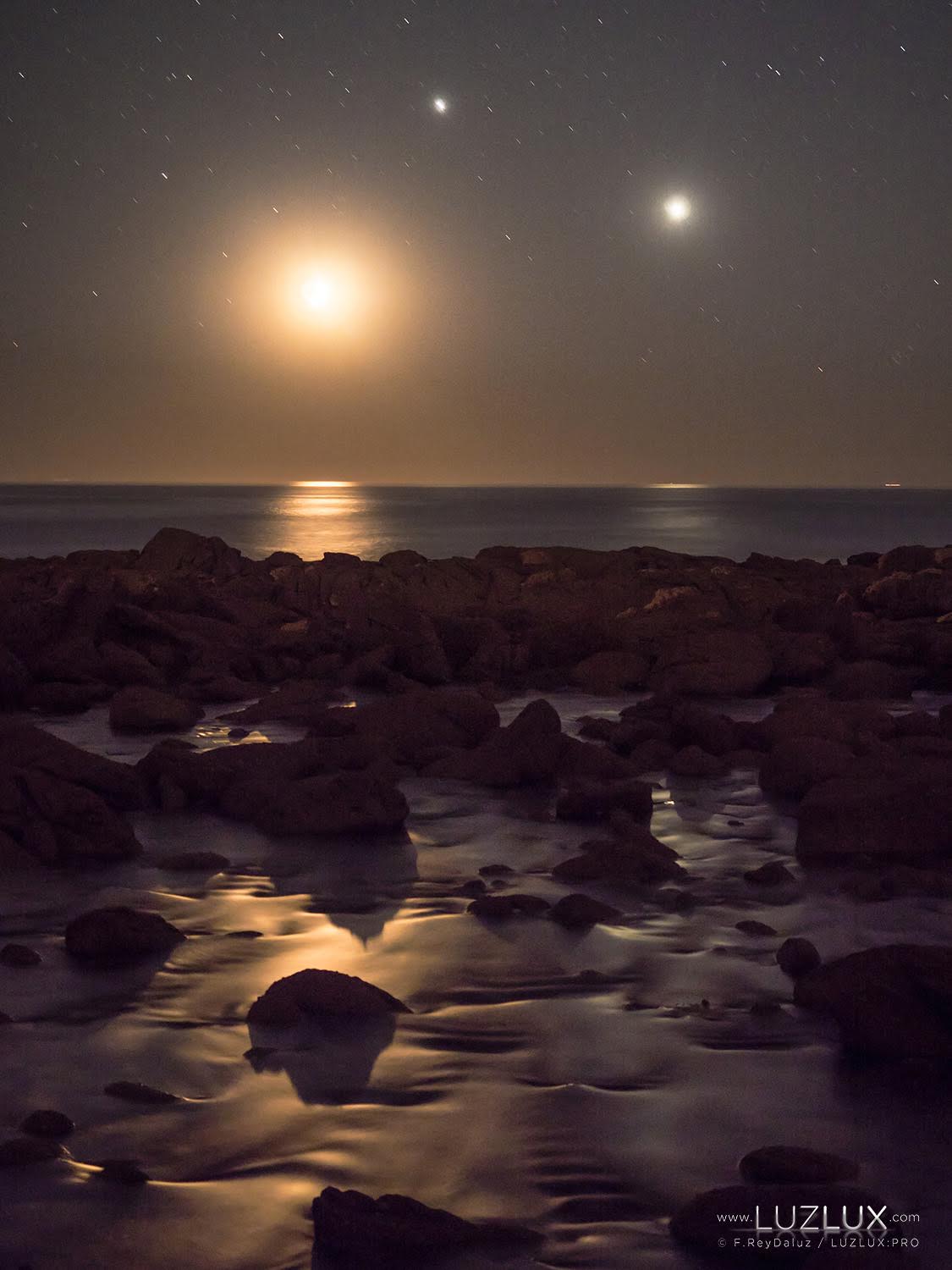
What are those bright objects hovering over the horizon? Planets -- and the Moon. First out, the horizon featured is a shoreline of the Atlantic Ocean that occurs at the Galicia National Park in northern Spain. Next furthest out, on the left, is the Moon. Easily the brightest object on the night sky, the Moon here was in only a crescent phase. The next furthest out, on the right, is the planet Venus, while planet Jupiter is seen at the top of the triangle. The long exposure from our rapidly rotating Earth made all of celestial objects -- including the far distant stars -- appear as slight arcs. The featured image was taken last Sunday night. Although the Moon's orbit has now taken it away from this part of the sky, the planets Venus and Jupiter can be seen superposed just after sunset until mid-August. The closest apparent separation of Venus and Jupiter will occur in one week, when the two planets will appear separated by less than the angular diameter of the Moon.
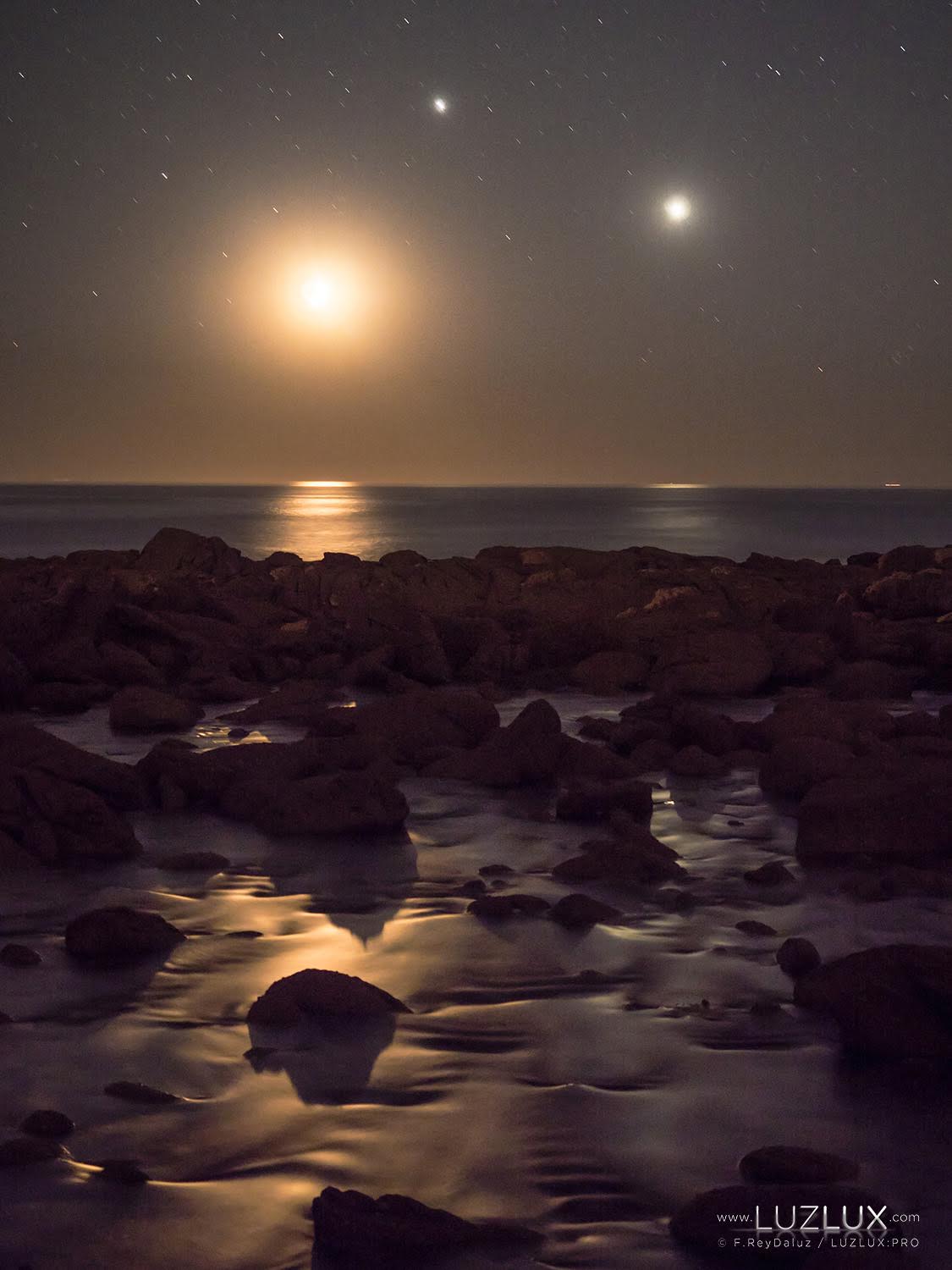
¿Qué son esos objetos brillantes que flotan sobre el horizonte? Planetas — y la Luna. En primer lugar, el horizonte mostrado corresponde a una costa del Océano Atlántico ubicada en el Parque Nacional de Galicia, en el norte de España. A continuación, en el extremo izquierdo, se encuentra la Luna. Sin duda el objeto más brillante del cielo nocturno, en este caso la Luna se encontraba en fase de cuarto creciente. En el extremo derecho, se observa el planeta Venus, mientras que el planeta Júpiter se ve en la parte superior del triángulo. La larga exposición realizada desde la Tierra en rápida rotación hizo que todos los objetos celestes —incluidas las estrellas distantes— aparecieran como leves arcos. La imagen destacada fue tomada la noche del domingo anterior. Aunque la órbita de la Luna ya la ha alejado de esta parte del cielo, los planetas Venus y Júpiter pueden verse superpuestos justo después del atardecer hasta mediados de agosto. La separación aparente más cercana entre Venus y Júpiter ocurrirá en una semana, cuando los dos planetas aparecerán separados por menos que el diámetro angular de la Luna.