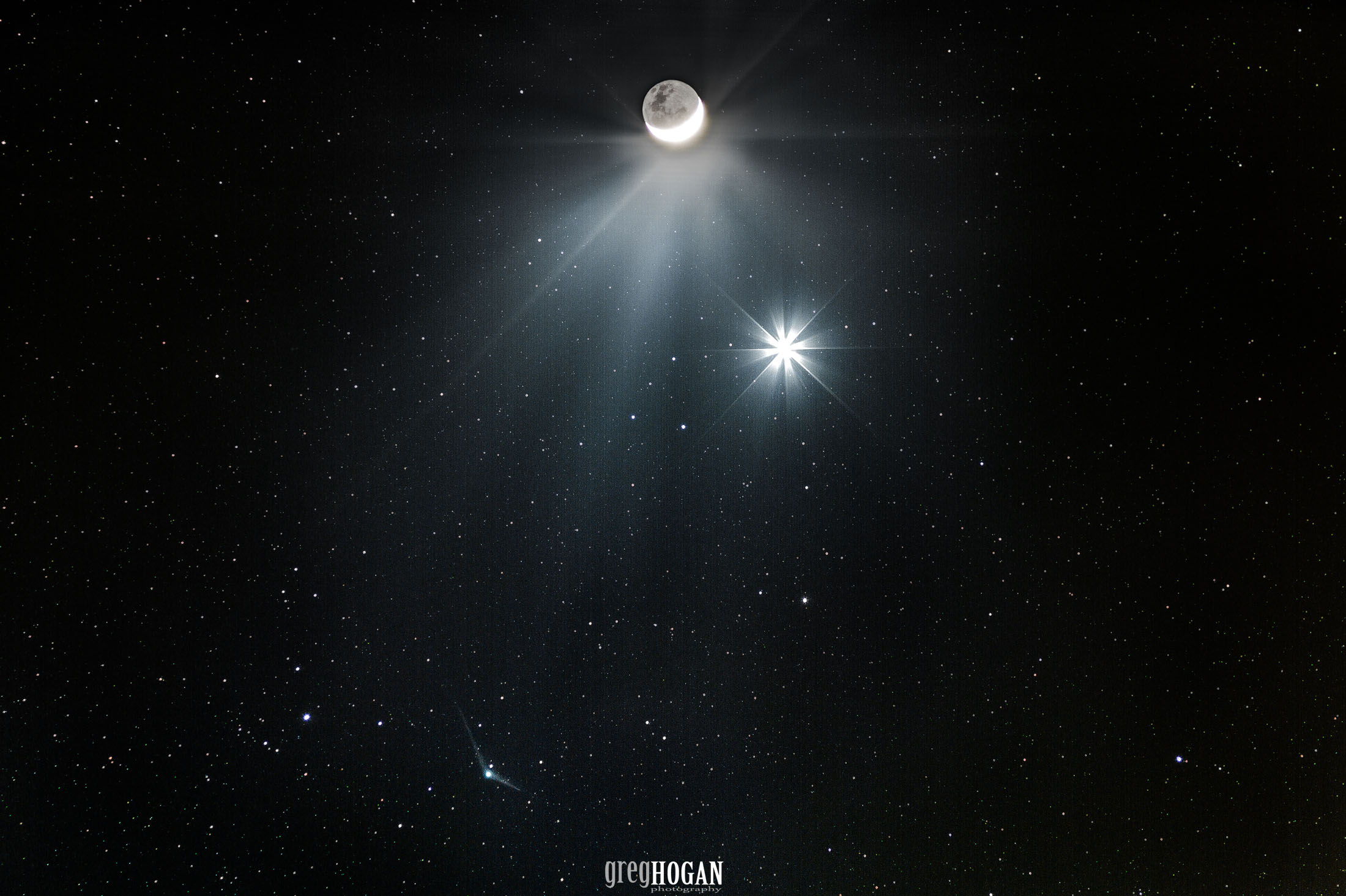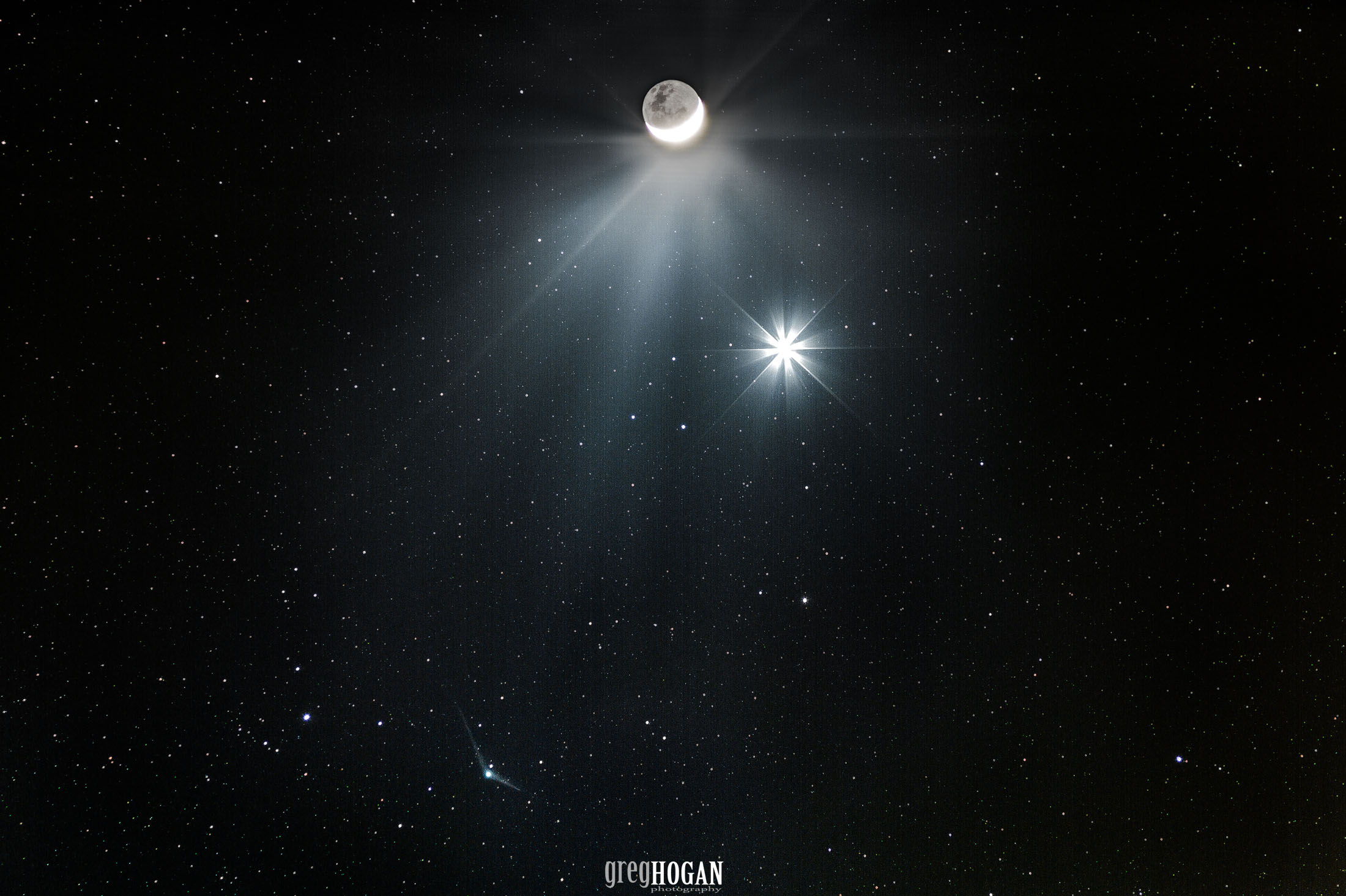
A crescent Moon and brilliant Venus met in predawn skies on December 7, a beautiful conjunction of planet Earth's two brightest celestial beacons after the Sun. Harder to see but also on the scene was Comet Catalina (C/2013 US10). The fainter comet clearly sporting two tails, lunar night side, bright sunlit lunar crescent, and brilliant morning star, are all recorded here by combining short and long exposures of the same field of view. Pointing down and right, Catalina's dust tail tends to trail behind the comet's orbit. Its ion tail, angled toward the top left of the frame, is blowing away from the Sun. Discovered in 2013, the new visitor from the Oort cloud was closest to the Sun on November 15 and is now outbound, headed for its closest approach to Earth in mid-January. Watch: The Geminids
Una Luna en cuarto creciente y brillante Venus se encontraron en el cielo antes del amanecer el 7 de diciembre, una hermosa conjunción de los dos objetos más brillantes del cielo terrestre después del Sol. Más difícil de ver, pero también presente en la escena, estaba el cometa Catalina (C/2013 US10). El cometa más tenue, claramente mostrando dos colas, la cara nocturna de la Luna, la brillante Luna en cuarto creciente iluminada por el Sol y la brillante estrella matutina, están registrados aquí combinando exposiciones cortas y largas del mismo campo de visión. Apuntando hacia abajo y a la derecha, la cola de polvo de Catalina tiende a quedarse atrás en la órbita del cometa. Su cola de iones, inclinada hacia la parte superior izquierda de la imagen, se aleja del Sol. Descubierto en 2013, el nuevo visitante del núcleo de Oort estuvo más cerca del Sol el 15 de noviembre y ahora se aleja, encaminado hacia su acercamiento más cercano a la Tierra a mediados de enero.