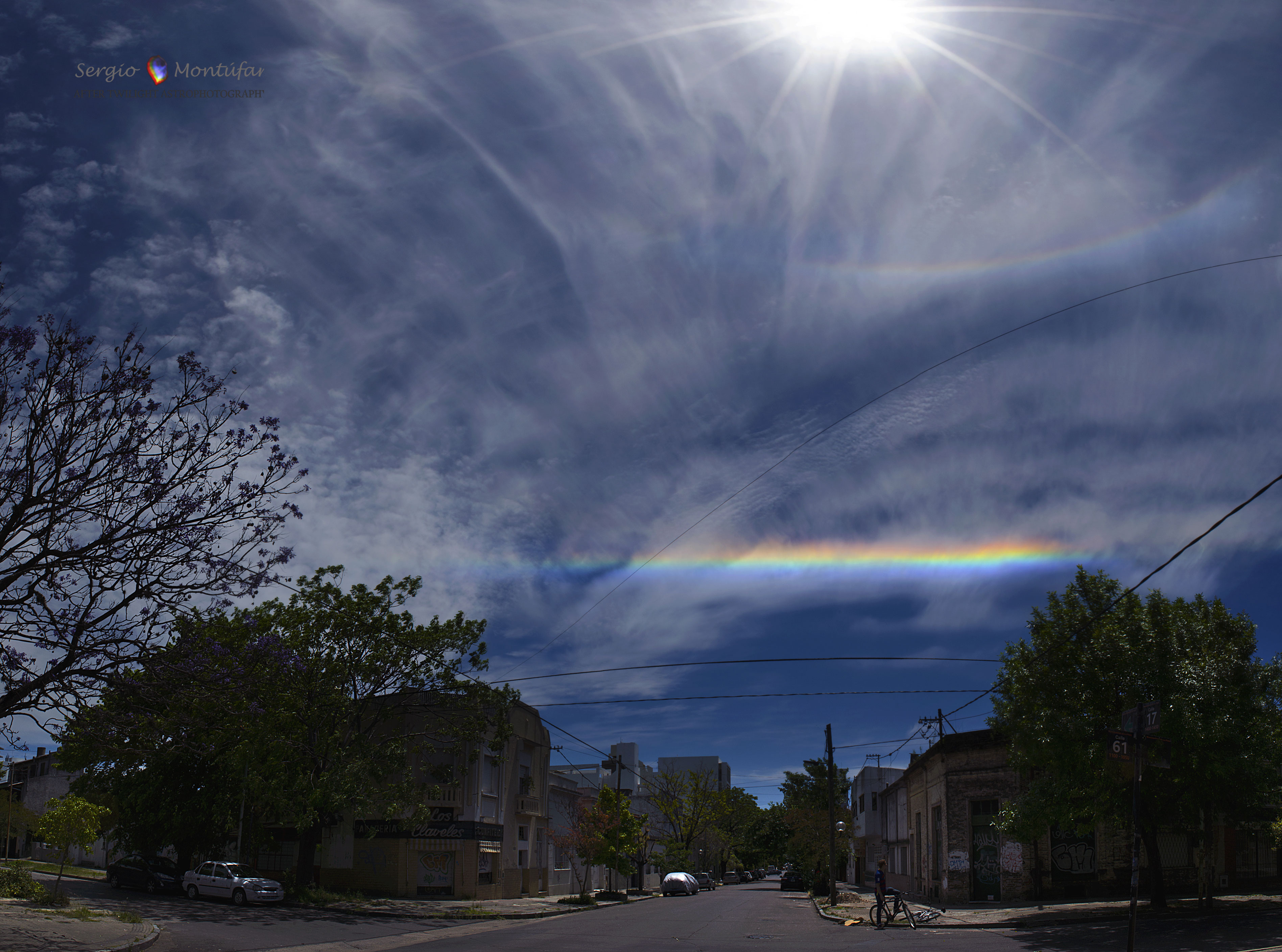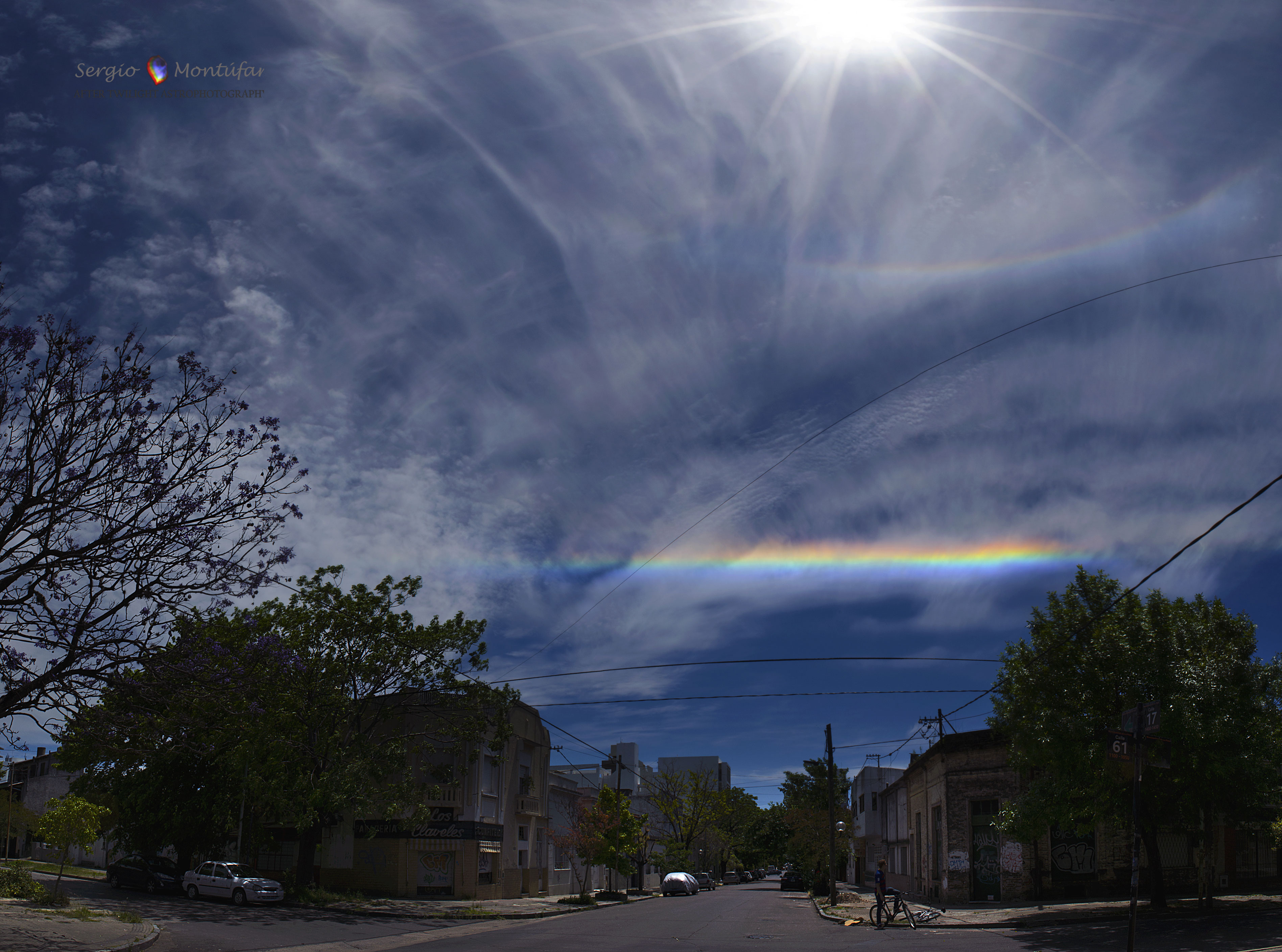
What are those colorful arcs in the sky? Like rainbows that are caused by rain, arcs of sunlight broken up into component colors can also result when ice crystals floating in Earth's atmosphere act together as a gigantic prism. The top color arc is more typical as it is part of the 22 degree halo surrounding the Sun when hexagonal ice crystals refract sunlight between two of the six sides. More unusual, though, is the bottom color arc. Sometimes called a fire rainbow, this circumhorizon arc is also created by ice, not fire nor even rain. Here, a series of horizontal, thin, flat ice crystals in high cirrus clouds refract sunlight between the side and bottom faces toward the observer. These arcs only occur when the Sun is higher than 58 degrees above the horizon. The featured sky occurred to the northwest in the early afternoon last month over a street Diagonal of La Plata City, Buenos Aires, Argentina. Follow APOD on: Facebook, Google Plus, or Twitter
¿Qué son esos arcos coloridos en el cielo? Al igual que los arcoíris que se forman por la lluvia, los arcos de luz solar separados en sus colores componentes también pueden aparecer cuando los cristales de hielo flotando en la atmósfera terrestre actúan juntos como un gran prisma. El arco de color superior es más común, ya que forma parte del halo de 22 grados que rodea al Sol cuando los cristales hexagonales de hielo refractan la luz solar entre dos de sus seis lados. Sin embargo, el arco de color inferior es más inusual. A veces llamado arco de fuego, este arco circunhorizonte también se forma por hielo, no por fuego ni siquiera por lluvia. Aquí, una serie de cristales horizontales, delgados y planos en nubes cirros altas refractan la luz solar entre la cara lateral y la cara inferior hacia el observador. Estos arcos solo ocurren cuando el Sol está más alto de 58 grados sobre el horizonte. El cielo mostrado aquí ocurrió hacia el noroeste durante la tarde temprano del mes pasado sobre una calle Diagonal de la ciudad de La Plata, Buenos Aires, Argentina.