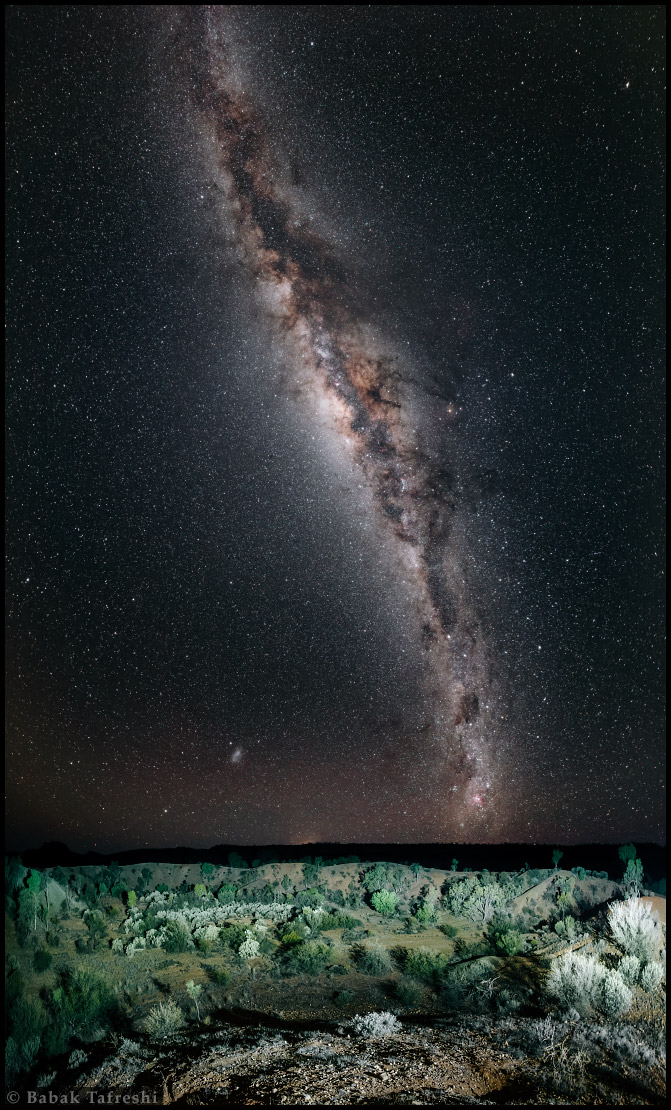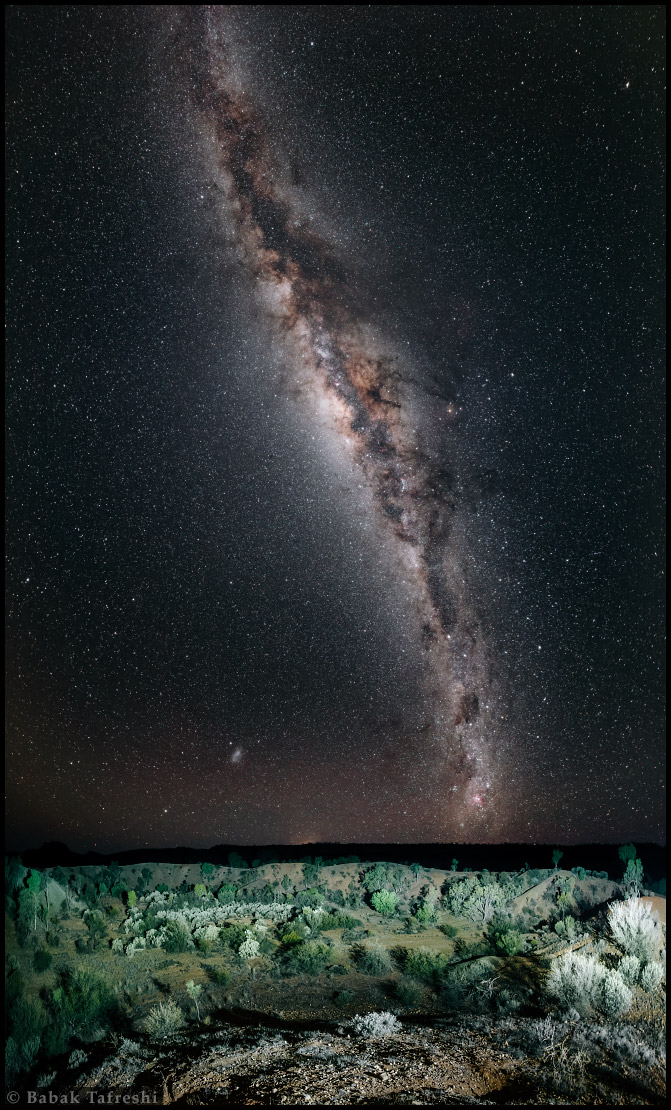
The Henbury craters in the Northern Territory, Australia, planet Earth, are the scars of an impact over 4,000 years old. When an ancient meteorite fragmented into dozens of pieces, the largest made the 180 meter diameter crater whose weathered walls and floor are lit in the foreground of this southern hemisphere nightscape. The vertical panoramic view follows our magnificent Milky Way galaxy stretching above horizon, its rich central starfields cut by obscuring dust clouds. A glance along the galactic plane also reveals Alpha and Beta Centauri and the stars of the Southern Cross. Captured in the region's spectacular, dark skies, the Small Magellanic Cloud, satellite of the Milky Way, is the bright galaxy to the left. Not the lights of a nearby town, the visible glow on the horizon below it is the Large Magellanic Cloud rising.
Los cráteres de Henbury, en el Territorio del Norte, Australia, en la Tierra, son las cicatrices de un impacto con más de 4000 años de antigüedad. Cuando un meteorito antiguo se fragmentó en docenas de piezas, la más grande formó el cráter de 180 metros de diámetro, cuyas paredes y suelo erosionados están iluminados en primer plano de este paisaje nocturno del hemisferio sur. La vista panorámica vertical sigue nuestra magnífica galaxia Vía Láctea extendiéndose por encima del horizonte, sus ricas zonas estelares centrales cortadas por nubes de polvo oscurecedoras. Una mirada a lo largo del plano galáctico también revela Alpha y Beta Centauri y las estrellas de la Cruz del Sur. Capturado en el espectacular cielo oscuro de la región, la Nube Magallánica Menor, satélite de la Vía Láctea, es la galaxia brillante a la izquierda. No son las luces de una ciudad cercana, la luz visible en el horizonte debajo de ella es la Nube Magellánica Mayor que se eleva.