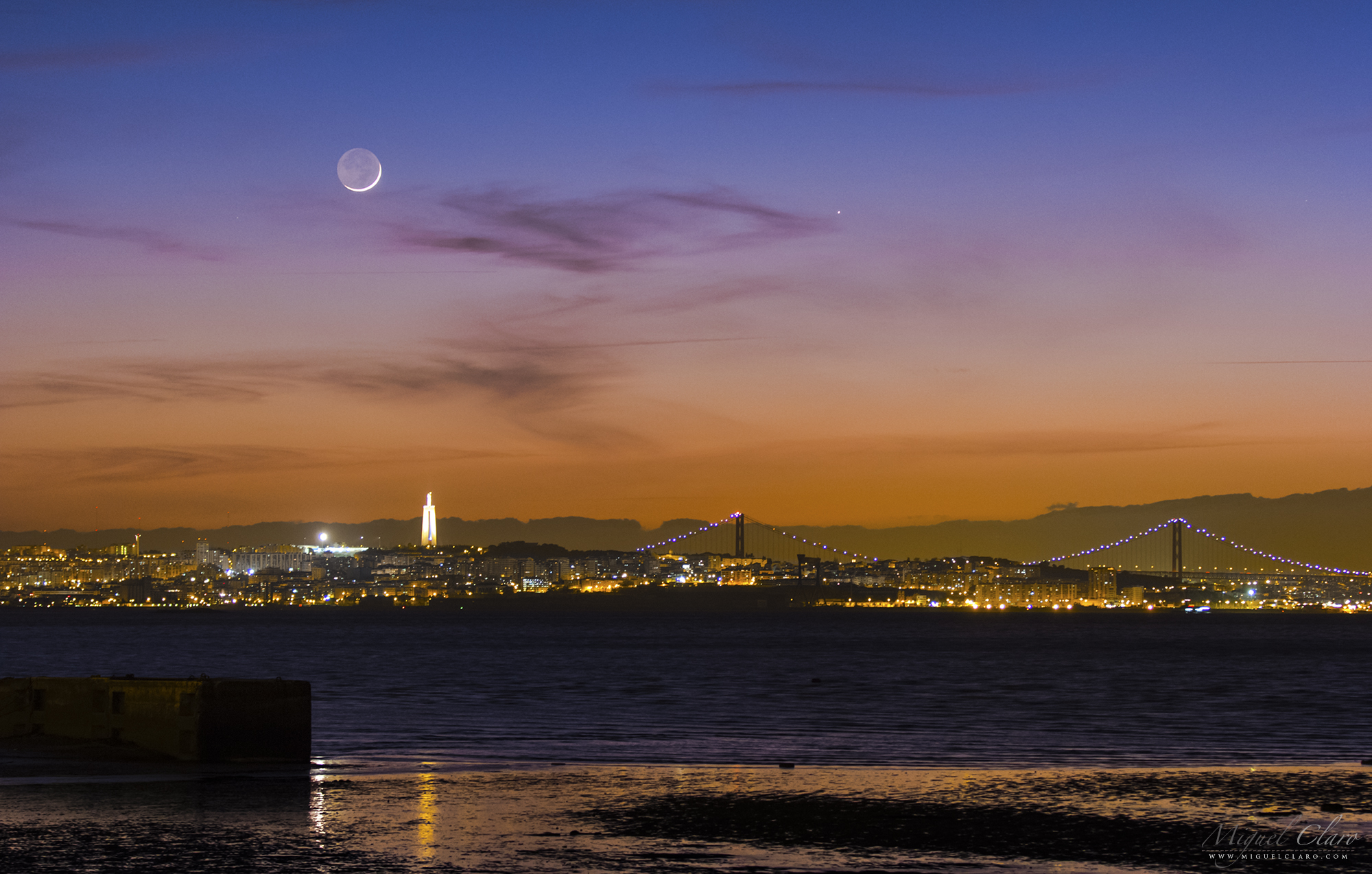
Innermost planet Mercury and a thin crescent Moon are never found far from the Sun in planet Earth's skies. Taken near dusk on April 8, this colorful evening skyscape shows them both setting toward the western horizon just after the Sun. The broad Tagus River and city lights of Lisbon, Portugal run through the foreground under the serene twilight sky. Near perigee or closest approach to Earth, the Moon's bright, slender crescent represents about 3 percent of the lunar disk in sunlight. Of course as seen from the Moon, a nearly full Earth would light up the lunar night, and that strong perigee earthshine makes the rest of the lunar disk visible in this scene. Bright Mercury stays well above the western horizon at sunset for northern skywatchers in the coming days. The fleeting planet reaches maximum elongation, or angular distance from the Sun, on April 18. But Mercury will swing back toward the Sun and actually cross the solar disk on May 9, the first transit of Mercury since November 8, 2006.
El planeta más cercano al Sol, Mercurio, y una delgada Luna en cuarto creciente nunca se alejan mucho del Sol en el cielo terrestre. Tomada cerca del atardecer del 8 de abril, esta escena colorida del cielo nocturno muestra cómo ambos se ponen hacia el horizonte occidental poco después de que el Sol se oculte. El ancho río Tajo y las luces de la ciudad de Lisboa, Portugal, atraviesan el primer plano bajo el tranquilo cielo crepuscular. Cerca de su perigeo, o punto más cercano a la Tierra, la brillante y delgada luna en cuarto creciente representa aproximadamente el 3 por ciento del disco lunar iluminado. Por supuesto, desde la Luna, una Tierra casi llena iluminaría la noche lunar, y esa fuerte luz terrestre durante el perigeo hace visible el resto del disco lunar en esta escena. Mercurio, brillante, permanece bien por encima del horizonte occidental al atardecer para los observadores del norte en los próximos días. El planeta efímero alcanzará su máxima elongación, o distancia angular máxima respecto al Sol, el 18 de abril. Pero Mercurio regresará hacia el Sol y en realidad cruzará el disco solar el 9 de mayo, el primer tránsito de Mercurio desde el 8 de noviembre de 2006.