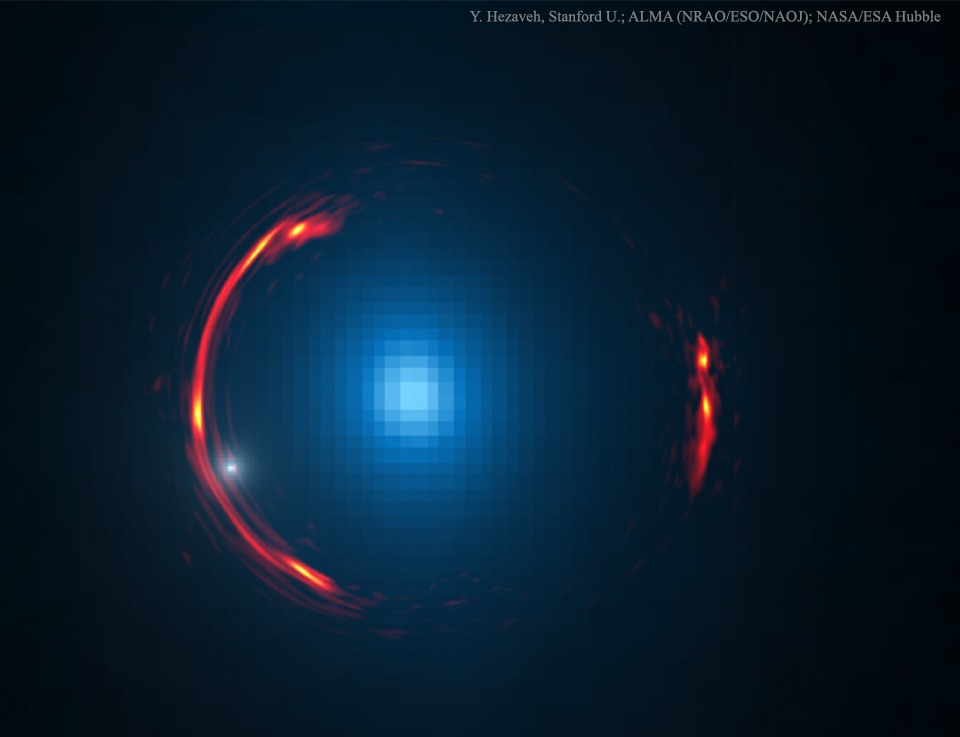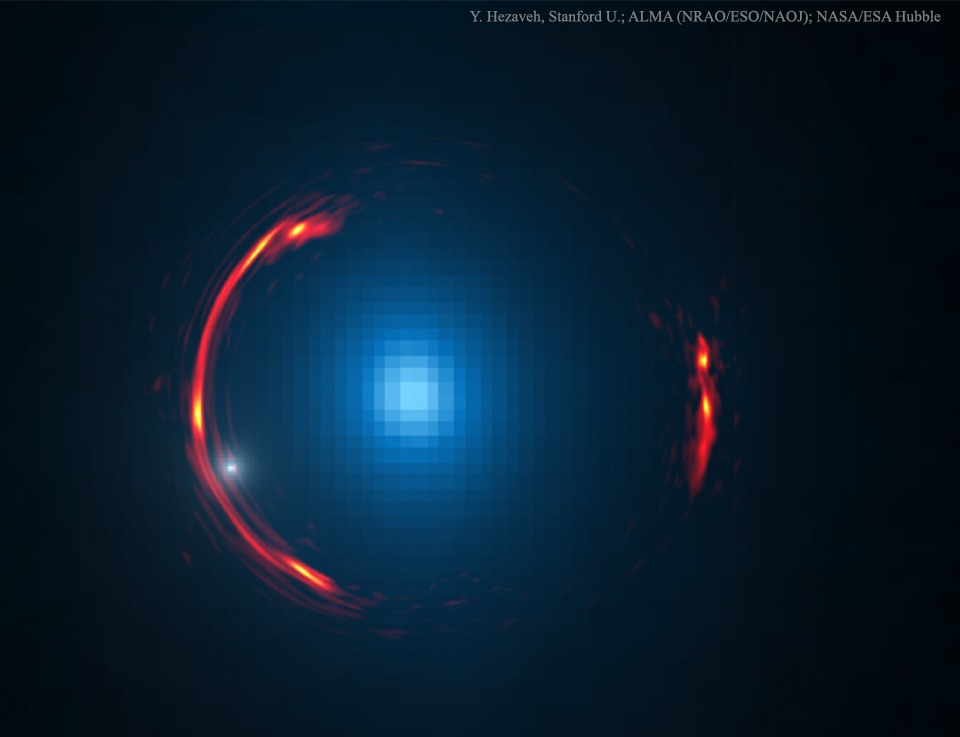
Can one galaxy hide behind another? Not in the case of SDP.81. Here the foreground galaxy, shown in blue in an image taken by the Hubble Space Telescope, acts like a huge gravitational lens, pulling light from a background galaxy, shown in red in an image taken in radio waves by the Atacama Large Millimeter Array (ALMA), around it, keeping it visible. The alignment is so precise that the distant galaxy is distorted into part of a ring around the foreground galaxy, a formation known as an Einstein ring. Detailed analysis of the gravitational lens distortions indicate that a small dark satellite galaxy participates in the deflections, bolstering indication that many satellite galaxies are quite dim and dominated by dark matter. That small galaxy is depicted by a small white dot on the left. Although spanning only a few arcseconds, the featured Einstein ring is really tens of thousands of light years across. Comments, questions? Just click the Discuss link two lines below.
¿Puede una galaxia ocultarse detrás de otra? No en el caso de SDP.81. Aquí, la galaxia del primer plano, mostrada en azul en una imagen tomada por el Telescopio Espacial Hubble, actúa como un gran lente gravitacional, atrayendo la luz de una galaxia de fondo, mostrada en rojo en una imagen tomada en ondas de radio por el Gran Arreglo Milimétrico de Atacama (ALMA), alrededor de ella, manteniéndola visible. La alineación es tan precisa que la galaxia distante se distorsiona en parte de un anillo alrededor de la galaxia del primer plano, una formación conocida como anillo de Einstein. El análisis detallado de las distorsiones del lente gravitacional indica que una pequeña galaxia oscura satélite participa en las deflexiones, reforzando la indicación de que muchas galaxias satélites son bastante tenues y dominadas por materia oscura. Esa pequeña galaxia se muestra como un pequeño punto blanco a la izquierda. Aunque abarca solo unos pocos segundos de arco, el anillo de Einstein destacado tiene realmente miles de miles de años luz de diámetro.