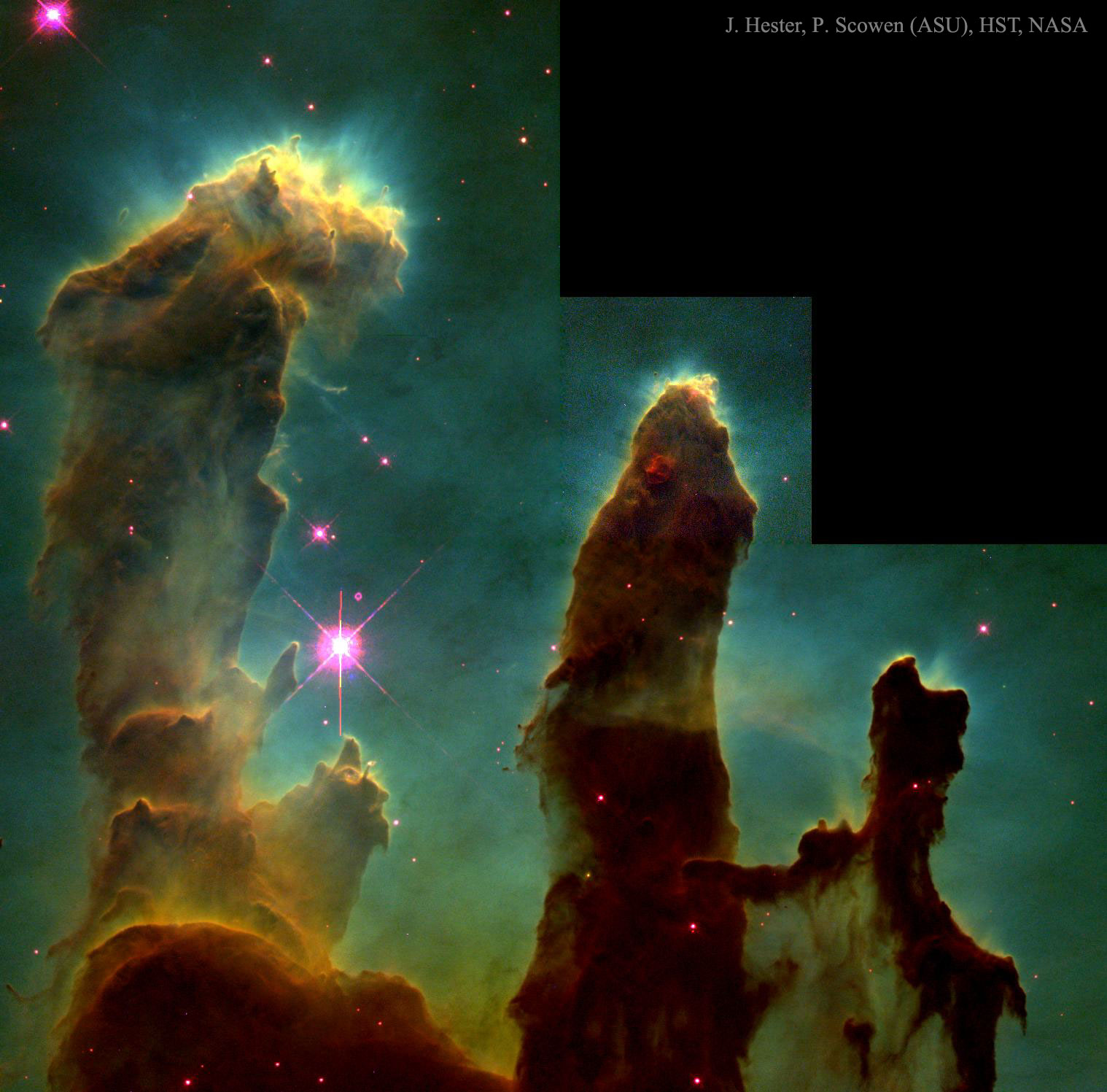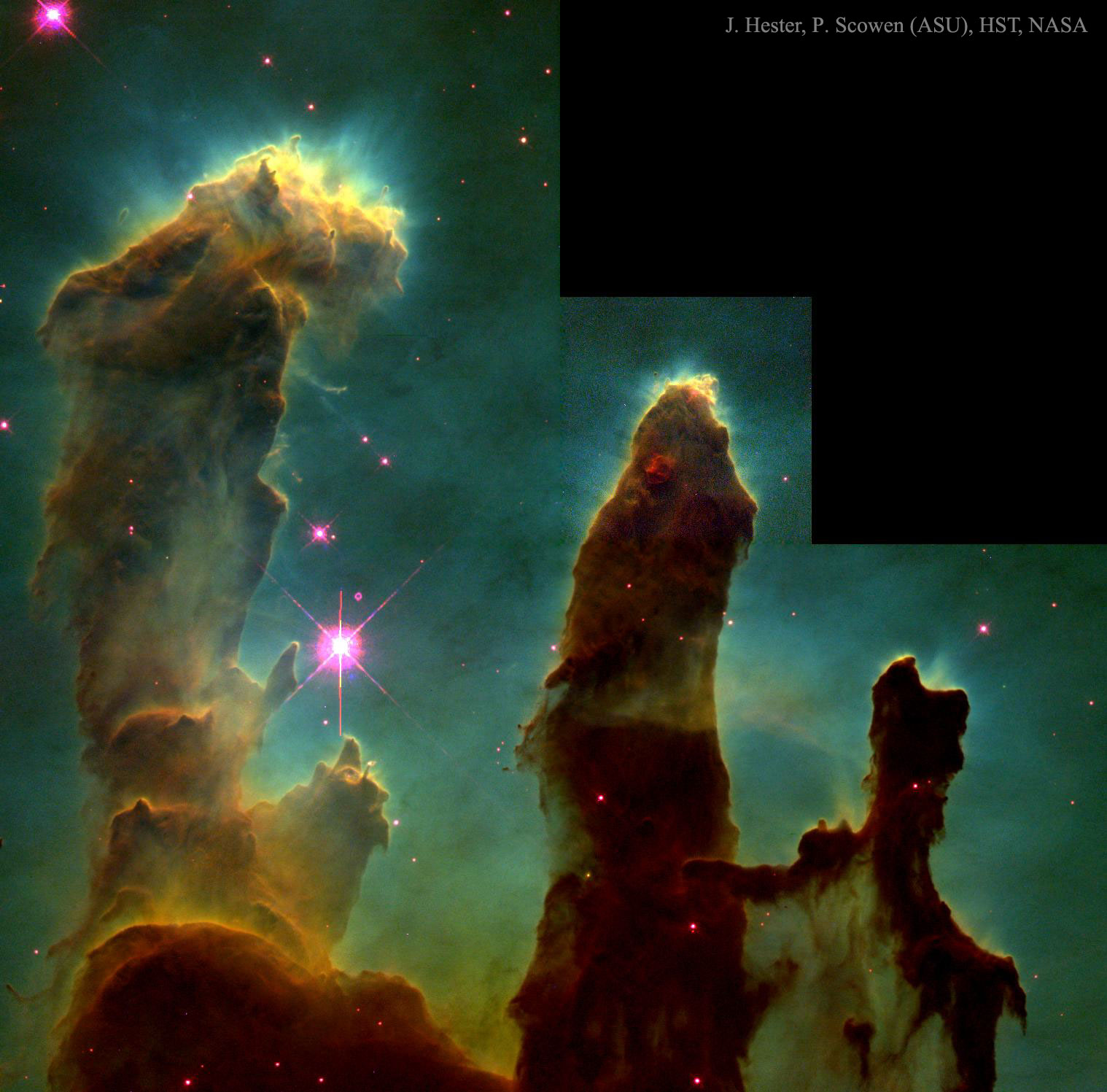
Newborn stars are forming in the Eagle Nebula. This image, taken with the Hubble Space Telescope in 1995, shows evaporating gaseous globules (EGGs) emerging from pillars of molecular hydrogen gas and dust. The giant pillars are light years in length and are so dense that interior gas contracts gravitationally to form stars. At each pillars' end, the intense radiation of bright young stars causes low density material to boil away, leaving stellar nurseries of dense EGGs exposed. The Eagle Nebula, associated with the open star cluster M16, lies about 7000 light years away. The pillars of creation were imaged again in 2007 by the orbiting Spitzer Space Telescope in infrared light, leading to the conjecture that the pillars may already have been destroyed by a local supernova, but light from that event has yet to reach the Earth. Be Honest: Have you seen this image before?
Estrellas recién nacidas están formándose en la Nebulosa Águila. Esta imagen, tomada con el Telescopio Espacial Hubble en 1995, muestra globulosos objetos de gas evaporante (EGGs) emergiendo de pilares de gas molecular e hidrógeno y polvo. Los grandes pilares tienen varios años luz de longitud y son tan densos que el gas interior se contrae gravitacionalmente para formar estrellas. En cada extremo de los pilares, la intensa radiación de estrellas jóvenes brillantes hace hervir el material de baja densidad, dejando expuestas las cunas estelares de densos EGGs. La Nebulosa Águila, asociada al cúmulo estelar abierto M16, se encuentra a unos 7000 años luz de distancia. Los pilares de la creación fueron nuevamente fotografiados en 2007 por el Telescopio Espacial Spitzer, en luz infrarroja, lo que llevó a la conjetura de que los pilares ya podrían haber sido destruidos por una supernova local, pero la luz de ese evento aún no ha llegado a la Tierra.