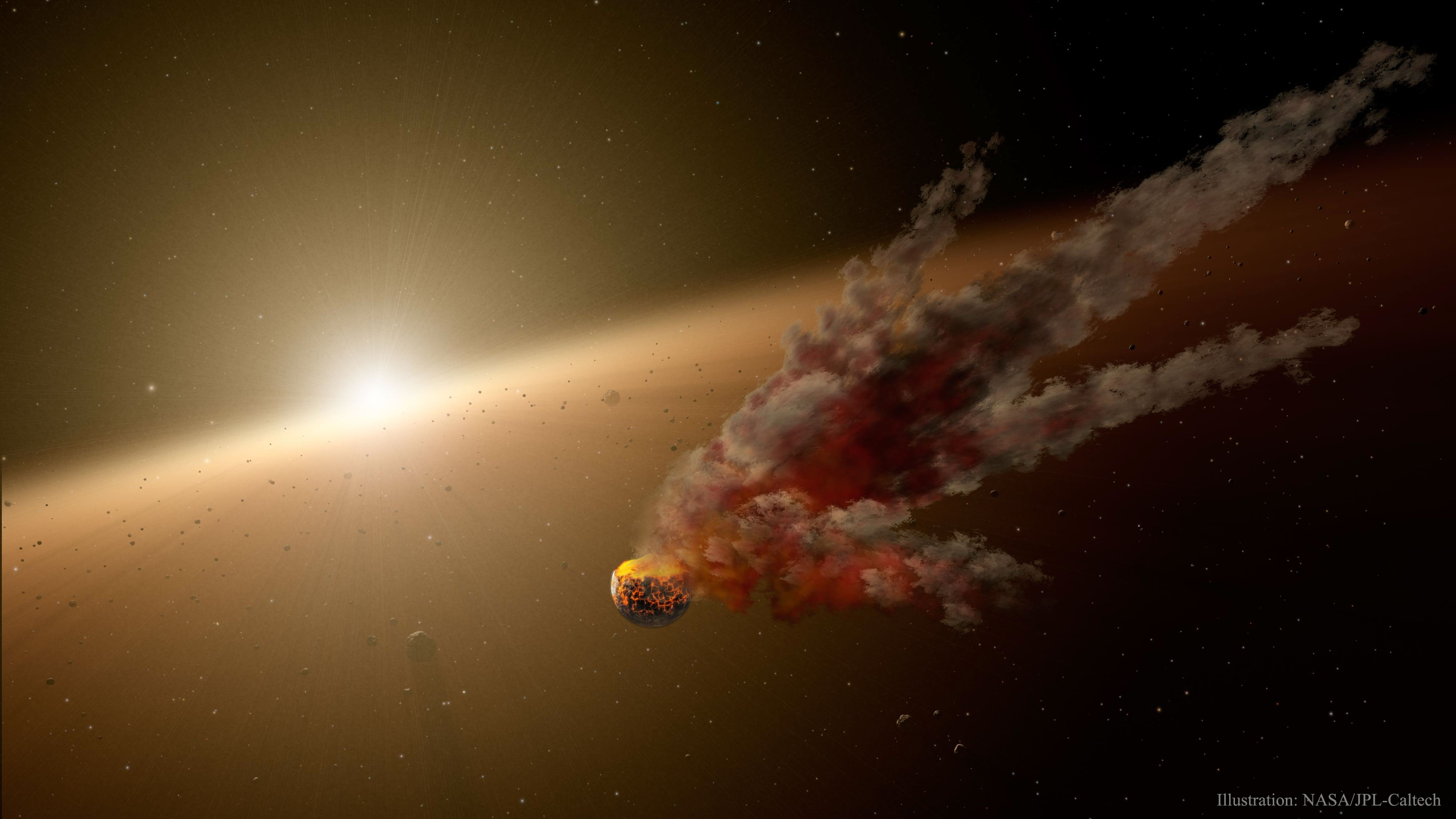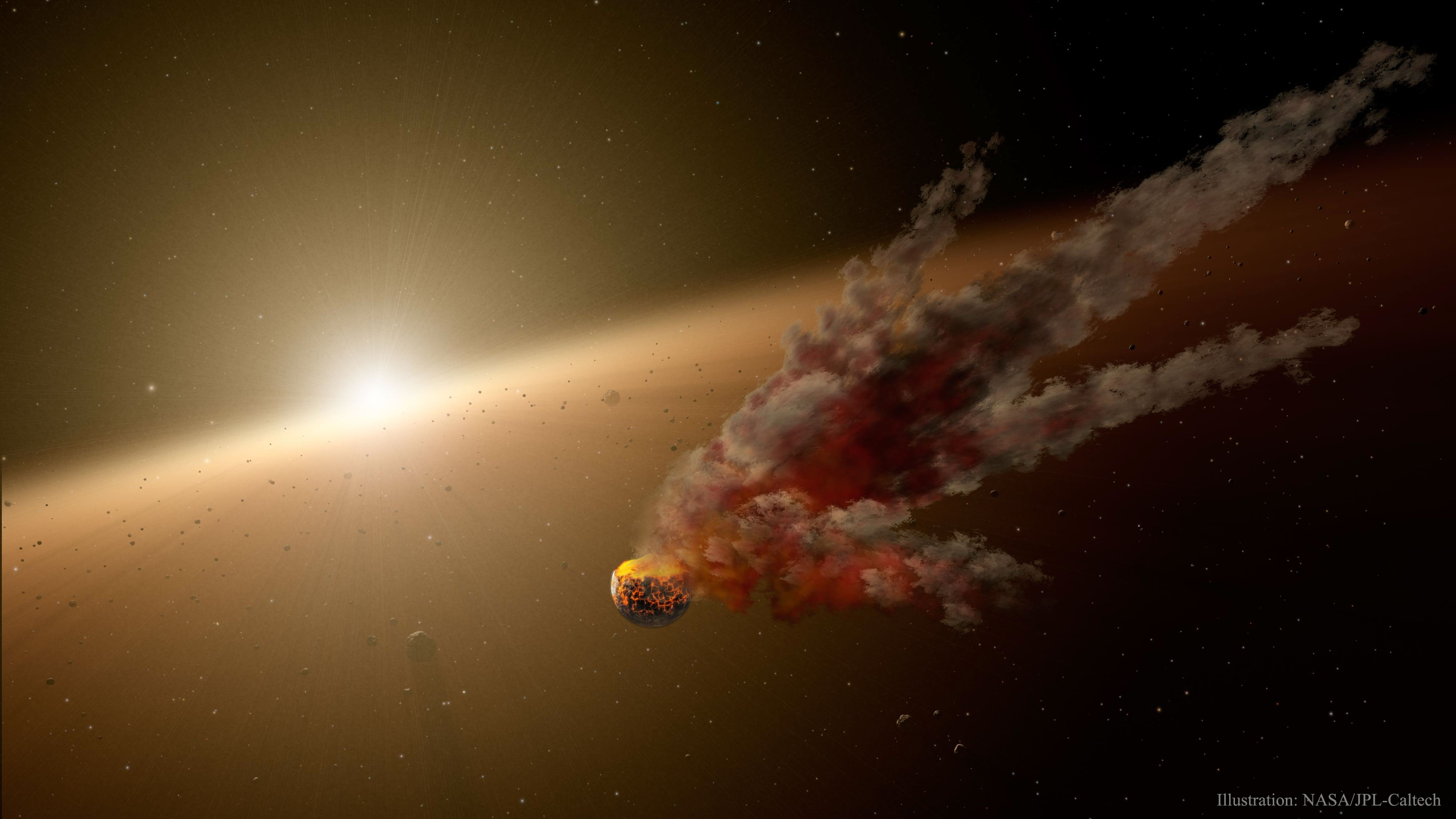
Why does star KIC 8462852 keep wavering? Nobody knows. A star somewhat similar to our Sun, KIC 8462852 was one of many distant stars being monitored by NASA's robotic Kepler satellite to see if it had planets. Citizen scientists voluntarily co-inspecting the data along with computers found this unusual case where a star's brightness dropped at unexpected times by as much as 20 percent for as long as months -- but then recovered. Common reasons for dimming -- such as eclipses by orbiting planets or stellar companions -- don't match the non-repetitive nature of the dimmings. A currently debated theory is dimming by a cloud of comets or the remnants of a shattered planet, but these would not explain data indicating that the star itself has become slightly dimmer over the past 125 years. Nevertheless, featured here is an artist's illustration of a planet breaking up, drawn to depict NGC 2547-ID8, a different system that shows infrared evidence of such a collision. Recent observations of KIC 8462852 did not detect the infrared glow of a closely orbiting dust disk, but gave a hint that the system might have such a disk farther out. Future observations are encouraged and creative origin speculations are sure to continue.
¿Por qué la estrella KIC 8462852 sigue fluctuando? Nadie lo sabe. Una estrella algo similar a nuestro Sol, KIC 8462852 fue una de muchas estrellas distantes que se monitorearon con el satélite robótico Kepler de NASA para ver si tenían planetas. Científicos ciudadanos inspeccionaron voluntariamente los datos junto con las computadoras y encontraron este caso inusual en el que la luminosidad de una estrella disminuyó en momentos inesperados hasta un 20 por ciento durante meses, pero luego se recuperó. Las razones comunes para la disminución de brillo — como eclipses por planetas orbitales o compañeros estelares — no coinciden con la naturaleza no repetitiva de las disminuciones. Una teoría actualmente debatida es la disminución causada por una nube de cometas o los restos de un planeta roto, pero esto no explicaría los datos que indican que la estrella en sí misma se ha vuelto ligeramente más oscura en los últimos 125 años. Sin embargo, aquí se muestra una ilustración artística de un planeta que se descompone, dibujada para representar NGC 2547-ID8, un sistema diferente que muestra evidencia infrarroja de tal colisión. Recientes observaciones de KIC 8462852 no detectaron el brillo infrarrojo de un disco de polvo que orbitara muy cerca, pero dieron una pista de que el sistema podría tener tal disco más alejado. Se fomentan observaciones futuras y seguramente continuarán las especulaciones creativas sobre su origen.