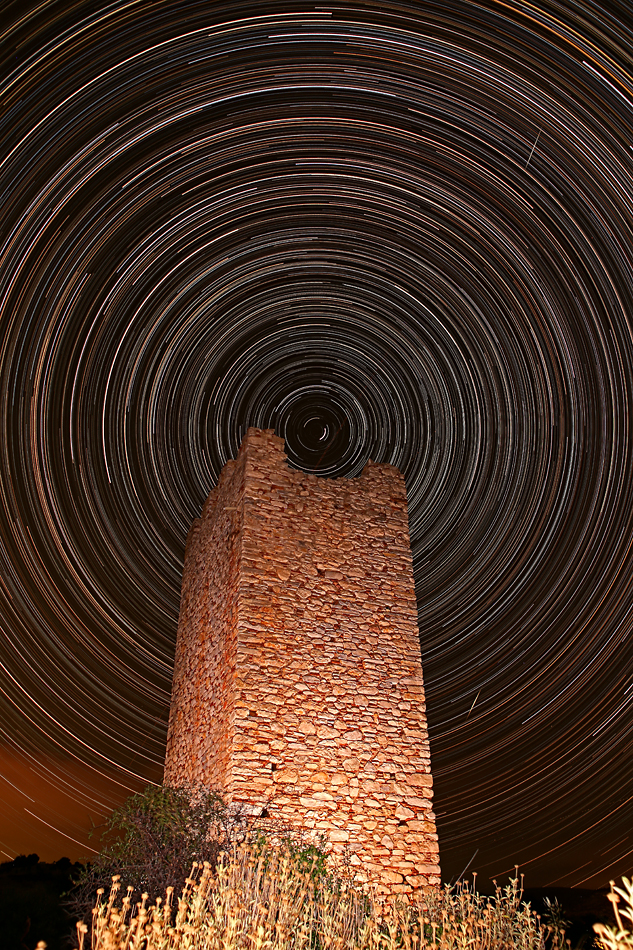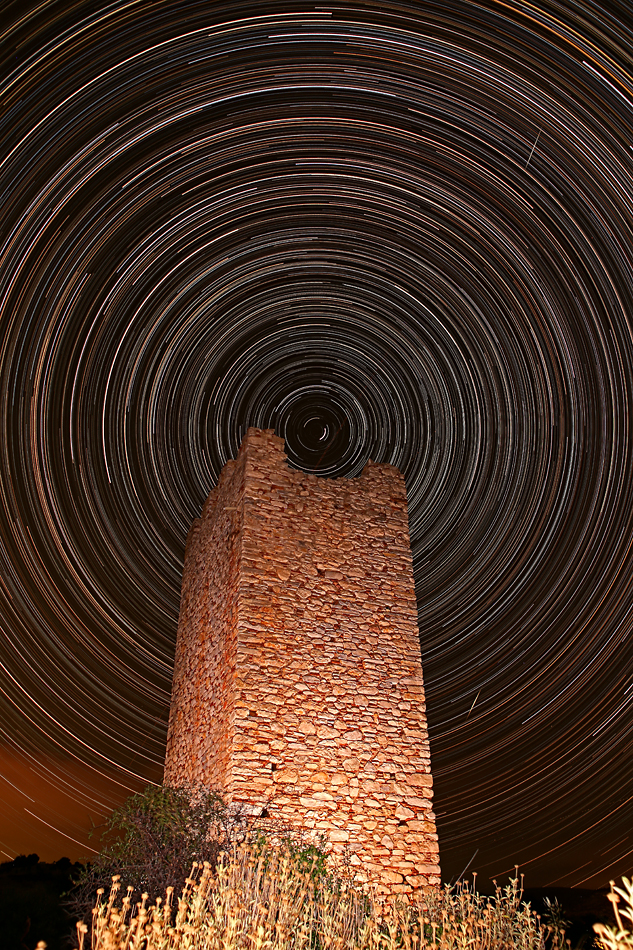
If you climbed to the top of this 13th century stone tower, it looks like you could reach out and touch the North Celestial Pole, the point at the center of all the star trail arcs. The well-composed image with scattered meteor streaks was recorded over a period of five and half hours as a series of 45 second long exposures spanning the dark of the night on July 7/8. The exposures were made with a digital camera fixed to a tripod near Marathon, Greece, planet Earth. Of course, the graceful star trails reflect the Earth's daily rotation around its axis. By extension, the axis of rotation leads to the center of the concentric arcs in the night sky. Convenient for northern hemisphere night sky photographers and celestial navigators alike, the bright star Polaris is very close to the North Celestial Pole and so makes the short bright trail in the tower's central gap.
Si ascendieras hasta la cima de esta torre de piedra del siglo XIII, parecería que podrías alcanzar con la mano el Polo Celestial Norte, el punto central alrededor del cual se curvan los arcos de las trayectorias estelares. La imagen bien compuesta, con destellos dispersos de meteoros, fue capturada durante un período de cinco horas y media, mediante una serie de exposiciones de 45 segundos cada una, durante la oscuridad de la noche del 7/8 de julio. Las exposiciones se realizaron con una cámara digital fija en un trípode cerca de Marathon, Grecia, en la Tierra. Por supuesto, las suaves trayectorias estelares reflejan la rotación diaria de la Tierra alrededor de su eje. Por extensión, el eje de rotación conduce al centro de los arcos concéntricos en el cielo nocturno. Conveniente tanto para fotógrafos de cielo nocturno como para navegadores celestes del hemisferio norte, la brillante estrella Polaris está muy cerca del Polo Celestial Norte y, por lo tanto, forma la corta trayectoria brillante en el hueco central de la torre.