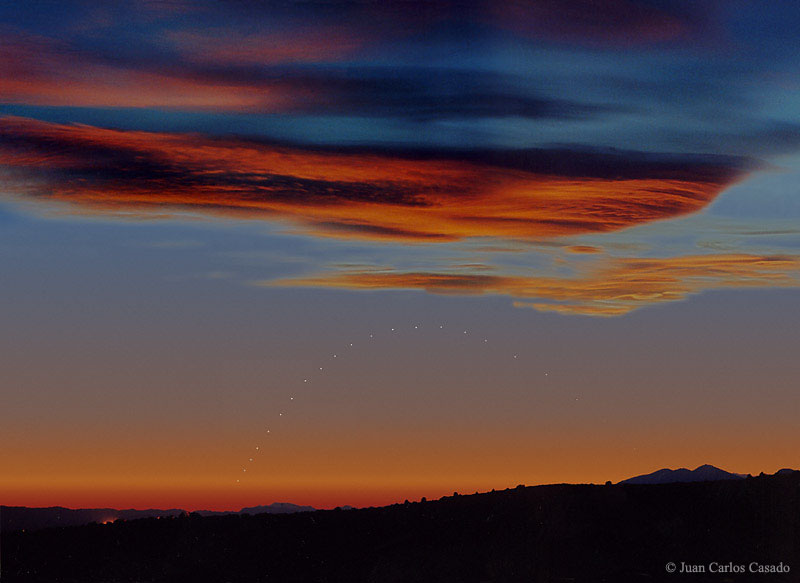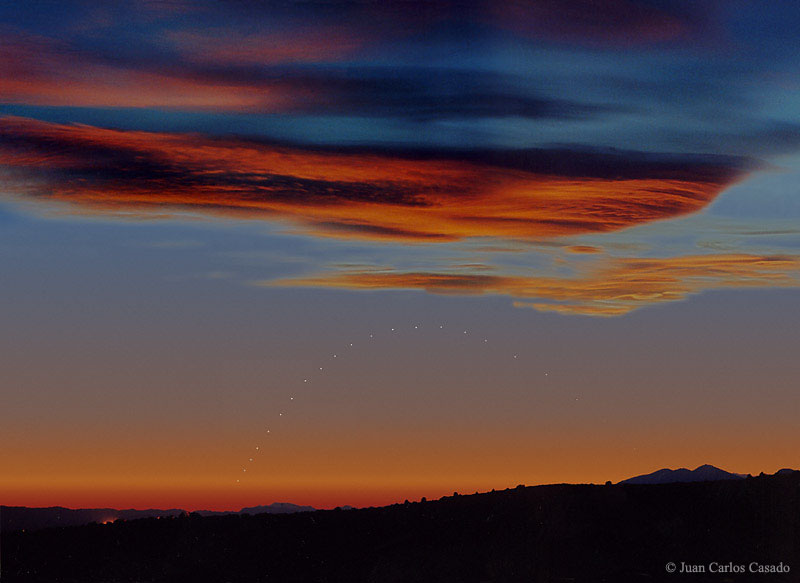
Have you ever seen the planet Mercury? Because Mercury orbits so close to the Sun, it never wanders far from the Sun in Earth's sky. If trailing the Sun, Mercury will be visible low on the horizon for only a short while after sunset. If leading the Sun, Mercury will be visible only shortly before sunrise. So at certain times of the year, informed skygazers with a little determination can usually pick Mercury out from a site with an unobscured horizon. Above, a lot of determination has been combined with a little digital manipulation to show Mercury's successive positions during March of 2000. Each picture was taken from the same location in Spain when the Sun itself was 10 degrees below the horizon and superposed on the single most photogenic sunset. Currently, Mercury is rising higher above the horizon with each passing sunset, and just now is angularly very close to the brighter planet Venus.
¿Alguna vez ha visto el planeta Mercurio? Debido a que Mercurio orbita muy cerca del Sol, nunca se aleja mucho del Sol en el cielo terrestre. Si se encuentra detrás del Sol, Mercurio será visible muy bajo en el horizonte durante solo un breve período después del atardecer. Si se encuentra delante del Sol, Mercurio será visible solo durante un breve período antes del amanecer. Por lo tanto, en ciertos momentos del año, los observadores informados con un poco de determinación pueden normalmente identificar a Mercurio desde un lugar con un horizonte despejado. Arriba, se han combinado mucho esfuerzo con un poco de manipulación digital para mostrar las sucesivas posiciones de Mercurio durante marzo de 2000. Cada imagen fue tomada desde el mismo lugar en España cuando el Sol mismo estaba 10 grados por debajo del horizonte y superpuesta sobre el atardecer más fotogénico posible. Actualmente, Mercurio está ascendiendo cada vez más sobre el horizonte con cada atardecer, y en este momento está angularmente muy cerca del planeta más brillante, Venus.