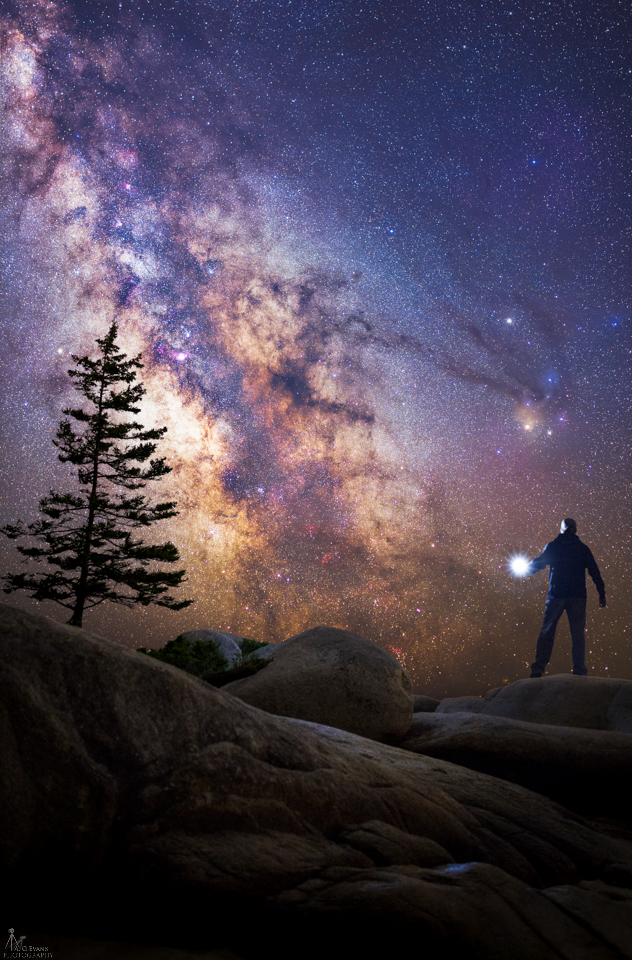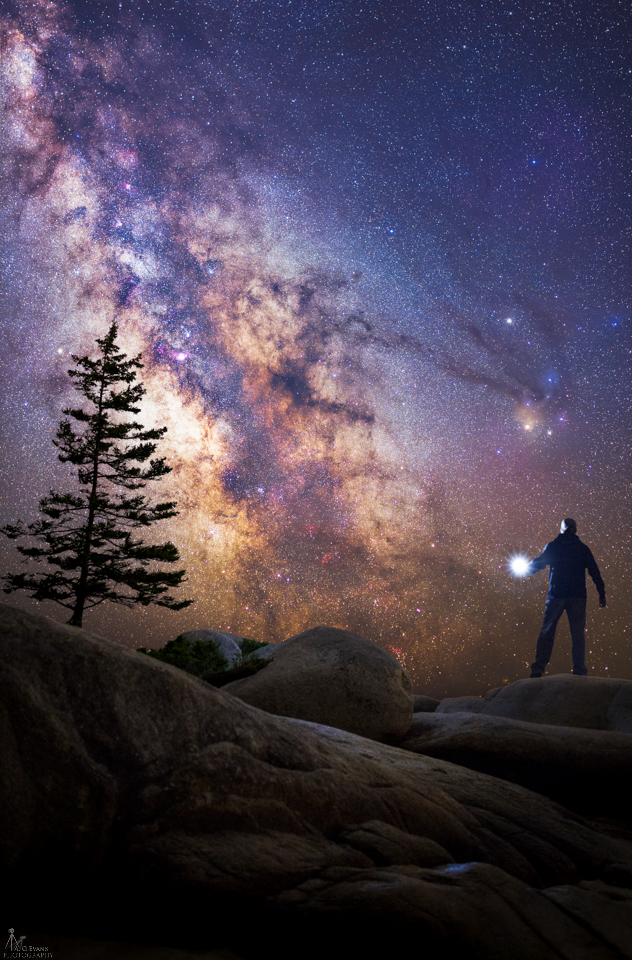
What if you climbed up on a rock and discovered the Universe? You can. Although others have noted much of it before, you can locate for yourself stars, planets, and even the plane of our Milky Way Galaxy. All you need is a dark clear sky -- the rock is optional. If you have a camera, you can further image faint nebulas, galaxies, and long filaments of interstellar dust. If you can process digital images, you can bring out faint features, highlight specific colors, and merge foreground and background images. In fact, an industrious astrophotographer has done all of these to create the presented picture. All of the component images were taken early last month on the same night within a few meters of each other. The picturesque setting was Sand Beach in Stonington, Maine, USA with the camera pointed south over Penobscot Bay. News: APOD is now available through Facebook translated into Catalan.
¿Qué pasaría si subieras a una roca y descubrieras el Universo? Puedes hacerlo. Aunque otros han observado gran parte de él antes, tú también puedes localizar por ti mismo estrellas, planetas e incluso el plano de nuestra Galaxia Vía Láctea. Todo lo que necesitas es un cielo oscuro y despejado — la roca es opcional. Si tienes una cámara, puedes capturar imágenes de nebulosas tenues, galaxias y largos filamentos de polvo interestelar. Si puedes procesar imágenes digitales, puedes resaltar características tenues, destacar colores específicos y fusionar imágenes del primer plano y del fondo. De hecho, un apasionado fotógrafo astronómico ha realizado todas estas acciones para crear la imagen presentada. Todas las imágenes componentes fueron tomadas al comienzo del mes pasado, en la misma noche, dentro de unos metros entre sí. El escenario pintoresco fue la playa de Sand Beach en Stonington, Maine, EE. UU., con la cámara apuntando hacia el sur sobre el Golfo de Penobscot.