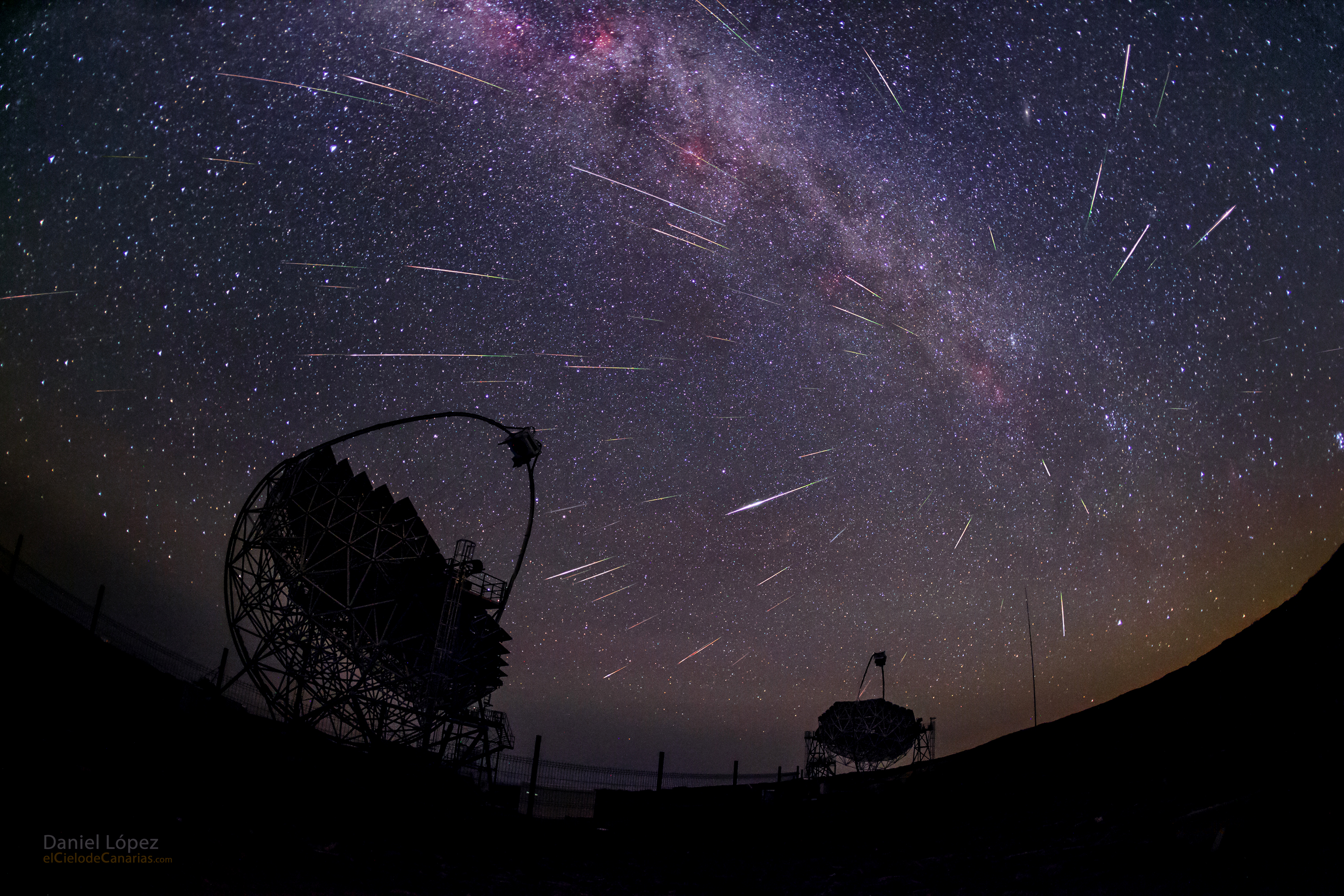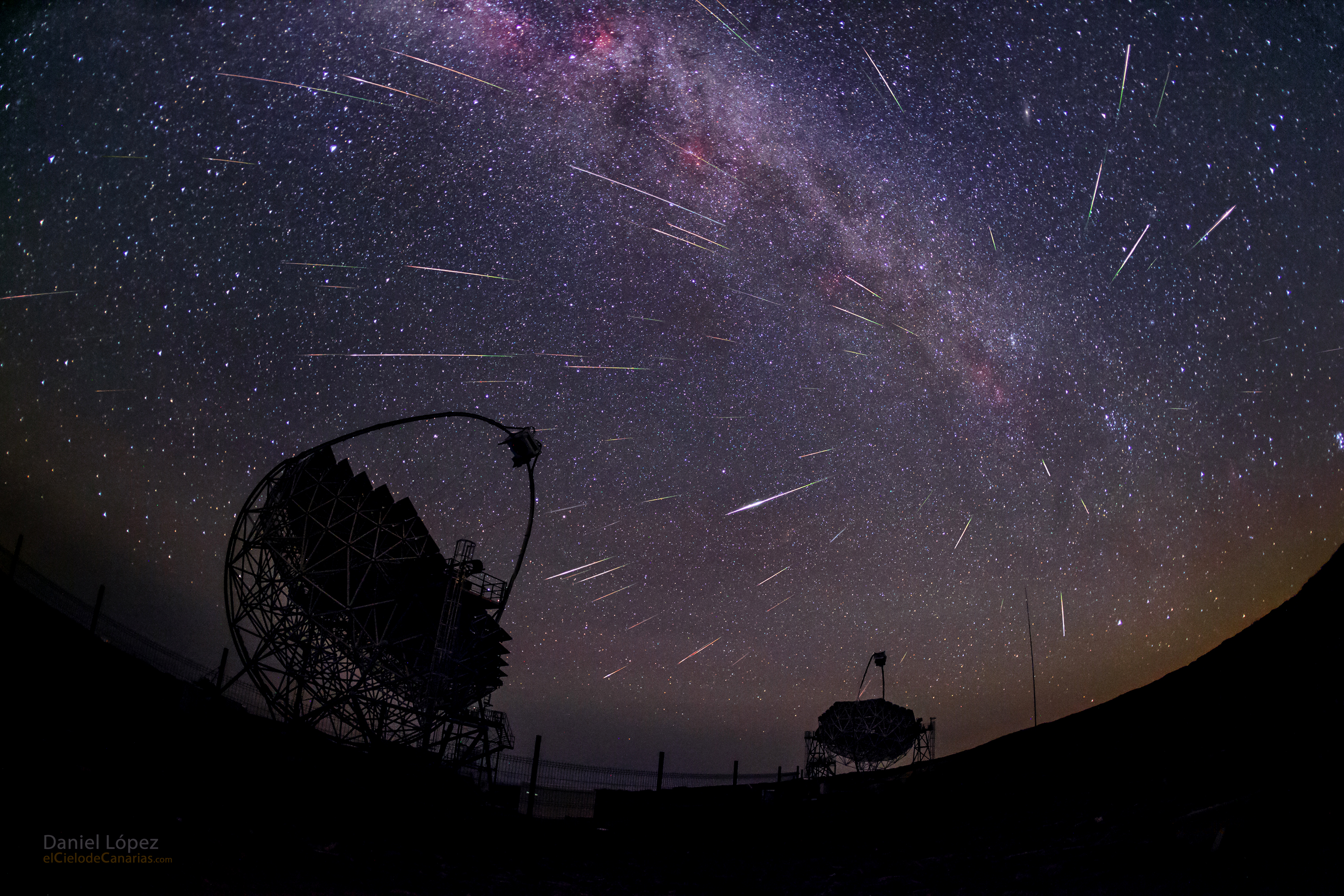
Gamma-rays and dust from periodic Comet Swift-Tuttle plowed through planet Earth's atmosphere on the night of August 11/12. Impacting at about 60 kilometers per second the grains of comet dust produced this year's remarkably active Perseid meteor shower. This composite wide-angle image of aligned shower meteors covers a 4.5 hour period on that Perseid night. In it the flashing meteor streaks can be traced back to the shower's origin on the sky. Alongside the Milky Way in the constellation Perseus, the radiant marks the direction along the perodic comet's orbit. Traveling at the speed of light, cosmic gamma-rays impacting Earth's atmosphere generated showers too, showers of high energy particles. Just as the meteor streaks point back to their origin, the even briefer flashes of light from the particles can be used to reconstruct the direction of the particle shower, to point back to the origin on the sky of the incoming gamma-ray. Unlike the meteors, the incredibly fast particle shower flashes can't be followed by eye. But both can be followed by the high speed cameras on the multi-mirrored dishes in the foreground. Of course, the dishes are MAGIC (Major Atmospheric Gamma Imaging Cherenkov) telescopes, an Earth-based gamma-ray observatory on the Canary Island of La Palma.
Los rayos gamma y el polvo del cometa periódico Swift-Tuttle atravesaron la atmósfera terrestre durante la noche del 11 al 12 de agosto. Impactando a aproximadamente 60 kilómetros por segundo, las partículas de polvo cometario generaron este año la espectacular lluvia de meteoros Perseidas. Esta imagen compuesta de amplio ángulo de meteoros alineados cubre un período de 4,5 horas de esa noche de las Perseidas. En ella, las estelas de los meteoros brillantes pueden rastrearse hasta el origen del chorro en el cielo. Junto a la Vía Láctea en la constelación de Perseo, el punto radiante marca la dirección a lo largo de la órbita del cometa periódico. Viajando a la velocidad de la luz, los rayos gamma cósmicos impactando en la atmósfera terrestre generaron también lluvias, lluvias de partículas de alta energía. Al igual que las estelas de los meteoros señalan su origen, las breves chispas de luz de las partículas pueden utilizarse para reconstruir la dirección del chorro de partículas, para señalar el origen en el cielo del rayo gamma entrante. A diferencia de los meteoros, las chispas del rápido chorro de partículas no pueden seguirse a simple vista. Pero ambas pueden ser seguidas por las cámaras de alta velocidad en los platos con múltiples espejos en primer plano. Por supuesto, los platos son los telescopios MAGIC (Major Atmospheric Gamma Imaging Cherenkov), una observación terrestre de rayos gamma ubicada en la isla canaria de La Palma.