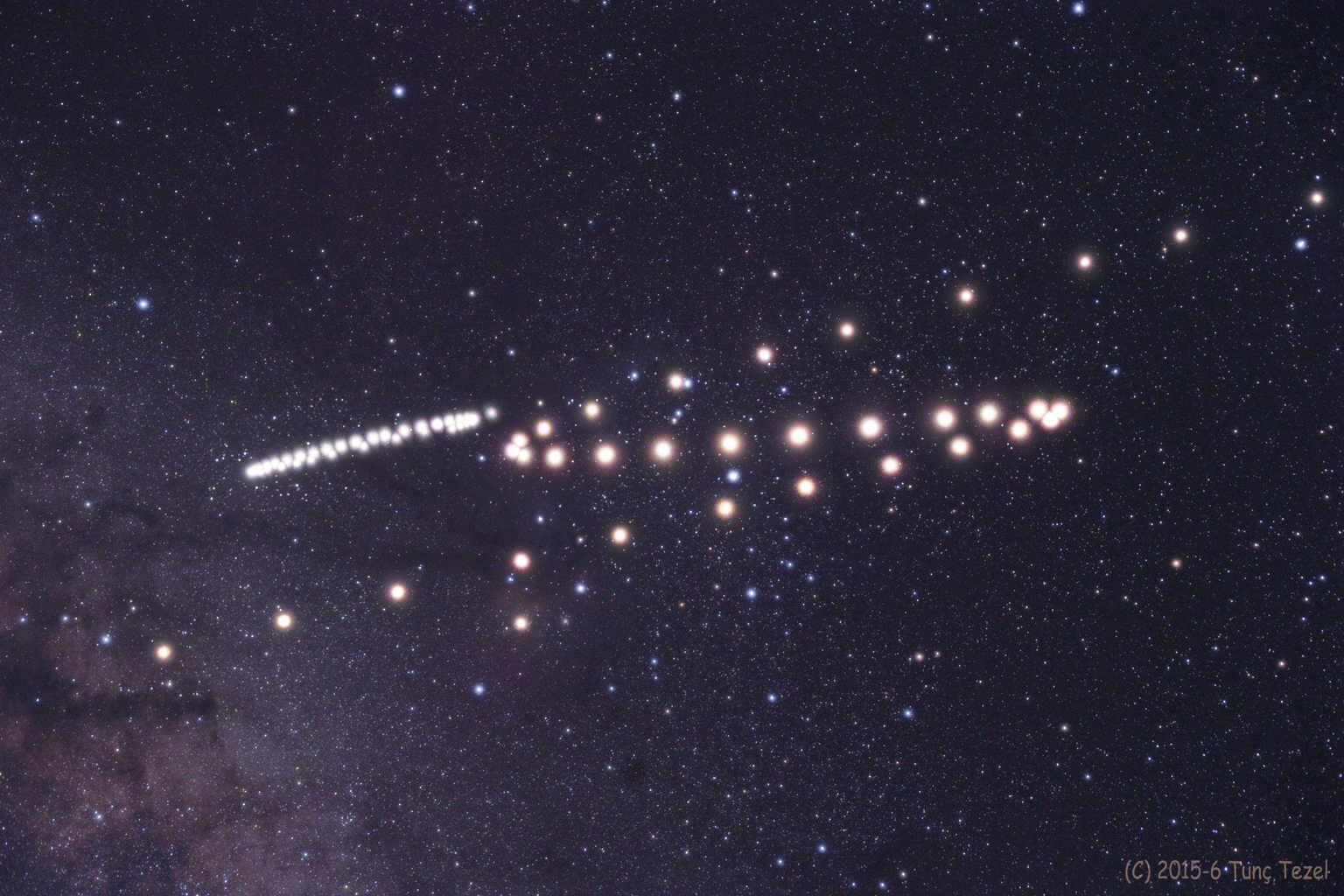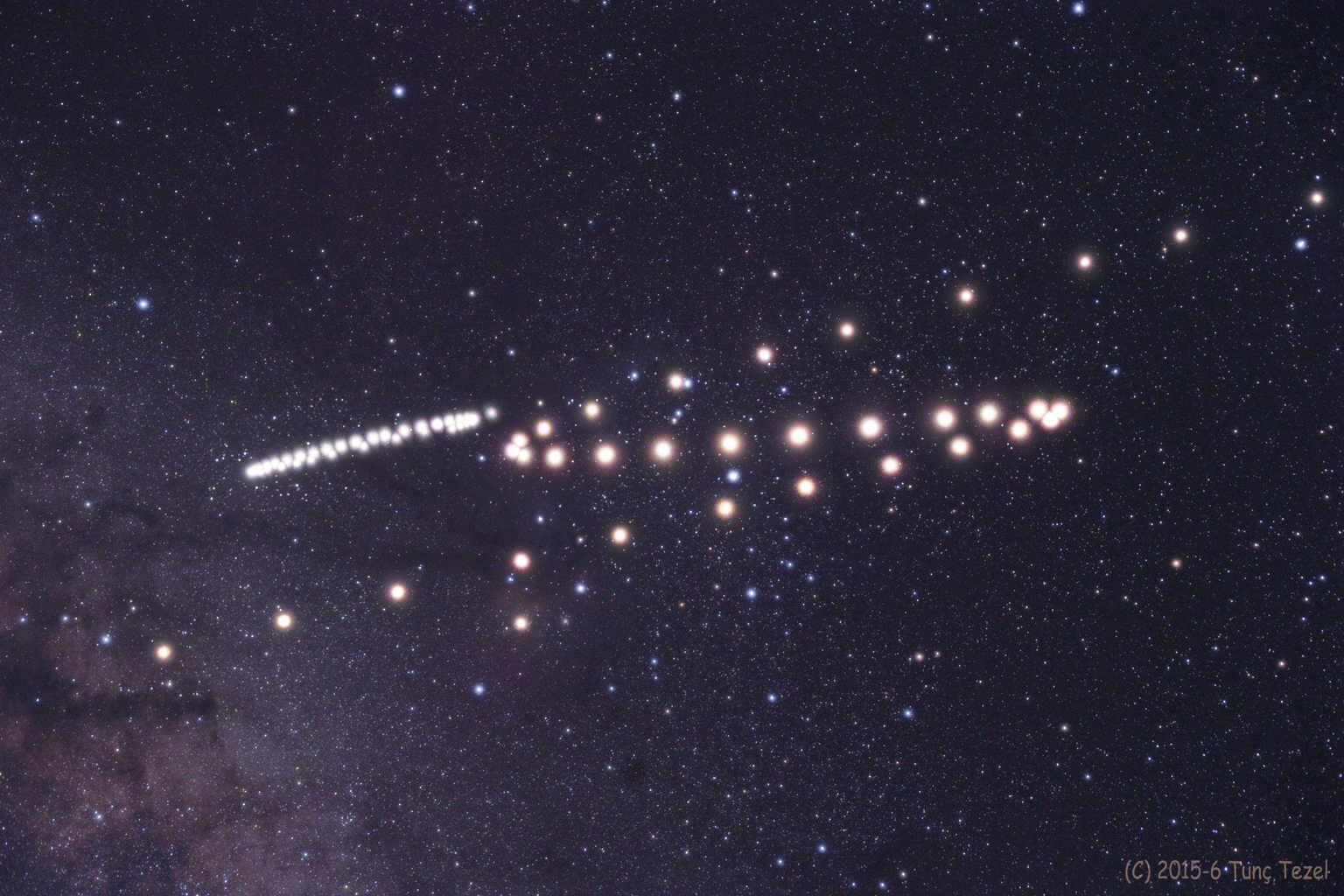
Wandering Mars and Saturn have spent much of this year remarkably close in planet Earth's night sky. In a sequence of exposures spanning mid-December 2015 through the beginning of this week, this composited skyview follows their time together, including both near opposition, just north of bright star Antares near the Milky Way's central bulge. In the corresponding video, Saturn's apparent movement is seen to be back and forth along the flattened, compact loop, while Mars traces the wider, reversing S-shaped track from upper right to lower left through the frame. To connect the dots and dates just slide your cursor over the picture (or follow this link). It looks that way, but Mars and Saturn don't actually reverse direction along their orbits. Instead, their apparent backwards or retrograde motion with respect to the background stars is a reflection of the orbital motion of the Earth itself. Retrograde motion can be seen each time Earth overtakes and laps planets orbiting farther from the Sun, the Earth moving more rapidly through its own relatively close-in orbit.
Marte y Saturno, planetas errantes, han pasado gran parte de este año sorprendentemente cercanos en el cielo nocturno visto desde la Tierra. En una secuencia de exposiciones que abarca desde mediados de diciembre de 2015 hasta principios de esta semana, esta vista compuesta sigue su trayectoria conjunta, incluyendo su posición cercana a la oposición, justo al norte de la brillante estrella Antares, cerca del núcleo central de la Vía Láctea. En el video correspondiente, se puede observar el movimiento aparente de Saturno, que se mueve de forma alternada a lo largo de un bucle aplanado y compacto, mientras que Marte describe una trayectoria más amplia en forma de S invertida, desde la parte superior derecha hasta la inferior izquierda del marco. Para conectar los puntos y las fechas, simplemente mueva el cursor sobre la imagen (o siga este enlace). Aunque así parece, Marte y Saturno no realmente invierten su dirección en sus órbitas. En cambio, su movimiento aparente hacia atrás, o movimiento retrógrado, con respecto a las estrellas de fondo, es una reflexión del movimiento orbital de la Tierra misma. El movimiento retrógrado puede observarse cada vez que la Tierra sobrepasa y da la vuelta a planetas que orbitan más lejos del Sol, ya que la Tierra se mueve más rápidamente a través de su propia órbita relativamente cercana.