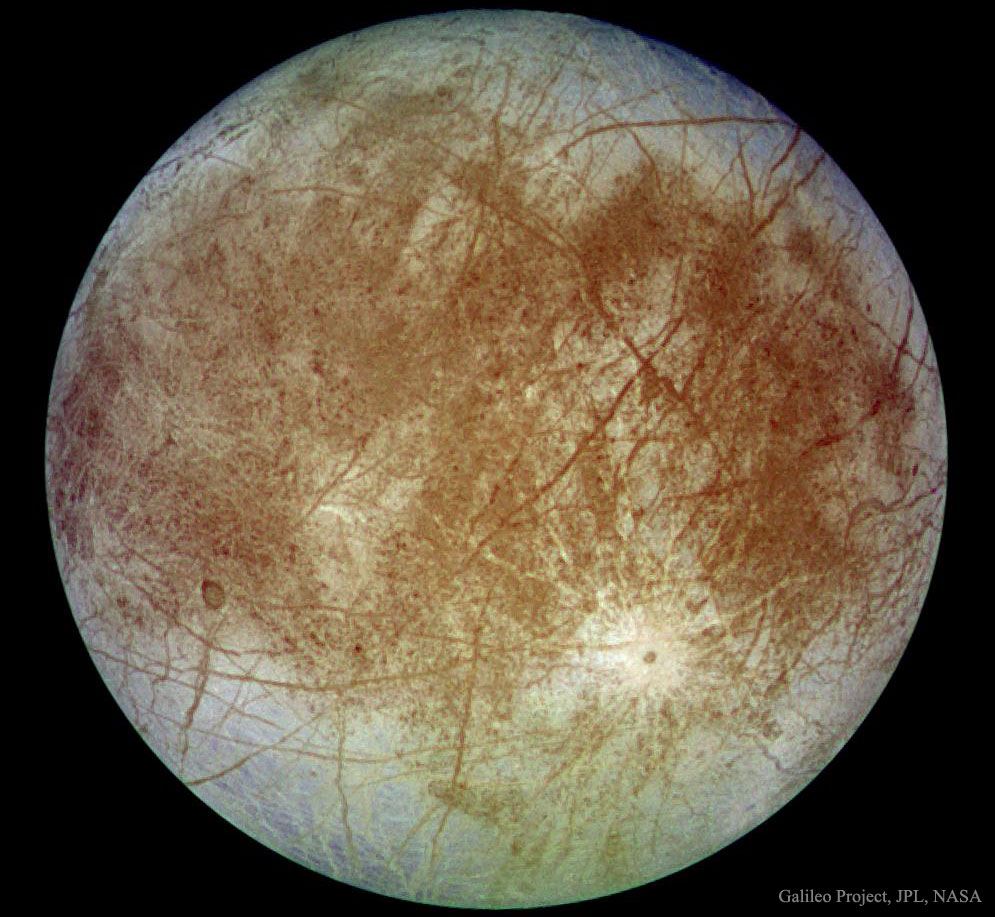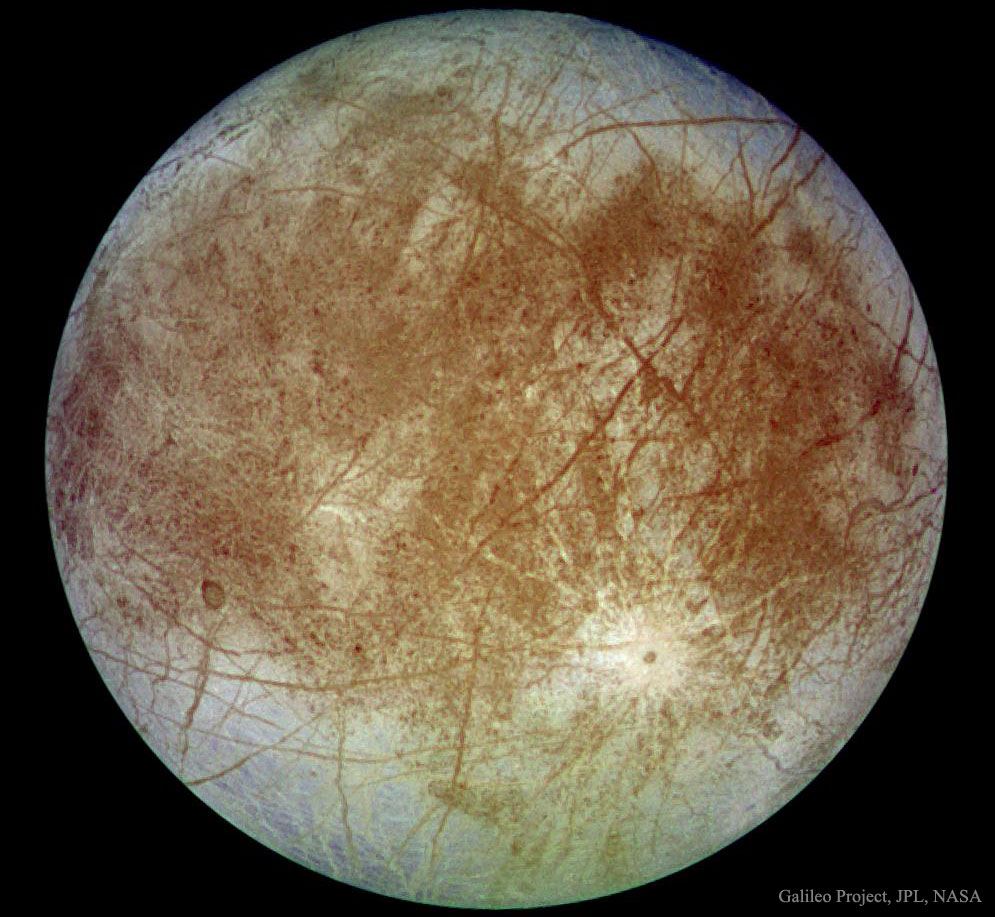
What mysteries might be solved by peering into this crystal ball? In this case, the ball is actually a moon of Jupiter, the crystals are ice, and the moon is not only dirty but cracked beyond repair. Nevertheless, speculation is rampant that oceans exist under Europa's fractured ice-plains that could support life. This speculation was bolstered again this week by released images from the Hubble Space Telescope indicating that plumes of water vapor sometimes emanate from the ice-crusted moon -- plumes that might bring microscopic sea life to the surface. Europa, roughly the size of Earth's Moon, is pictured here in natural color as photographed in 1996 by the now-defunct Jupiter-orbiting Galileo spacecraft. Future observations by Hubble and planned missions such as the James Webb Space Telescope later this decade and a Europa flyby mission in the 2020s may further humanity's understanding not only of Europa and the early Solar System but also of the possibility that life exists elsewhere in the universe. Free Download: APOD 2017 Calendar: NASA Images
¿Qué misterios podrían resolverse al mirar dentro de esta bola de cristal? En este caso, la bola es en realidad un satélite de Júpiter, los cristales son hielo, y el satélite no solo está sucio, sino que también está fracturado de manera irreparable. Sin embargo, se especula ampliamente que existen océanos bajo las llanuras heladas fracturadas de Europa que podrían albergar vida. Esta especulación fue nuevamente reforzada esta semana por imágenes liberadas del Telescopio Espacial Hubble que indican que a veces emanan chorros de vapor de agua de este satélite cubierto de hielo — chorros que podrían traer vida microscópica a la superficie. Europa, aproximadamente del tamaño de la Luna terrestre, se muestra aquí en color natural, como fue fotografiada en 1996 por la ahora inactiva nave espacial Galileo, que orbitaba Júpiter. Futvas observaciones del Hubble y misiones planeadas, como el Telescopio Espacial James Webb a finales de esta década y una misión de sobrevuelo a Europa en la década de 2020, podrían ampliar nuestro conocimiento no solo de Europa y del Sistema Solar primitivo, sino también de la posibilidad de que exista vida en otros lugares del universo.