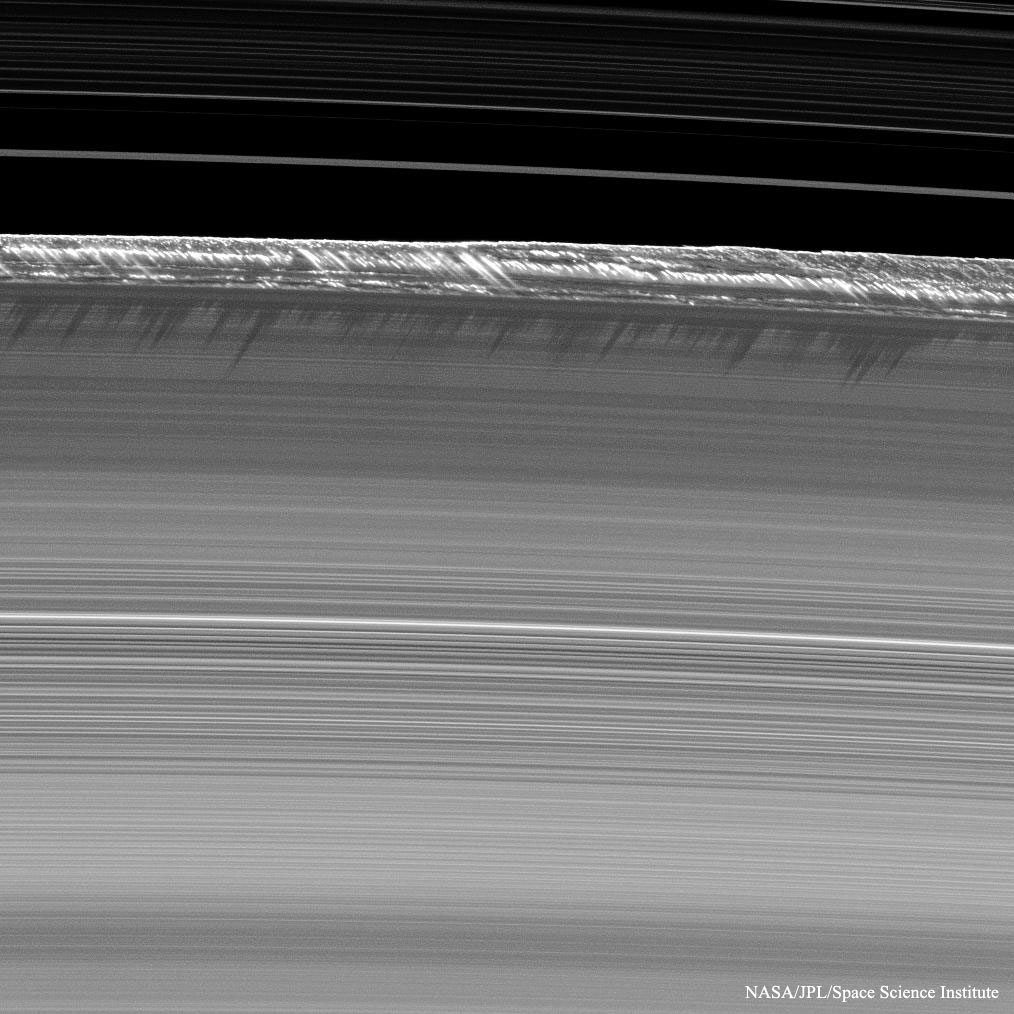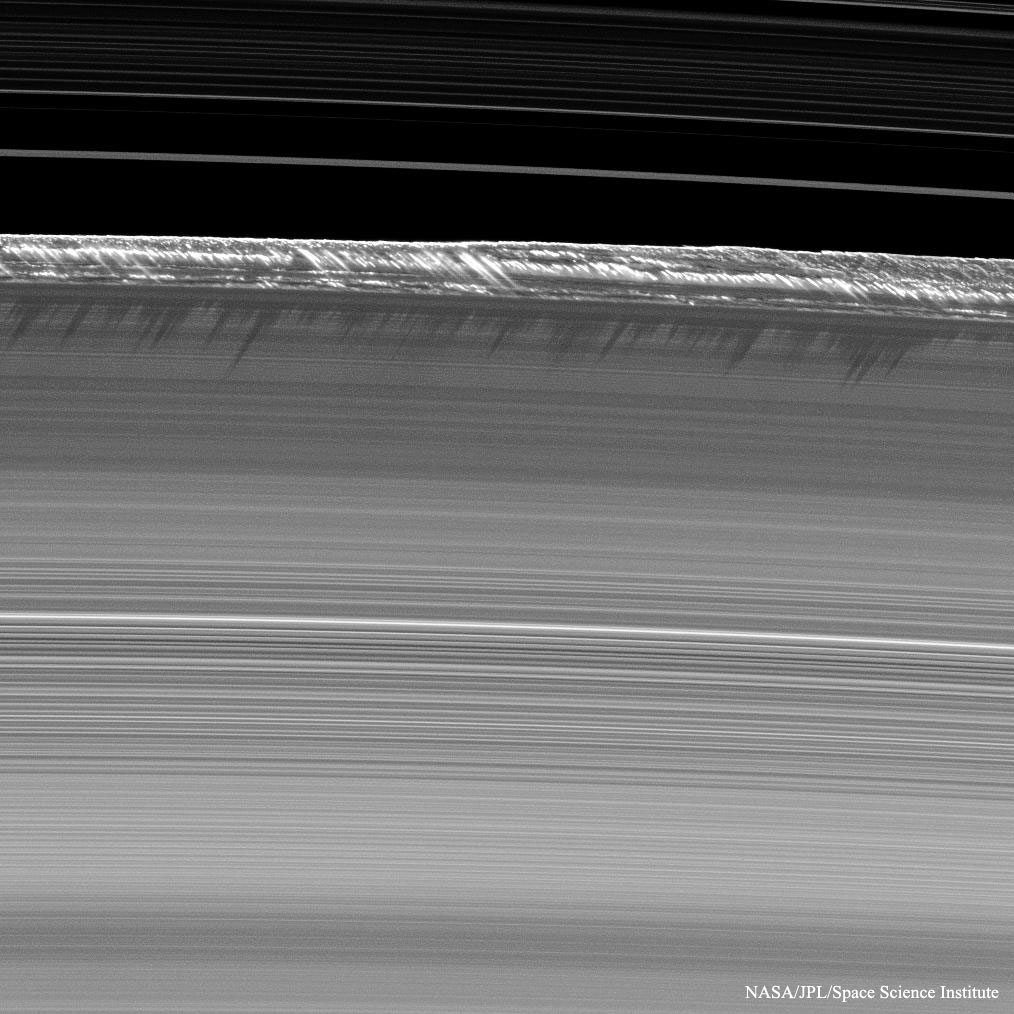
What created these unusually long shadows on Saturn's rings? The dark shadows -- visible near the middle of the image -- extend opposite the Sun and, given their length, stem from objects having heights up to a few kilometers. The long shadows were unexpected given that the usual thickness of Saturn's A and B rings is only about 10 meters. After considering the choppy but elongated shapes apparent near the B-ring edge, however, a leading theory has emerged that some kilometer-sized moonlets exist there that have enough gravity to create even larger vertical deflections of nearby small ring particles. The resulting ring waves are called propellers, named for how they appear individually. It is these coherent groups of smaller ring particles that are hypothesized to be casting the long shadows. The featured image was taken by the robotic Cassini spacecraft currently orbiting Saturn. The image was captured in 2009, near Saturn's equinox, when sunlight streamed directly over the ring plane and caused the longest shadows to be cast.
¿Qué creó estas sombras inusualmente largas en los anillos de Saturno? Las sombras oscuras — visibles cerca del centro de la imagen — se extienden en dirección opuesta al Sol, y, dada su longitud, provienen de objetos con alturas de hasta varios kilómetros. Las largas sombras eran inesperadas, dado que el espesor habitual de los anillos A y B de Saturno es solo de aproximadamente 10 metros. Sin embargo, tras considerar las formas irregulares pero alargadas visibles cerca del borde del anillo B, se ha formulado una teoría principal que sugiere que existen allí pequeños satélites de tamaño kilométrico que tienen suficiente gravedad para provocar desviaciones verticales aún mayores de las partículas pequeñas cercanas de los anillos. Las ondas resultantes en los anillos se llaman propulsores, por la forma en que aparecen individualmente. Son estos grupos coherentes de partículas anillares más pequeñas los que se hipotetizan como los responsables de proyectar las largas sombras. La imagen destacada fue tomada por la nave espacial robótica Cassini, actualmente orbitando Saturno. La imagen fue capturada en 2009, cerca del equinoccio de Saturno, cuando la luz solar incidía directamente sobre el plano de los anillos y provocó las sombras más largas.