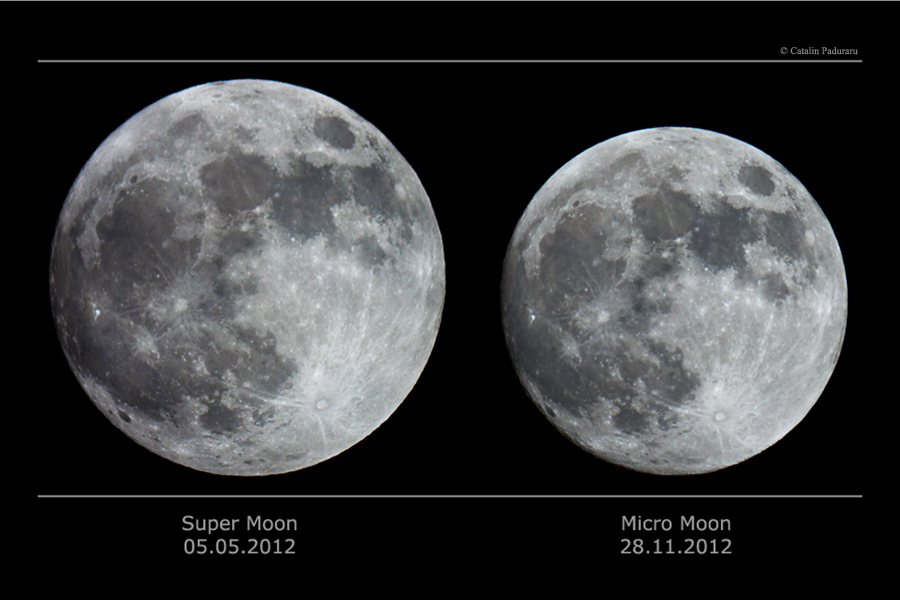
What is so super about tomorrow's supermoon? Tomorrow, a full moon will occur that appears slightly larger and brighter than usual. The reason is that the Moon's fully illuminated phase occurs within a short time from perigee - when the Moon is its closest to the Earth in its elliptical orbit. Although the precise conditions that define a supermoon vary, tomorrow's supermoon will undoubtedly qualify because it will be the closest, largest, and brightest full moon in over 65 years. One reason supermoons are popular is because they are so easy to see -- just go outside at sunset and watch an impressive full moon rise! Since perigee actually occurs tomorrow morning, tonight's full moon, visible starting at sunset, should also be impressive. Pictured here, a supermoon from 2012 is compared to a micromoon -- when a full Moon occurs near the furthest part of the Moon's orbit -- so that it appears smaller and dimmer than usual. Given many definitions, at least one supermoon occurs each year, with another one coming next month (moon-th). However, a full moon will not come this close to Earth again until 2034.
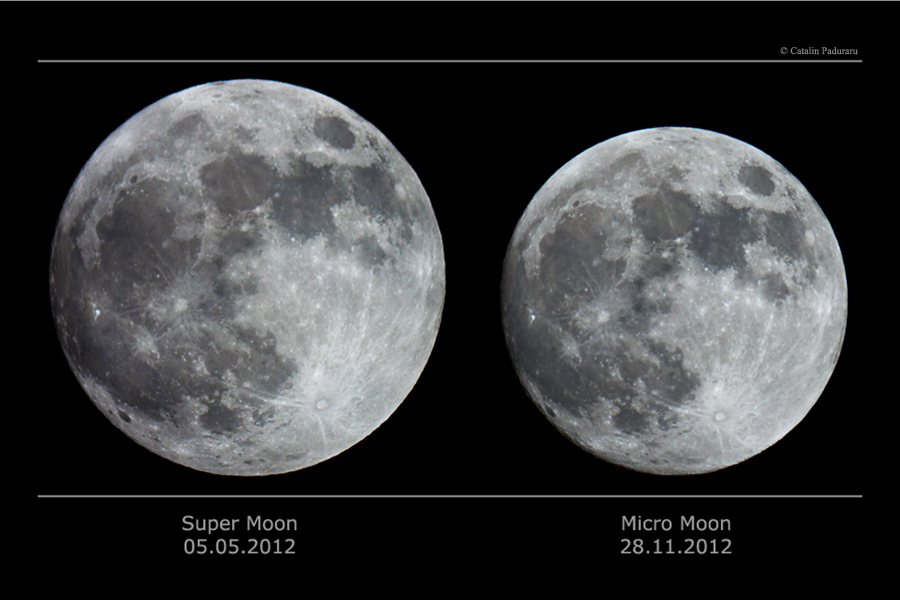
¿Qué hace tan especial la luna super del día de mañana? El día de mañana ocurrirá una luna llena que aparecerá ligeramente más grande y más brillante que lo habitual. La razón es que la fase completamente iluminada de la Luna ocurre en un breve período de tiempo después del perigeo — cuando la Luna está más cerca de la Tierra en su órbita elíptica. Aunque las condiciones precisas que definen una luna super varían, la luna super del día de mañana sin duda calificará porque será la luna llena más cercana, más grande y más brillante en más de 65 años. Una razón por la que las lunas super son populares es porque son muy fáciles de ver — simplemente salga afuera al atardecer y observe una impresionante luna llena salir. Dado que el perigeo ocurre realmente mañana por la mañana, la luna llena de esta noche, visible a partir del atardecer, también debería ser impresionante. En la imagen, una luna super de 2012 se compara con una luna micro — cuando una luna llena ocurre cerca del punto más alejado de la órbita de la Luna — de modo que aparece más pequeña y más tenue que lo habitual. Dado que existen muchas definiciones, al menos una luna super ocurre cada año, con otra próxima mes que viene (luna-mes). Sin embargo, una luna llena no volverá a acercarse tanto a la Tierra hasta 2034.