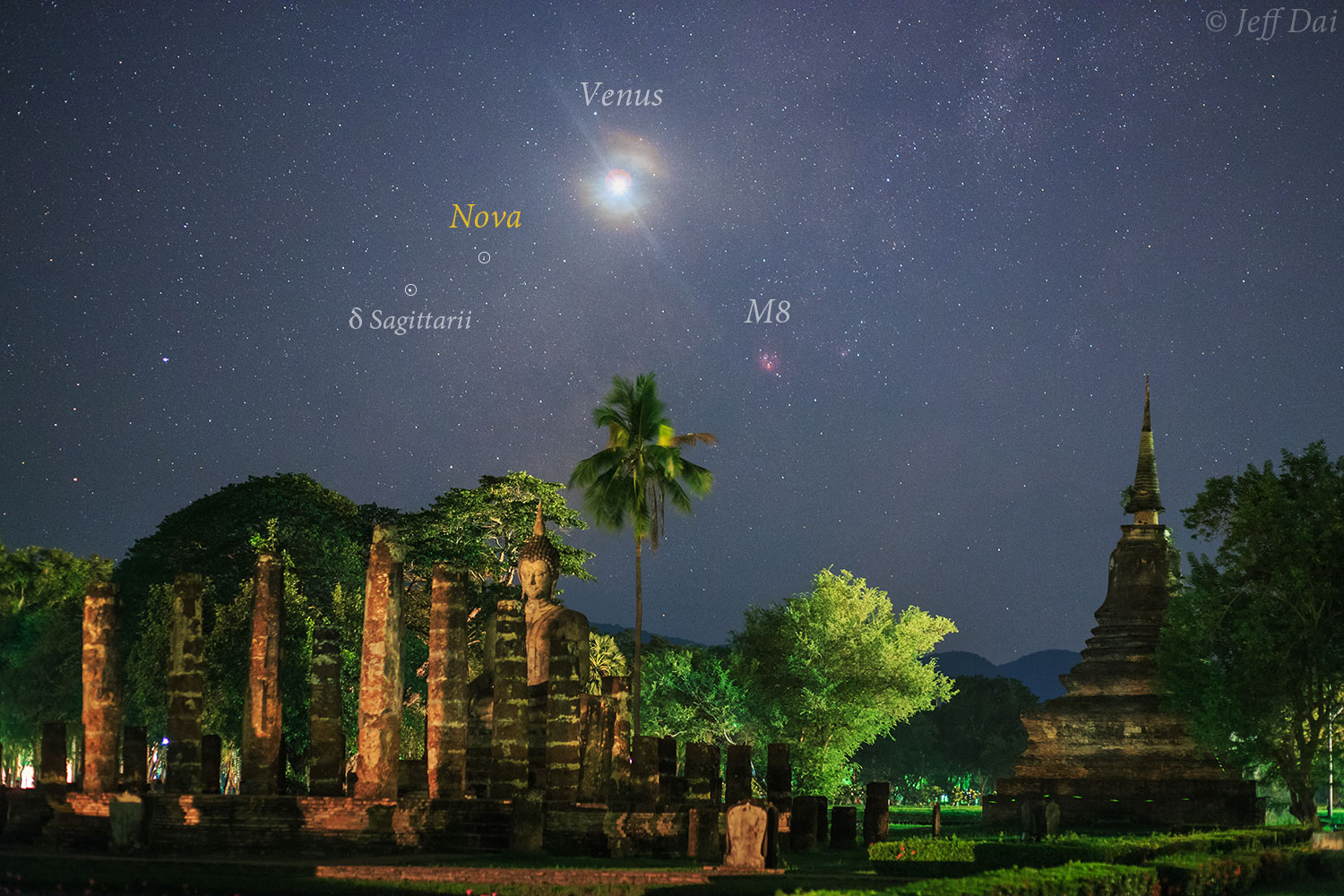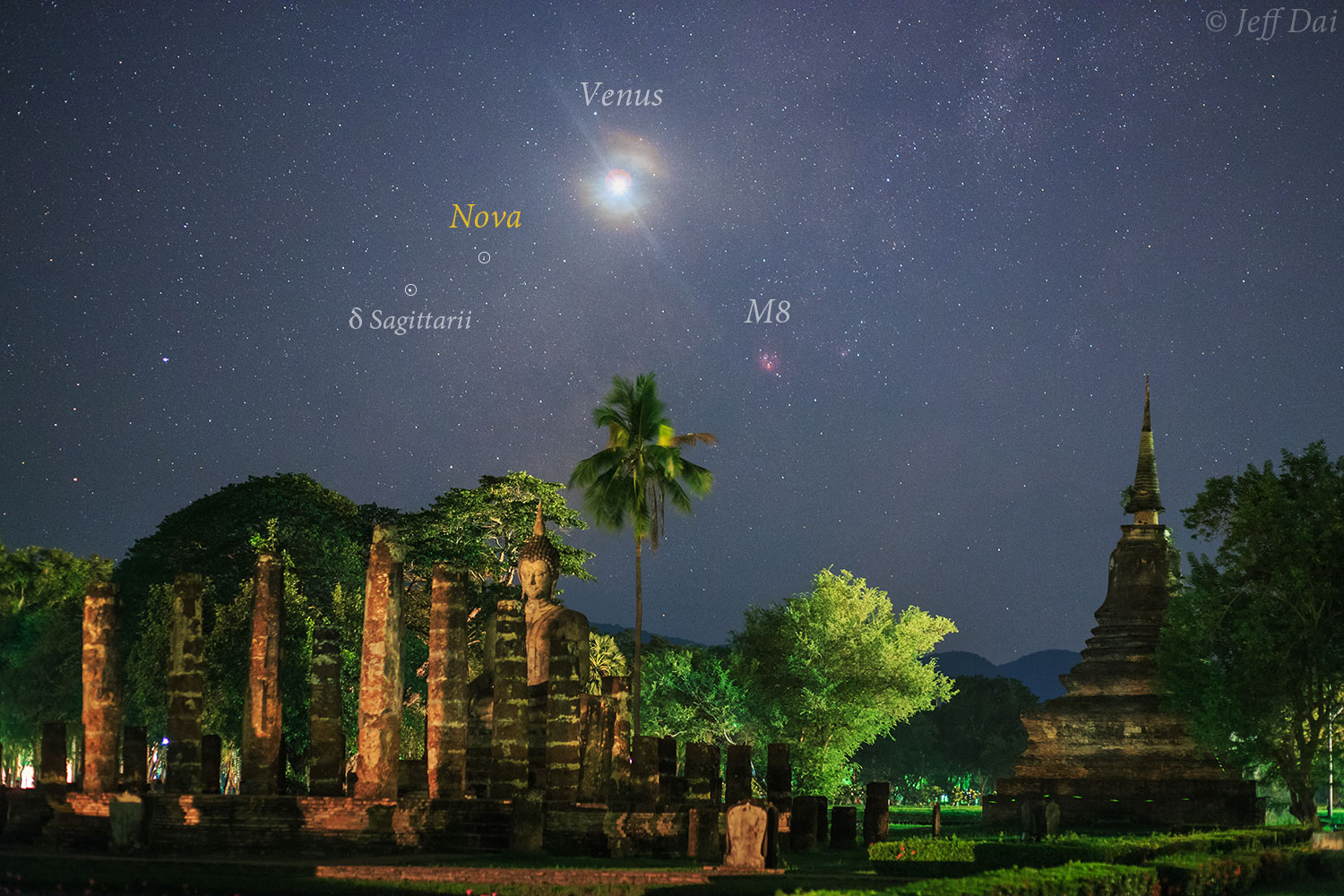
A nova in Sagittarius is bright enough to see with binoculars. Discovered last month by the All-Sky Automated Survey for Supernovae (ASAS-SN), the stellar explosion even approached the limit of naked-eye visibility last week. A classical nova results from a thermonuclear explosion on the surface of a white dwarf star -- a dense star having the size of our Earth but the mass of our Sun. In the featured image, the nova was captured last week above ancient Wat Mahathat in Sukhothai, Thailand. To see Nova Sagittarius 2016 yourself, just go out just after sunset and locate near the western horizon the constellation of the Archer (Sagittarius), popularly identified with an iconic teapot. Also visible near the nova is the very bright planet Venus. Don�t delay, though, because not only is the nova fading, but that part of the sky is setting continually closer to sunset.
Una nova en Sagitario es lo suficientemente brillante como para ser vista con binoculares. Descubierta el mes pasado por la Encuesta Automatizada de Todo el Cielo para Supernovas (ASAS-SN), la explosión estelar incluso se acercó al límite de visibilidad a simple vista la semana pasada. Una nova clásica resulta de una explosión termonuclear en la superficie de una enana blanca — una estrella densa que tiene el tamaño de la Tierra pero la masa del Sol. En la imagen destacada, la nova fue capturada la semana pasada sobre el antiguo Wat Mahathat en Sukhothai, Tailandia. Para ver usted mismo a la Nova Sagittarius 2016, simplemente salga poco después del atardecer y localice cerca del horizonte occidental la constelación del Arquero (Sagitario), popularmente identificada con una tetera icónica. También visible cerca de la nova está el muy brillante planeta Venus. No retrasen, sin embargo, porque no solo la nova está desvaneciéndose, sino que esa parte del cielo se está acercando continuamente al atardecer.