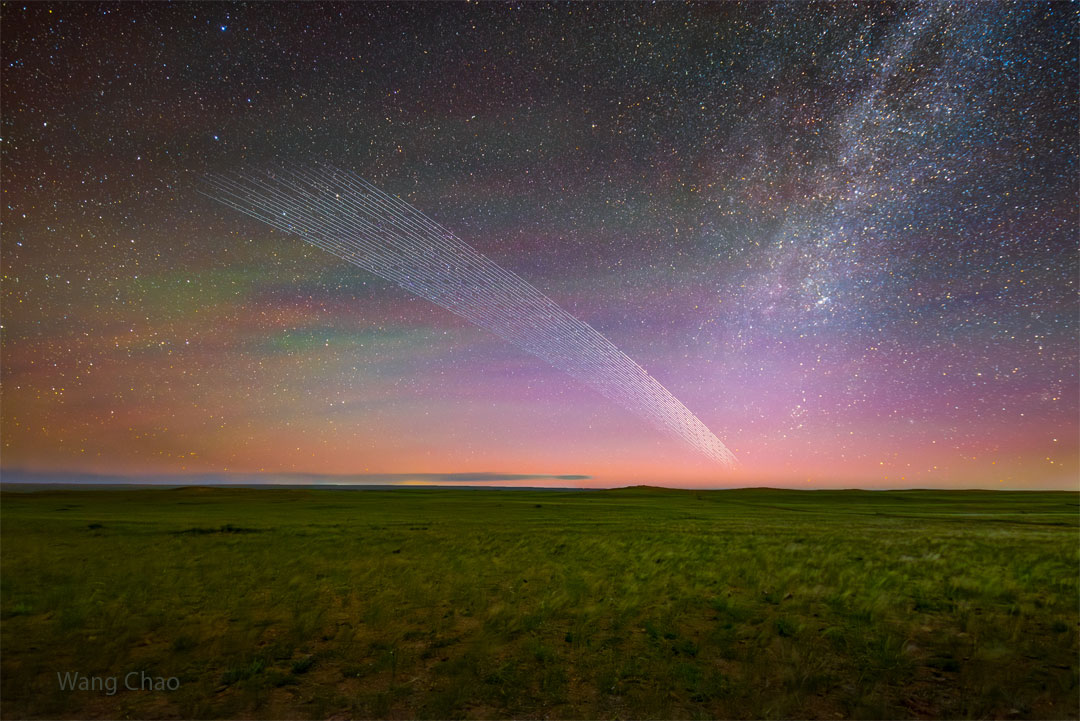
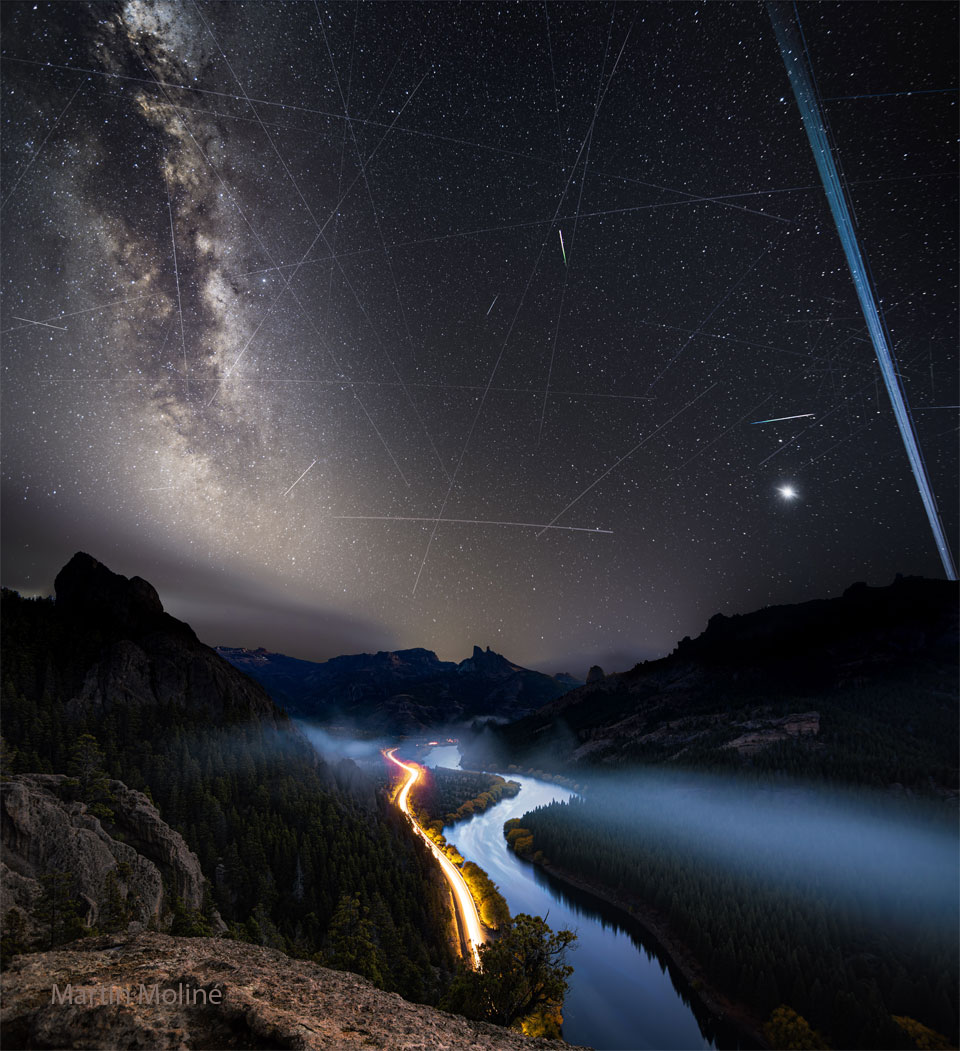
Put a satellite in a circular orbit about 42,000 kilometers from the center of the Earth and it will orbit once in 24 hours. Because that matches Earth's rotation period, it is known as a geosynchronous orbit. If that orbit is also in the plane of the equator, the satellite will hang in the sky over a fixed location in a geostationary orbit. As predicted in the 1940s by futurist Arthur C. Clarke, geostationary orbits are in common use for communication and weather satellites, a scenario now well-known to astroimagers. Deep images of the night sky made with telescopes that follow the stars can also pick up geostationary satellites glinting in sunlight still shining far above the Earth's surface. Because they all move with the Earth's rotation against the background of stars, the satellites leave trails that seem to follow a highway across the celestial landscape. The phenomenon was captured last month in this video showing several satellites in geostationary orbit crossing the famous Orion Nebula. Open Science: Browse 1,400+ codes in the Astrophysics Source Code Library
Colocar un satélite en una órbita circular a unos 42.000 kilómetros del centro de la Tierra hace que orbite una vez cada 24 horas. Dado que este período coincide con el de rotación de la Tierra, se conoce como órbita geosincrónica. Si dicha órbita también se encuentra en el plano del ecuador, el satélite permanecerá fijo en el cielo sobre una ubicación específica, en una órbita geostacionaria. Como predijo en la década de 1940 el futurista Arthur C. Clarke, las órbitas geostacionarias son comúnmente utilizadas para satélites de comunicación y meteorológicos, un escenario ahora bien conocido por los astroimágenes. Imágenes profundas del cielo nocturno capturadas con telescopios que siguen las estrellas también pueden mostrar satélites geostacionarios que reflejan la luz solar aún brillando muy por encima de la superficie terrestre. Debido a que todos ellos se mueven junto con la rotación de la Tierra frente al fondo de las estrellas, los satélites dejan trayectorias que parecen seguir una autopista a través del paisaje celeste. Este fenómeno fue capturado el mes pasado en este video que muestra varios satélites en órbita geostacionaria cruzando la famosa Nebulosa de Orión.