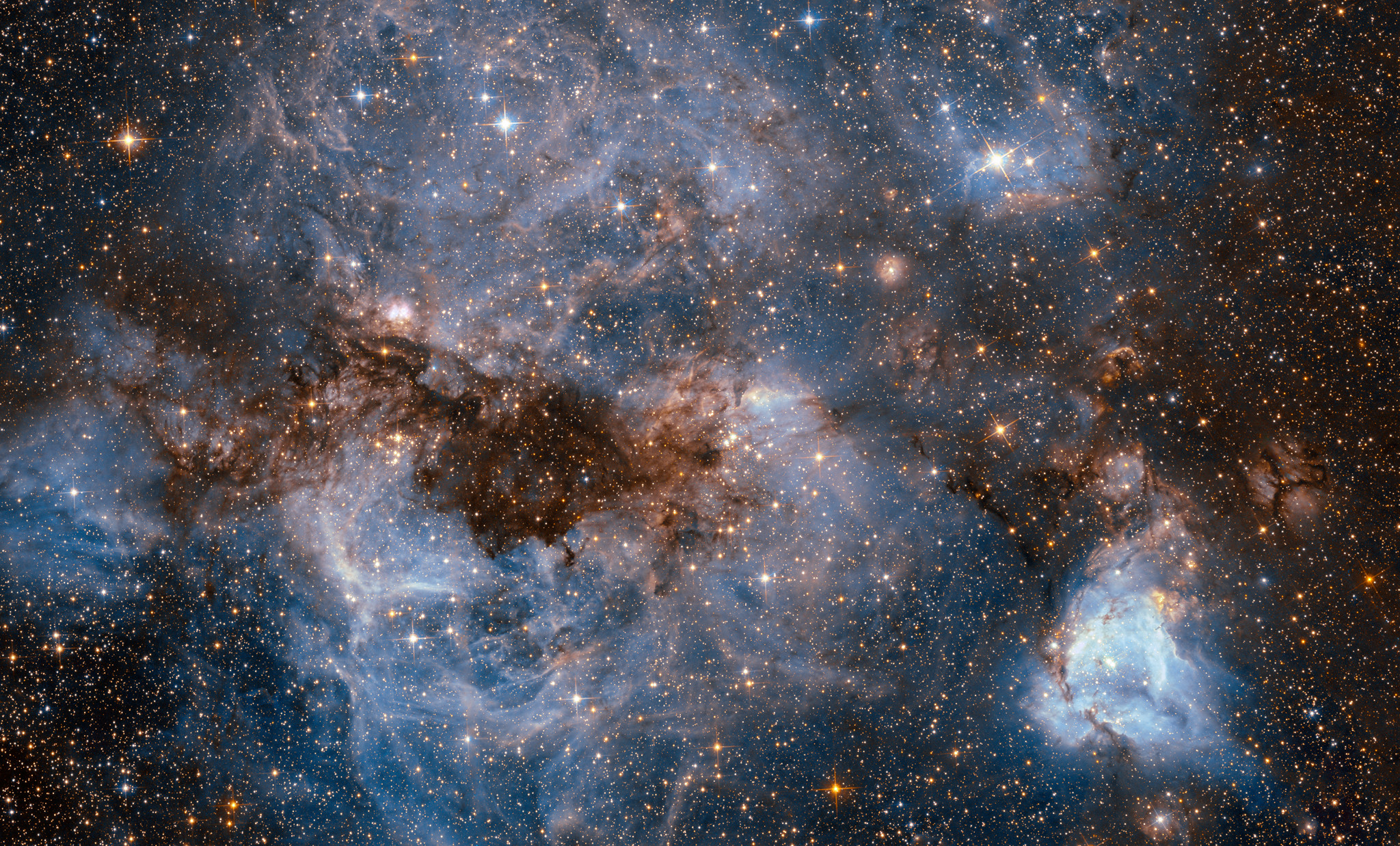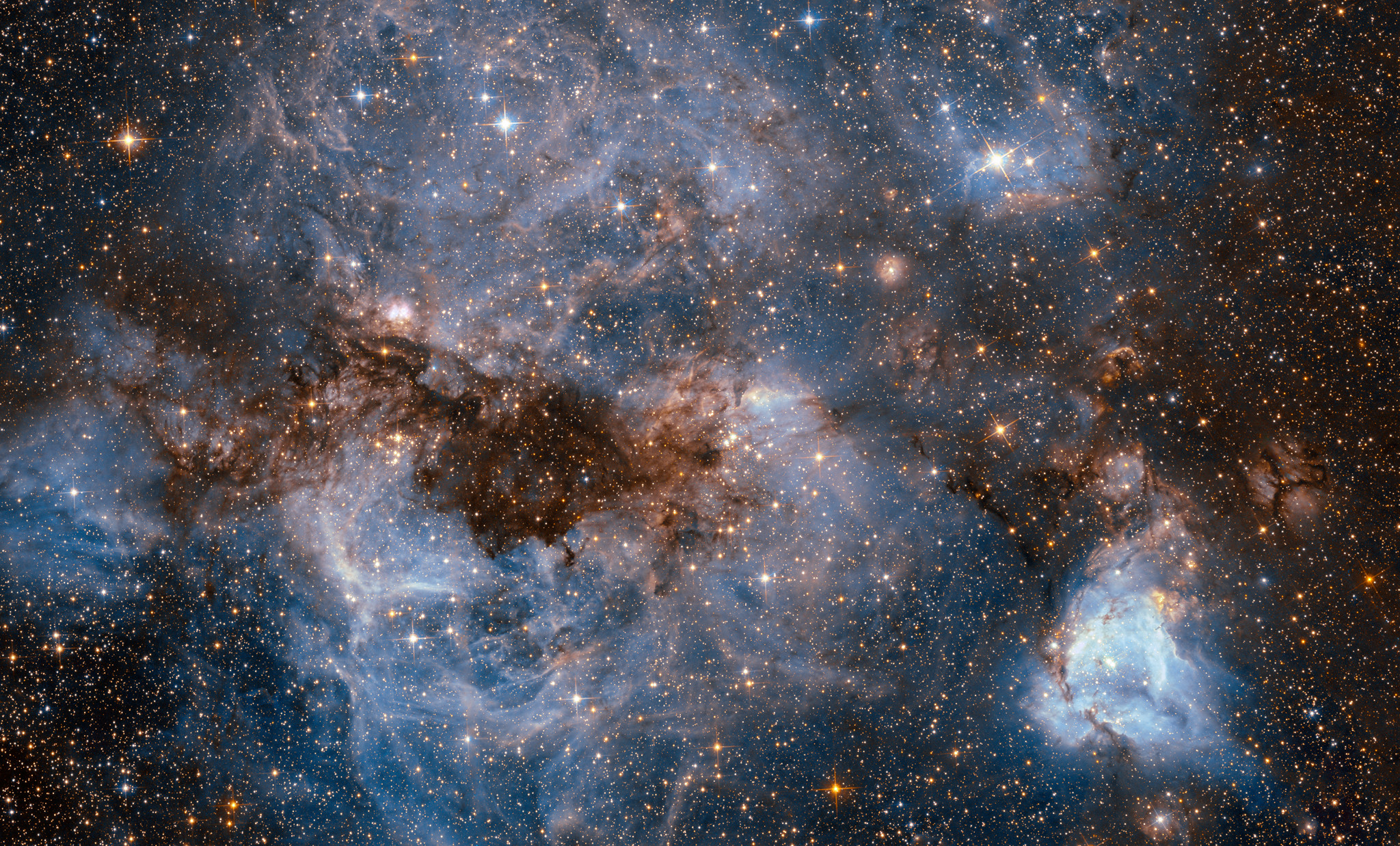
Over 150 light-years across, this cosmic maelstrom of gas and dust is not too far away. It lies south of the Tarantula Nebula in our satellite galaxy the Large Magellanic Cloud a mere 180,000 light-years distant. Massive stars have formed within. Their energetic radiation and powerful stellar winds sculpt the gas and dust and power the glow of this HII region, entered into the Henize catalog of emission stars and nebulae in the Magellanic Clouds as N159. The bright, compact, butterfly-shaped nebula above and left of center likely contains massive stars in a very early stage of formation. Resolved for the first time in Hubble images, the compact blob of ionized gas has come to be known as the Papillon Nebula. Participate: Take an Aesthetics & Astronomy Survey
Con más de 150 años luz de diámetro, este torbellino cósmico de gas y polvo no está muy lejos. Se encuentra al sur de la Nebulosa Tarántula en nuestra galaxia satélite, la Nube Magallánica Grande, a tan solo 180 000 años luz de distancia. En su interior se han formado estrellas masivas. Su radiación energética y sus fuertes vientos estelares moldean el gas y el polvo, y alimentan el brillo de esta región HII, registrada en el catálogo de Henize sobre estrellas y nebulosas emisoras en las Nubes Magallánicas como N159. La nebulosa brillante, compacta y de forma de mariposa que se encuentra arriba y a la izquierda del centro probablemente contiene estrellas masivas en una etapa muy temprana de formación. Resuelta por primera vez en imágenes del telescopio Hubble, el compacto bulto de gas ionizado ha llegado a conocerse como la Nebulosa Papillon.