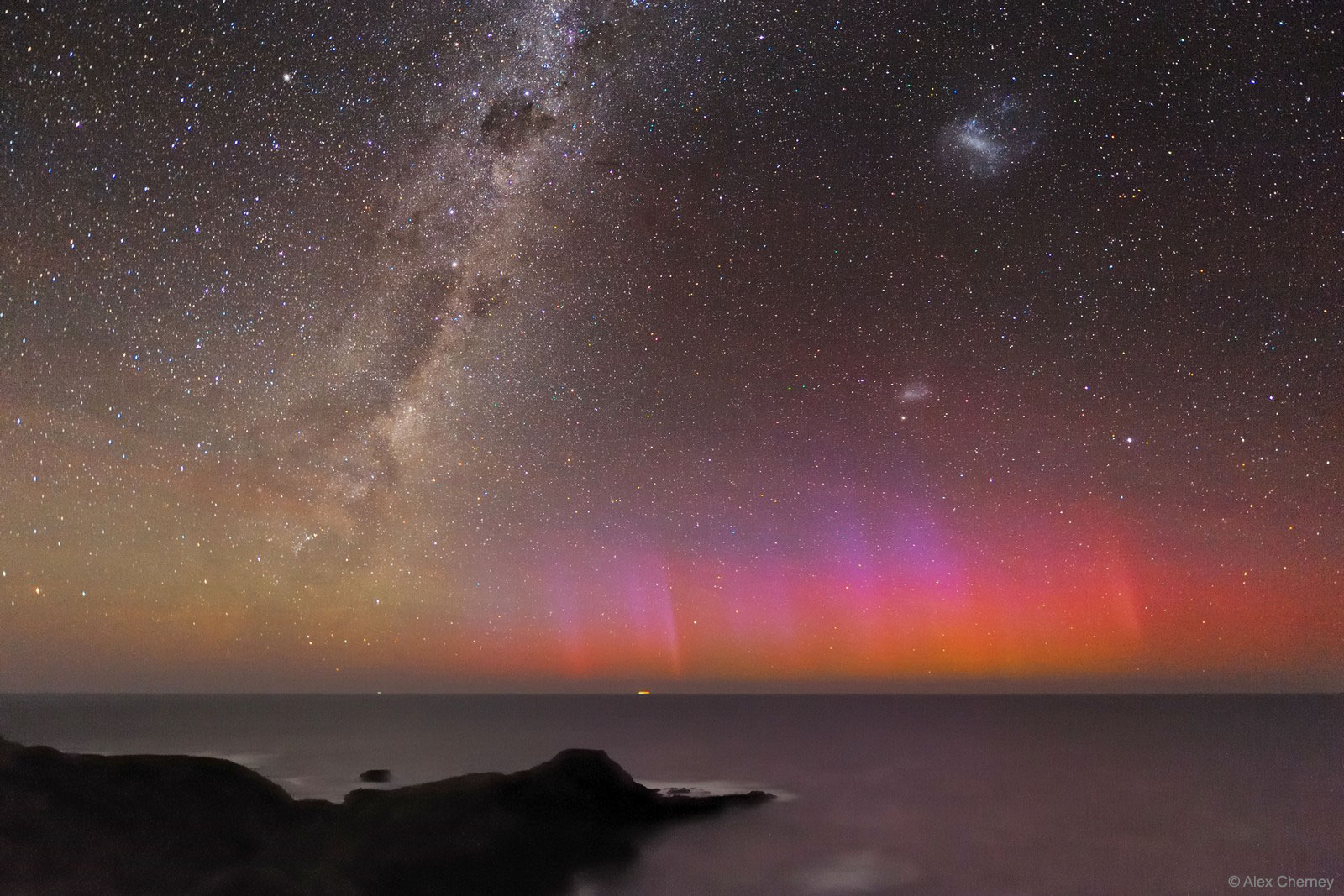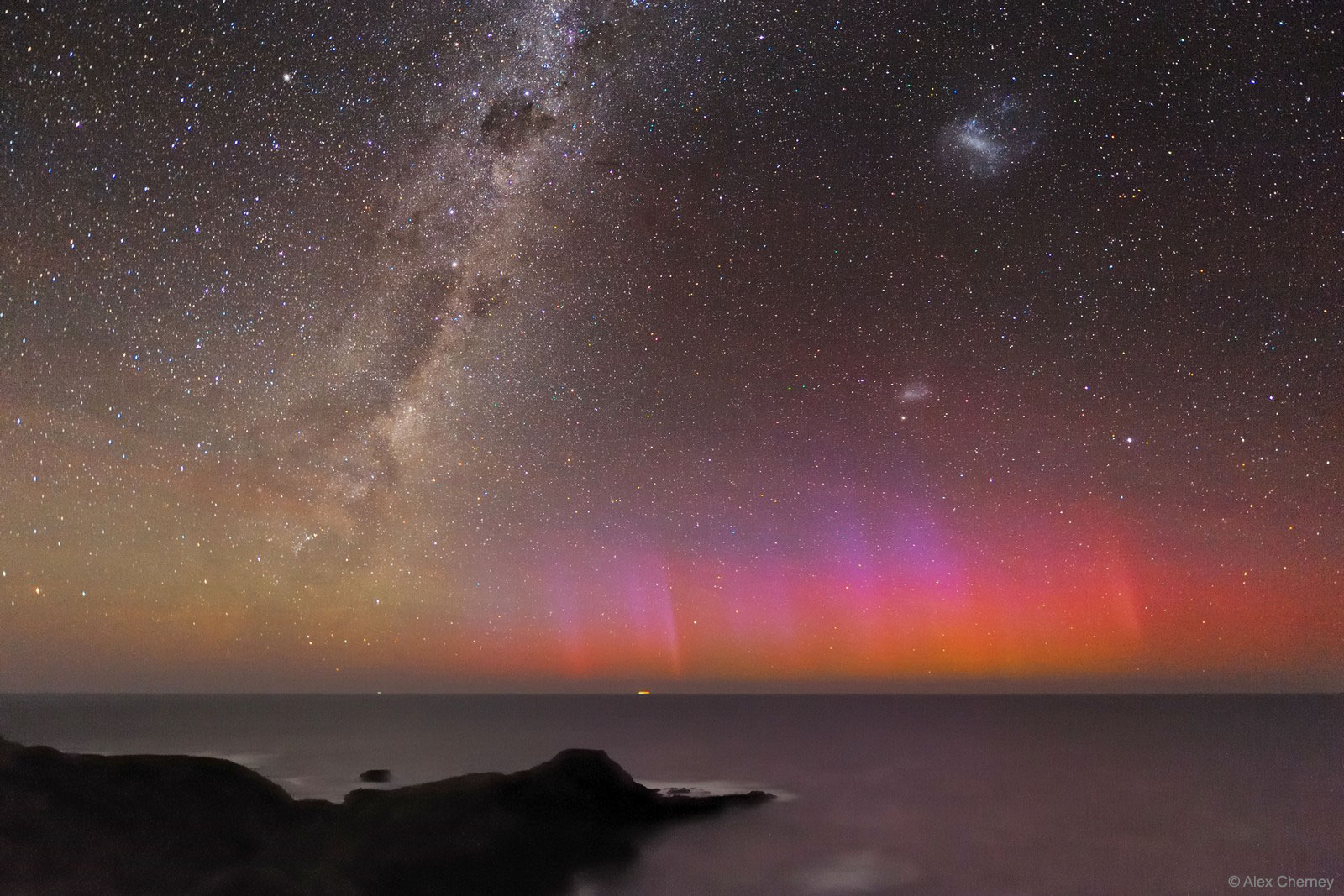
Why would the sky glow red? Aurora. A solar storm in 2012, emanating mostly from active sunspot region 1402, showered particles on the Earth that excited oxygen atoms high in the Earth's atmosphere. As the excited element's electrons fell back to their ground state, they emitted a red glow. Were oxygen atoms lower in Earth's atmosphere excited, the glow would be predominantly green. Pictured here, this high red aurora is visible just above the horizon last week near Flinders, Victoria, Australia. The sky that night, however, also glowed with more familiar but more distant objects, including the central disk of our Milky Way Galaxy on the left, and the neighboring Large and Small Magellanic Cloud galaxies on the right. A time-lapse video highlighting auroras visible that night puts the picturesque scene in context. Why the sky did not also glow green remains unknown.
¿Por qué brillaría el cielo en rojo? Aurora. Una tormenta solar en 2012, que emanaba principalmente de la región activa de manchas solares 1402, bombardeó partículas sobre la Tierra que excitaron átomos de oxígeno altos en la atmósfera terrestre. Al caer los electrones excitados de nuevo a su estado fundamental, emitieron un brillo rojo. Si los átomos de oxígeno estuvieran más bajos en la atmósfera terrestre, el brillo sería predominantemente verde. En la imagen, esta aurora roja alta es visible justo por encima del horizonte la semana pasada cerca de Flinders, Victoria, Australia. Sin embargo, el cielo esa noche también brilló con objetos más familiares pero más distantes, incluyendo el disco central de nuestra Galaxia Vía Láctea a la izquierda, y las galaxias vecinas de la Nube Magallánica Grande y la Nube Magallánica Pequeña a la derecha. Un video de timelapse que destaca las auroras visibles esa noche pone la escena pictórica en contexto. ¿Por qué el cielo no brilló también en verde sigue siendo desconocido.