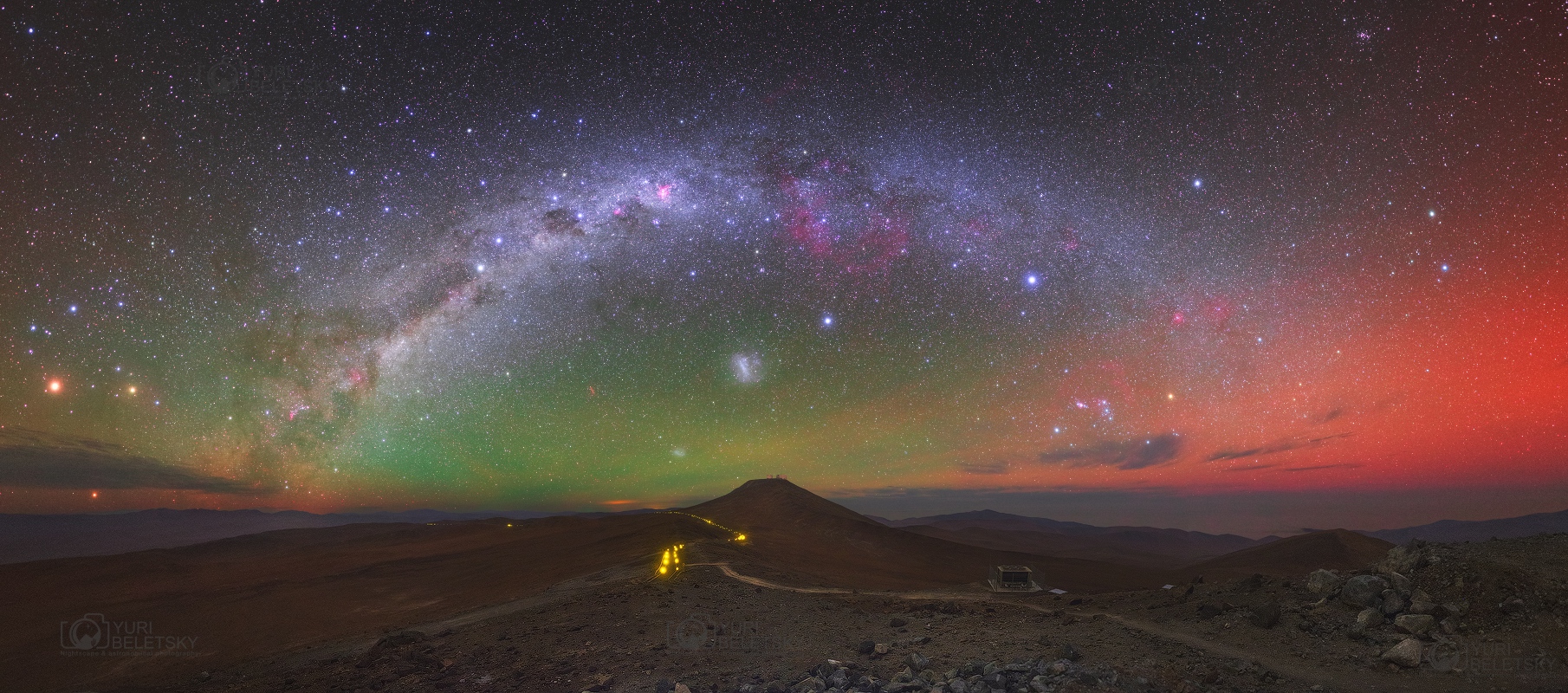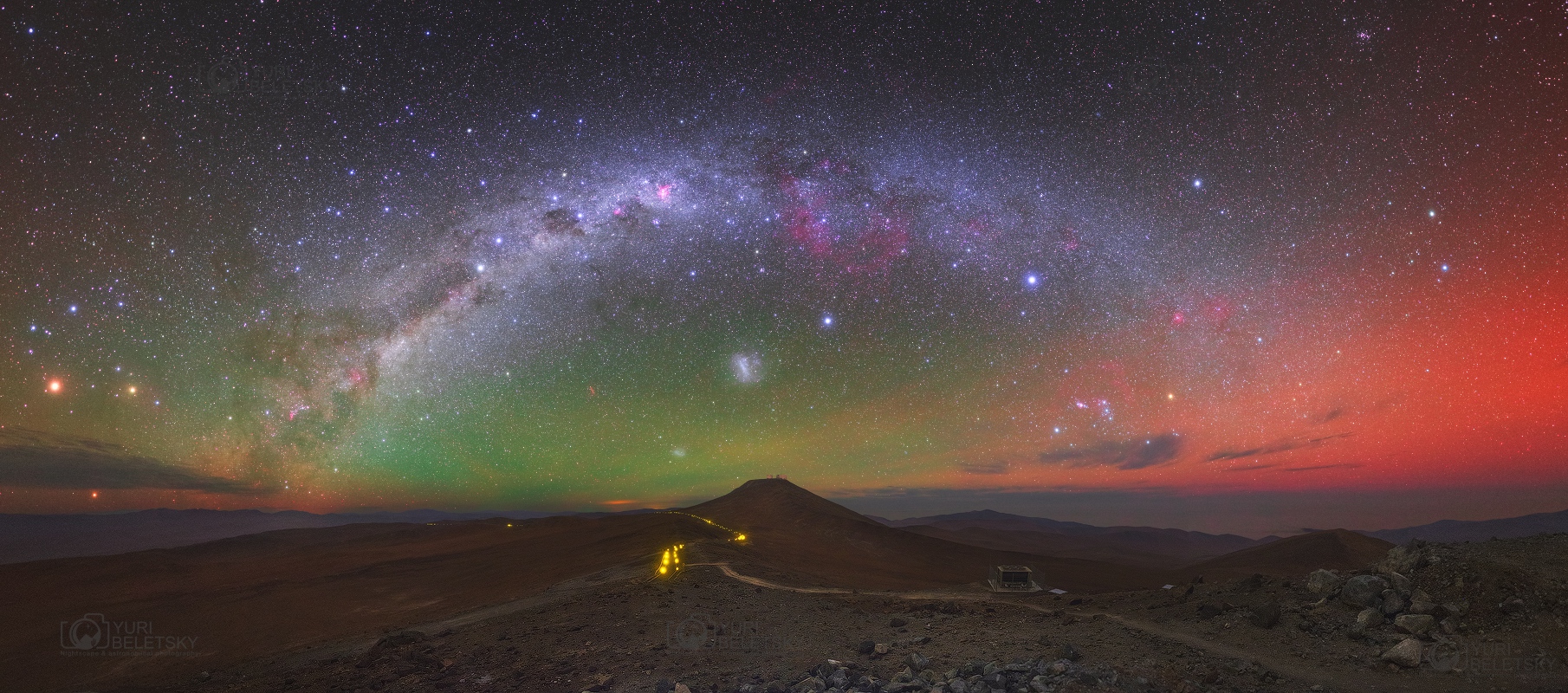
Captured last April after sunset on a Chilean autumn night an exceptionally intense airglow flooded this scene. The panoramic skyscape is also filled with stars, clusters, and nebulae along the southern Milky Way including the Large and Small Magellanic clouds. Originating at an altitude similar to aurorae, the luminous airglow is due to chemiluminescence, the production of light through chemical excitation. Commonly recorded with a greenish tinge by sensitive digital cameras, both red and green airglow emission here is predominately from atmospheric oxygen atoms at extremely low densities and has often been present in southern hemisphere nights during the last few years. Like the Milky Way on that dark night the strong airglow was visible to the eye, but seen without color. Mars, Saturn, and bright star Antares in Scorpius form the celestial triangle anchoring the scene on the left. The road leads toward the 2,600 meter high mountain Cerro Paranal and the European Southern Observatory's Very Large Telescopes.
Capturada el pasado abril, tras el atardecer en una noche de otoño chileno, una intensa luminosidad atmosférica inundó esta escena. El paisaje celeste panorámico también está lleno de estrellas, cúmulos y nebulosas a lo largo de la Vía Láctea austral, incluyendo las Nubes Magdalenas Mayor y Menor. Originada a una altitud similar a la de las auroras, el brillo luminoso es debido a la quimiluminiscencia, la producción de luz mediante la excitación química. Comúnmente registrada con un tono verdoso por cámaras digitales sensibles, tanto el brillo rojo como el verde aquí se debe principalmente a átomos de oxígeno en la atmósfera a densidades extremadamente bajas y ha estado presente con frecuencia en las noches del hemisferio sur durante los últimos años. Al igual que la Vía Láctea en esa noche oscura, el intenso brillo atmosférico fue visible a simple vista, pero sin color. Marte, Saturno y la brillante estrella Antares en Escorpión forman el triángulo celeste que ancla la escena a la izquierda. La carretera conduce hacia la montaña Cerro Paranal, de 2.600 metros de altura, y los Telescopios Very Large de la Observatorio Europeo Austral.