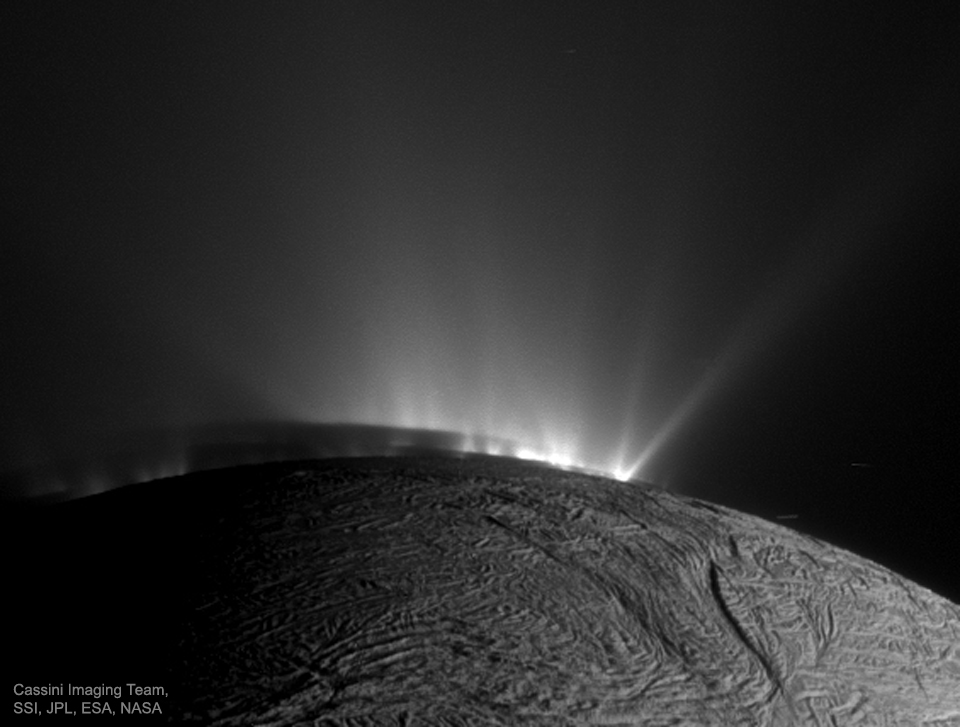
Does Enceladus have underground oceans that could support life? The discovery of jets spewing water vapor and ice was detected by the Saturn-orbiting Cassini spacecraft in 2005. The origin of the water feeding the jets, however, was originally unknown. Since discovery, evidence has been accumulating that Enceladus has a deep underground sea, warmed by tidal flexing. Pictured here, the textured surface of Enceladus is visible in the foreground, while rows of plumes rise from ice fractures in the distance. These jets are made more visible by the Sun angle and the encroaching shadow of night. A recent fly-through has found evidence that a plume -- and so surely the underlying sea -- is rich in molecular hydrogen, a viable food source for microbes that could potentially be living there.
¿Tiene Enceladus océanos subterráneos que podrían albergar vida? La detección de chorros que expulsan vapor de agua y hielo fue realizada por la nave espacial Cassini, que orbita Saturno, en 2005. Sin embargo, en un principio era desconocida la procedencia del agua que alimenta estos chorros. Desde su descubrimiento, se ha acumulado evidencia de que Enceladus posee un gran océano subterráneo, calentado por el flexionamiento tidal. En la imagen, se puede ver la superficie texturizada de Enceladus en primer plano, mientras que filas de chorros emergen de grietas en el hielo en el fondo. Estos chorros son más visibles debido al ángulo del Sol y la sombra creciente de la noche. Un reciente vuelo de aproximación ha encontrado evidencia de que un chorros — y por tanto, con toda seguridad, el océano subyacente — está rico en hidrógeno molecular, una fuente de alimento viable para microorganismos que podrían estar viviendo allí.