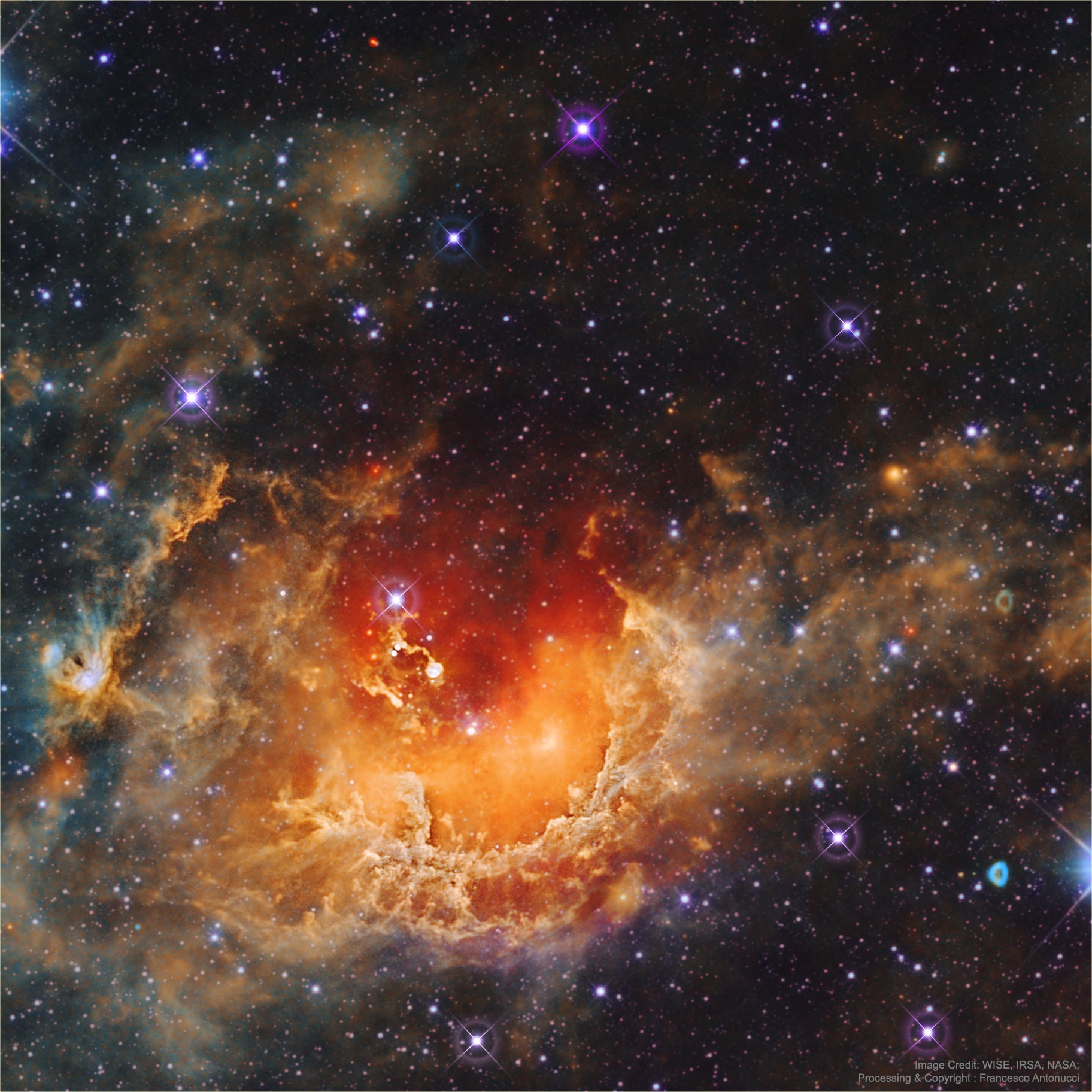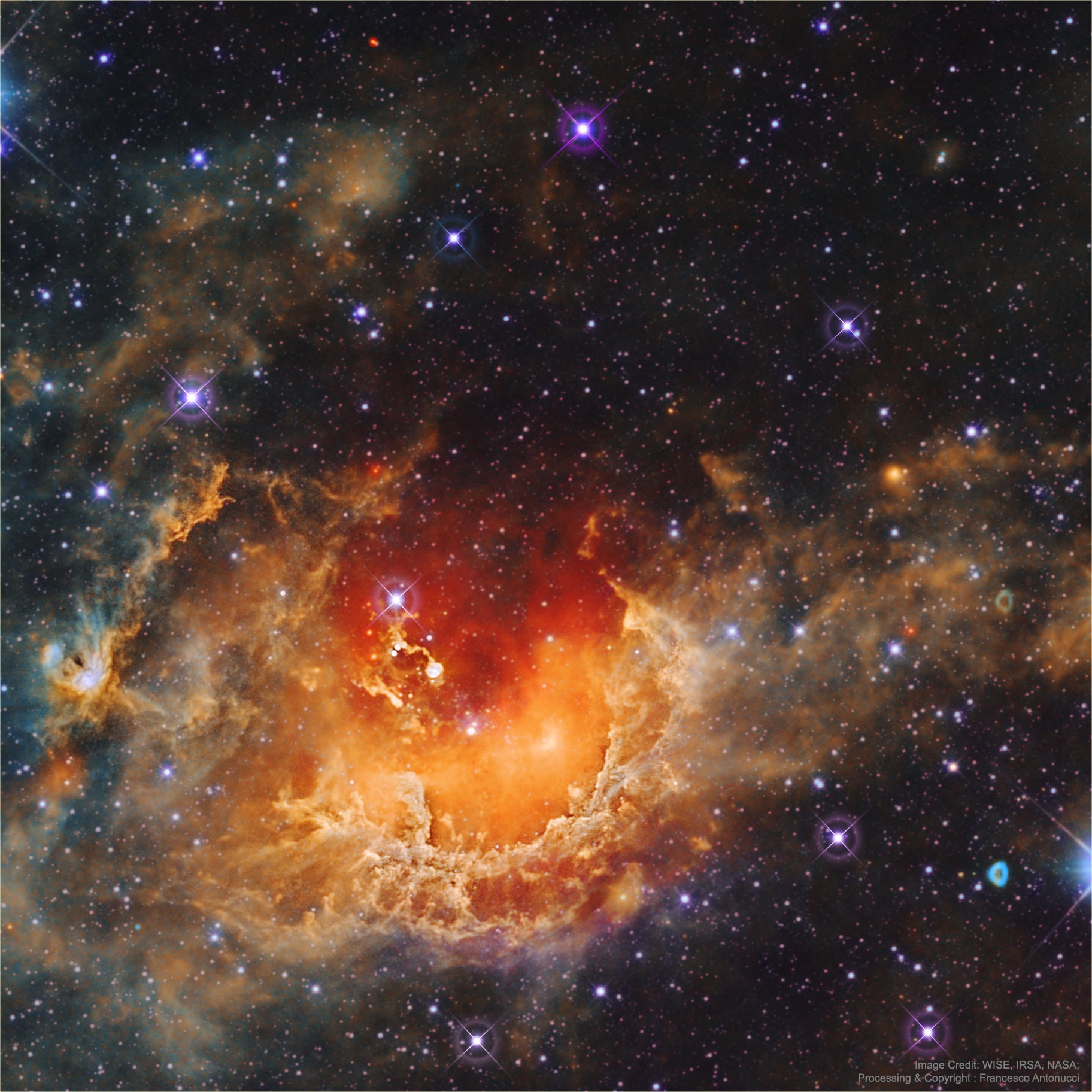
What's all of the commotion in the Tadpole nebula? Star formation. Dusty emission in the Tadpole nebula, IC 410, lies about 12,000 light-years away in the northern constellation of the Charioteer (Auriga). The cloud of glowing gas is over 100 light-years across, sculpted by stellar winds and radiation from embedded open star cluster NGC 1893. Formed in the interstellar cloud a mere 4 million years ago, bright newly formed cluster stars are seen all around the star-forming nebula. Notable near the image center are two relatively dense streamers of material trailing away from the nebula's central regions. Potentially sites of ongoing star formation in IC 410, these cosmic tadpole shapes are about 10 light-years long. The featured image was taken in infrared light by NASA's Wide Field Infrared Survey Explorer (WISE) satellite. Open Science: Browse 1,400+ codes in the Astrophysics Source Code Library
¿Cuál es el motivo de tanta actividad en la nebulosa Tadpole? La formación estelar. La emisión polvorienta en la nebulosa Tadpole, IC 410, se encuentra a unos 12 000 años luz de distancia en la constelación norteña del Carro (Auriga). La nube de gas brillante tiene más de 100 años luz de ancho y está moldeada por los vientos estelares y la radiación proveniente del cúmulo estelar abierto NGC 1893, incrustado en ella. Formado en la nube interestelar hace apenas 4 millones de años, las estrellas recién formadas brillantes se ven distribuidas alrededor de la nebulosa formadora de estrellas. Cerca del centro de la imagen se pueden observar dos filamentos relativamente densos de material que se extienden desde las regiones centrales de la nebulosa. Potenciales lugares de formación estelar en curso en IC 410, estas formas cósmicas en forma de rana tienen aproximadamente 10 años luz de longitud. La imagen destacada fue tomada en luz infrarroja por el satélite de la NASA Wide Field Infrared Survey Explorer (WISE).