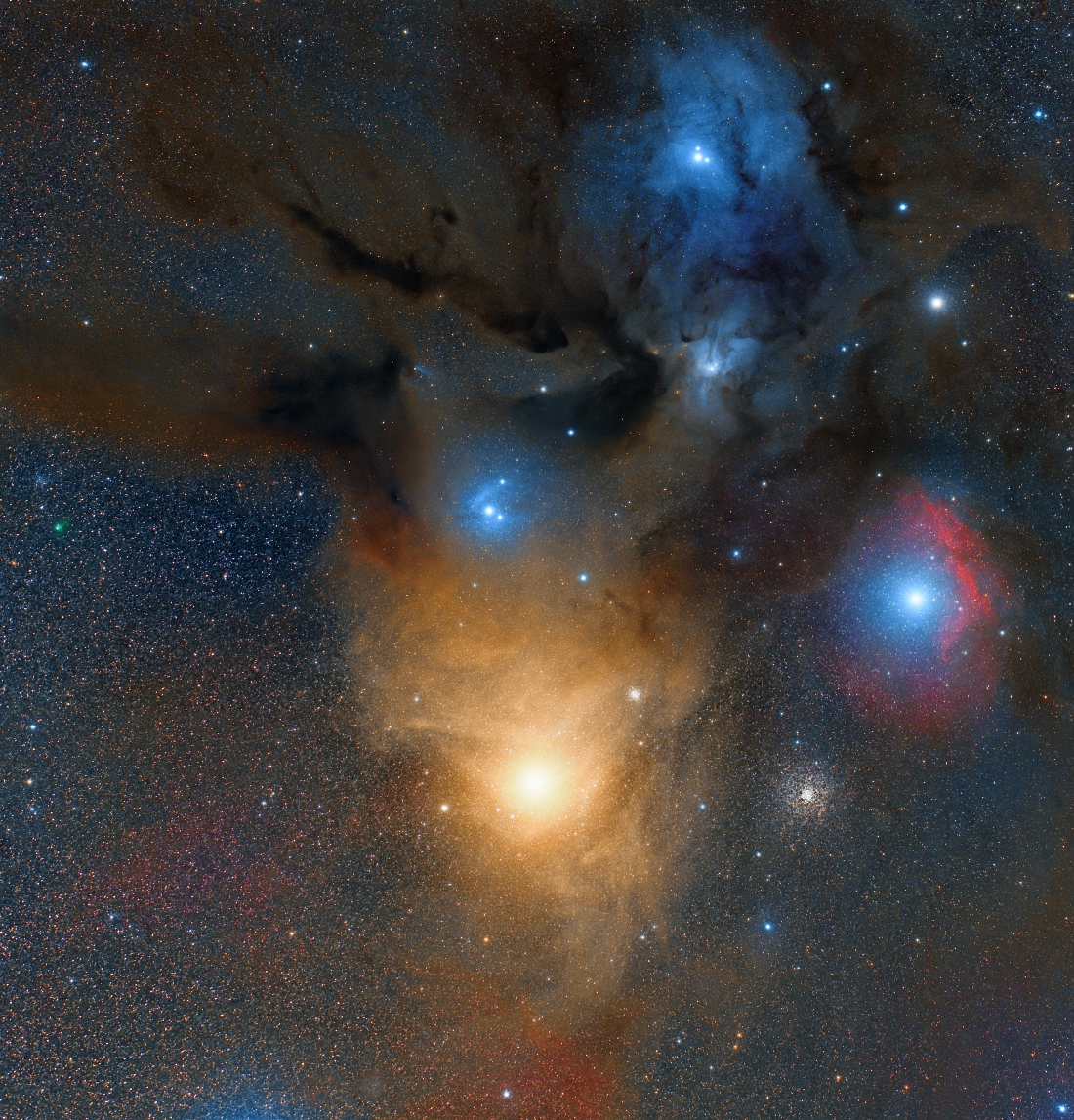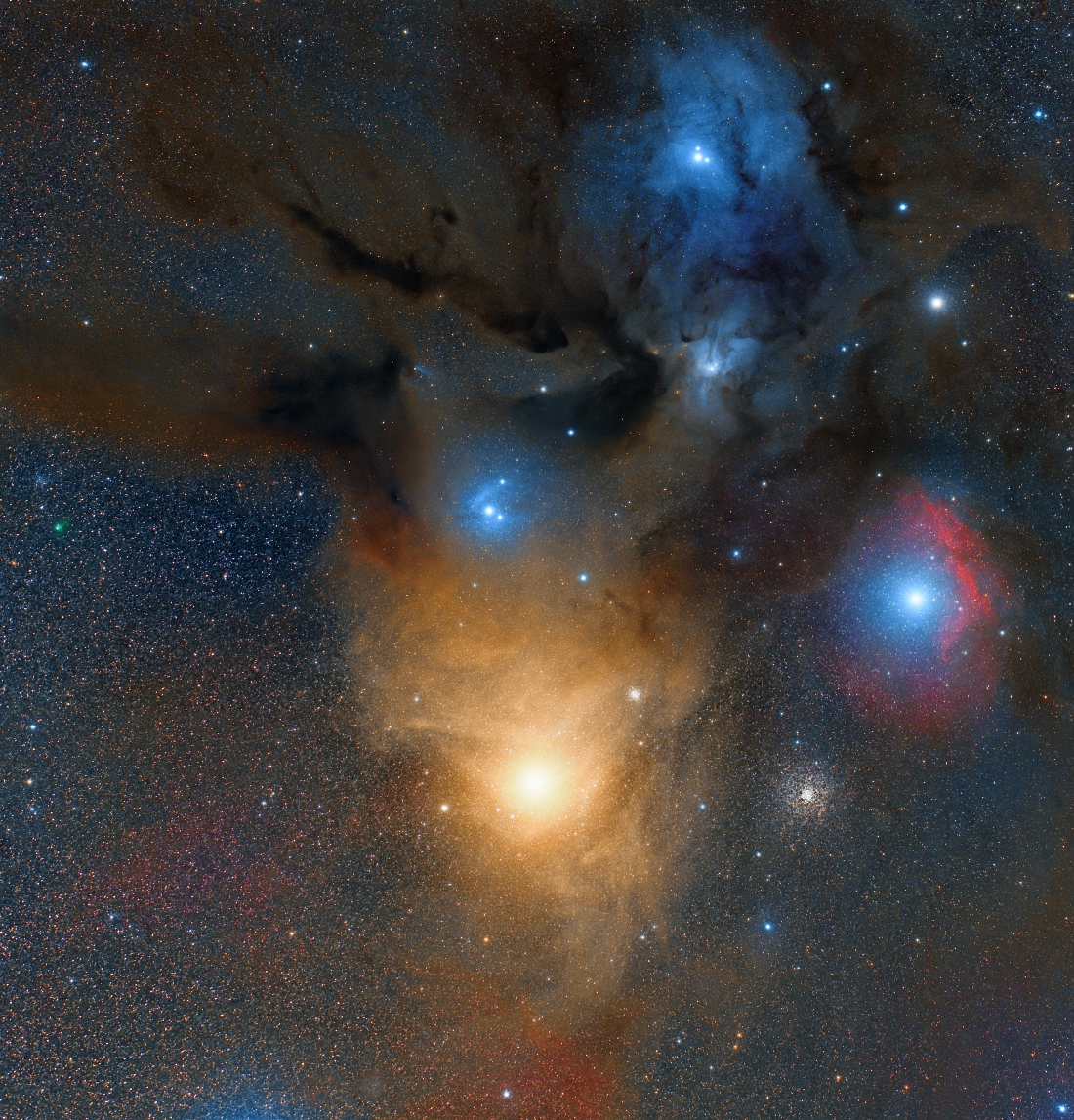
Sweeping through this stunning field of view, Comet 71P/Clark really is in the foreground of these cosmic clouds. The 2 panel telescopic mosaic is color enhanced and is about 5 degrees (10 full moons) across. It captures the faint comet's position on the night of May 23/24 over 5 light-minutes from Earth, very near the line-of-sight to bright star Antares and the Rho Ophiuchi cloud complex. In the frame Antares, also known as Alpha Scorpii, is at bottom center surrounded by a dusty cosmic cloud reflecting the cool giant star's yellowish light. Globular star cluster M4 shines just right of Antares, but M4 lies some 7,000 light-years away compared to Antares' 500 light-year distance. Slightly closer than Antares, Rho Ophiuchi's bluish starlight is reflected by the dust in molecular clouds toward the top. You can spot the small coma and short tail of the comet as a faint smudge near the center of the left edge of the frame. Just look for the comet's striking greenish color, produced as diatomic carbon molecules fluoresce in sunlight.
A través de este impresionante campo visual, el cometa 71P/Clark realmente está en primer plano de estas nubes cósmicas. El mosaico telescópico de dos paneles está reforzado en color y abarca aproximadamente 5 grados (10 lunas llenas) de extensión. Captura la posición del tenue cometa durante la noche del 23/24 de mayo, a 5 minutos-luz de la Tierra, muy cerca de la línea de visión hacia la brillante estrella Antares y el complejo de nubes Rho Ophiuchi. En el marco, Antares, también conocida como Alpha Scorpii, se encuentra en el centro inferior, rodeada por una nube cósmica polvorienta que refleja la luz amarillenta de la estrella gigante fría. El cúmulo estelar globular M4 brilla justo a la derecha de Antares, pero M4 se encuentra a unos 7,000 años-luz de distancia, en comparación con los 500 años-luz de distancia de Antares. Ligeramente más cercano que Antares, la luz azulada de las estrellas de Rho Ophiuchi es reflejada por el polvo en las nubes moleculares hacia la parte superior. Puedes localizar la pequeña coma y la corta cola del cometa como una mancha tenue cerca del centro del borde izquierdo del marco. Busca el llamativo color verde del cometa, producido cuando las moléculas de carbono diatómico fluorescen bajo la luz solar.