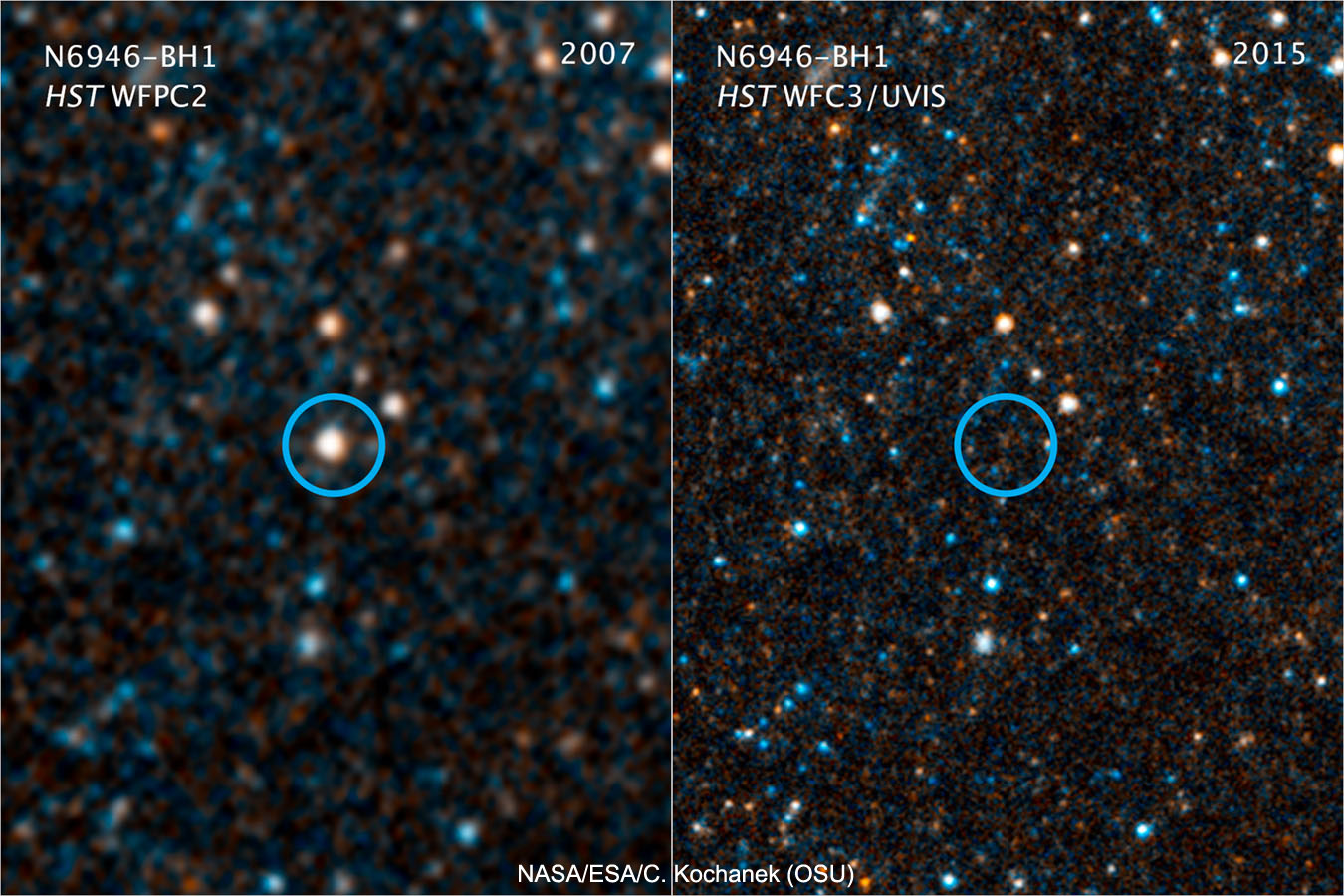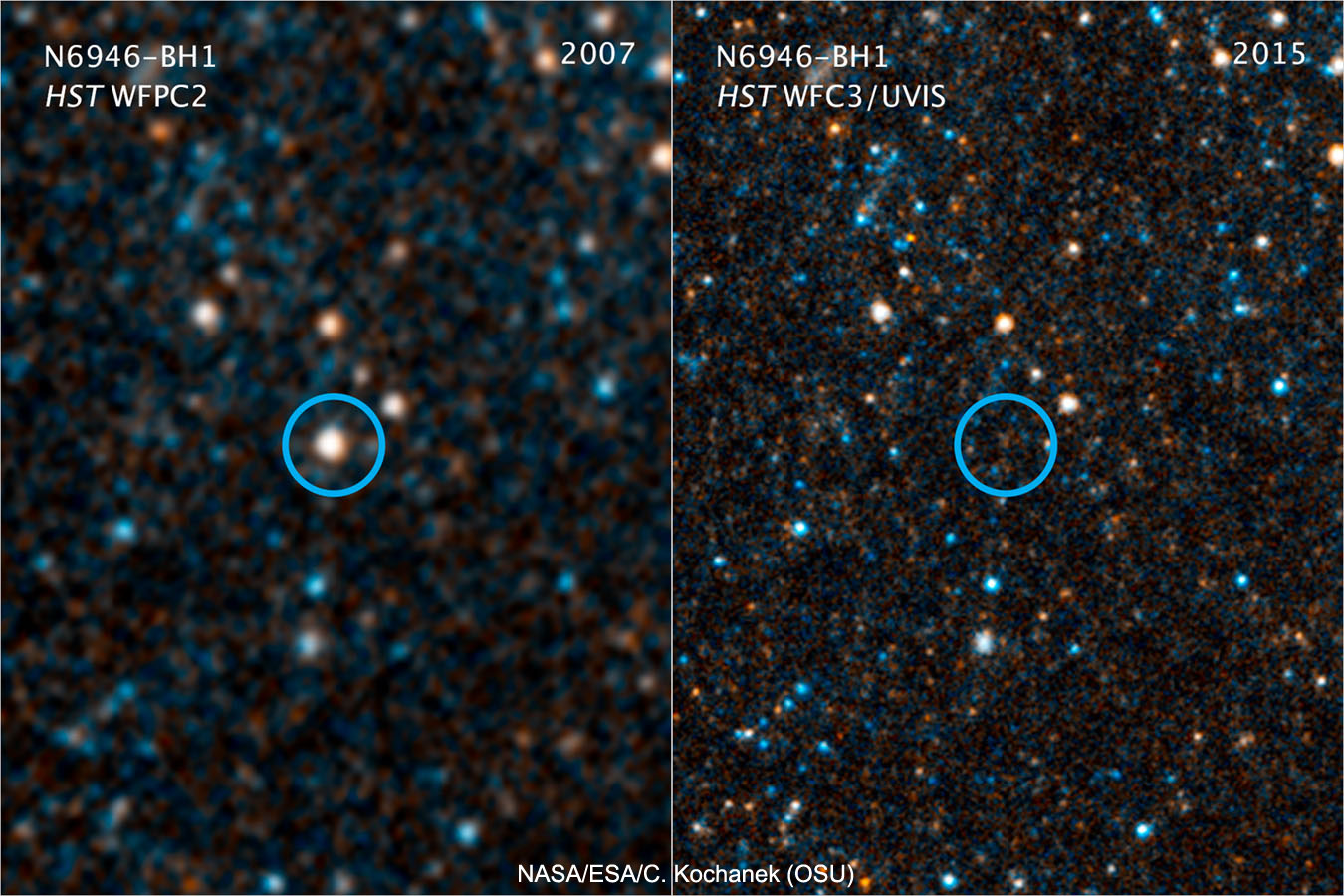
What's happened to giant star N6946-BH1? It was there just a few years ago -- Hubble imaged it. Now there's only a faint glow. What's curiouser, no bright supernova occurred -- although the star did brighten significantly for a few months. The leading theory is that, at about 25 times the mass of our Sun, N6946-BH1's great gravity held much of the star together during its final tumultuous death throes, after which most of the star sank into a black hole of its own making. If so, then some of what remained outside of the black hole likely then formed an accretion disk that emits comparatively faint infrared light as it swirls around, before falling in. If this mode of star death is confirmed with other stars, it gives direct evidence that a very massive star can end its life with a whimper rather than a bang. Open Science: Browse 1,400+ codes in the Astrophysics Source Code Library
¿Qué le ha ocurrido a la estrella gigante N6946-BH1? Hace solo unos años, el telescopio Hubble la captó. Ahora solo queda un débil resplandor. Lo más sorprendente es que no hubo una supernova brillante, aunque la estrella sí brilló significativamente durante unos meses. La teoría más aceptada es que, al tener aproximadamente 25 veces la masa de nuestro Sol, la gran gravedad de N6946-BH1 mantuvo la mayor parte de la estrella unida durante sus últimos momentos tumultuosos, tras los cuales la mayor parte de la estrella se hundió en un agujero negro que se formó por sí mismo. Si esto es correcto, entonces parte de lo que quedó fuera del agujero negro probablemente formó un disco de acreción que emite luz infrarroja relativamente tenue mientras gira alrededor, antes de caer en él. Si este modo de muerte estelar se confirma en otras estrellas, proporcionaría evidencia directa de que una estrella muy masiva puede terminar su vida con un suspiro en lugar de una explosión.