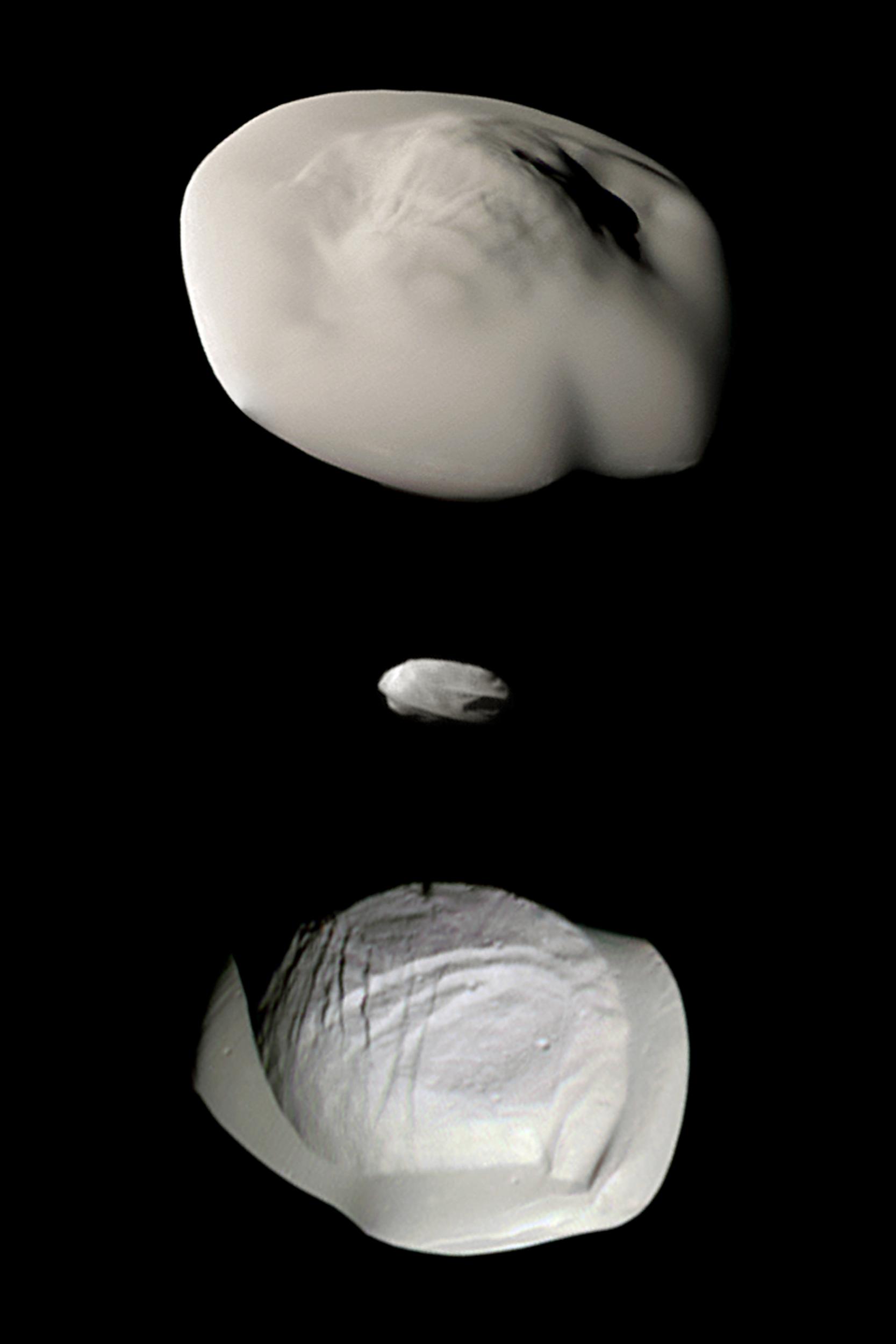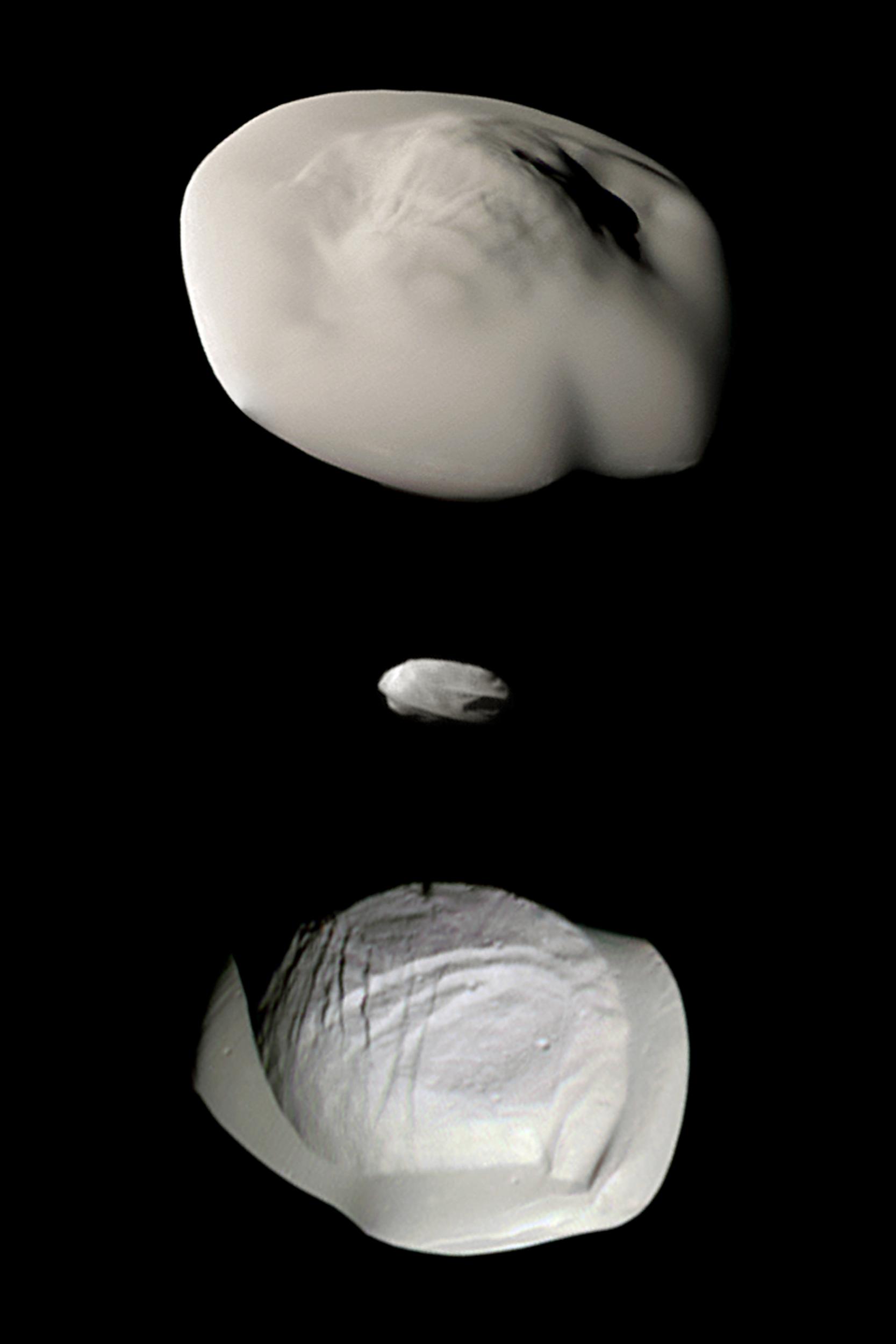
Atlas, Daphnis, and Pan are small, inner, ring moons of Saturn, shown at the same scale in this montage of images from the still Saturn-orbiting Cassini spacecraft. In fact, Daphnis was discovered in Cassini images from 2005. Atlas and Pan were first sighted in images from the Voyager 1 and 2 spacecraft. Flying saucer-shaped Atlas orbits near the outer edge of Saturn's bright A Ring while Daphnis orbits inside the A Ring's narrow Keeler Gap and Pan within the A Ring's larger Encke Gap. The curious equatorial ridges of the small ring moons could be built up by the accumulation of ring material over time. Even diminutive Daphnis makes waves in the ring material as it glides along the edge of the Keeler Gap.
Atlas, Daphnis y Pan son pequeños satélites interiores de los anillos de Saturno, mostrados a la misma escala en esta montaje de imágenes tomadas por la nave espacial Cassini, que aún orbita Saturno. De hecho, Daphnis fue descubierto en imágenes de Cassini de 2005. Atlas y Pan fueron observados por primera vez en imágenes tomadas por las naves espaciales Voyager 1 y 2. Atlas, con forma de platillo volador, orbita cerca del borde exterior del brillante Anillo A de Saturno, mientras que Daphnis orbita dentro del estrecho hueco Keeler del Anillo A, y Pan dentro del más amplio hueco Encke del Anillo A. Las curiosas crestas ecuatoriales de estos pequeños satélites podrían haberse formado por la acumulación de material de los anillos con el tiempo. Incluso el diminuto Daphnis genera ondas en el material de los anillos mientras se desliza a lo largo del borde del hueco Keeler.