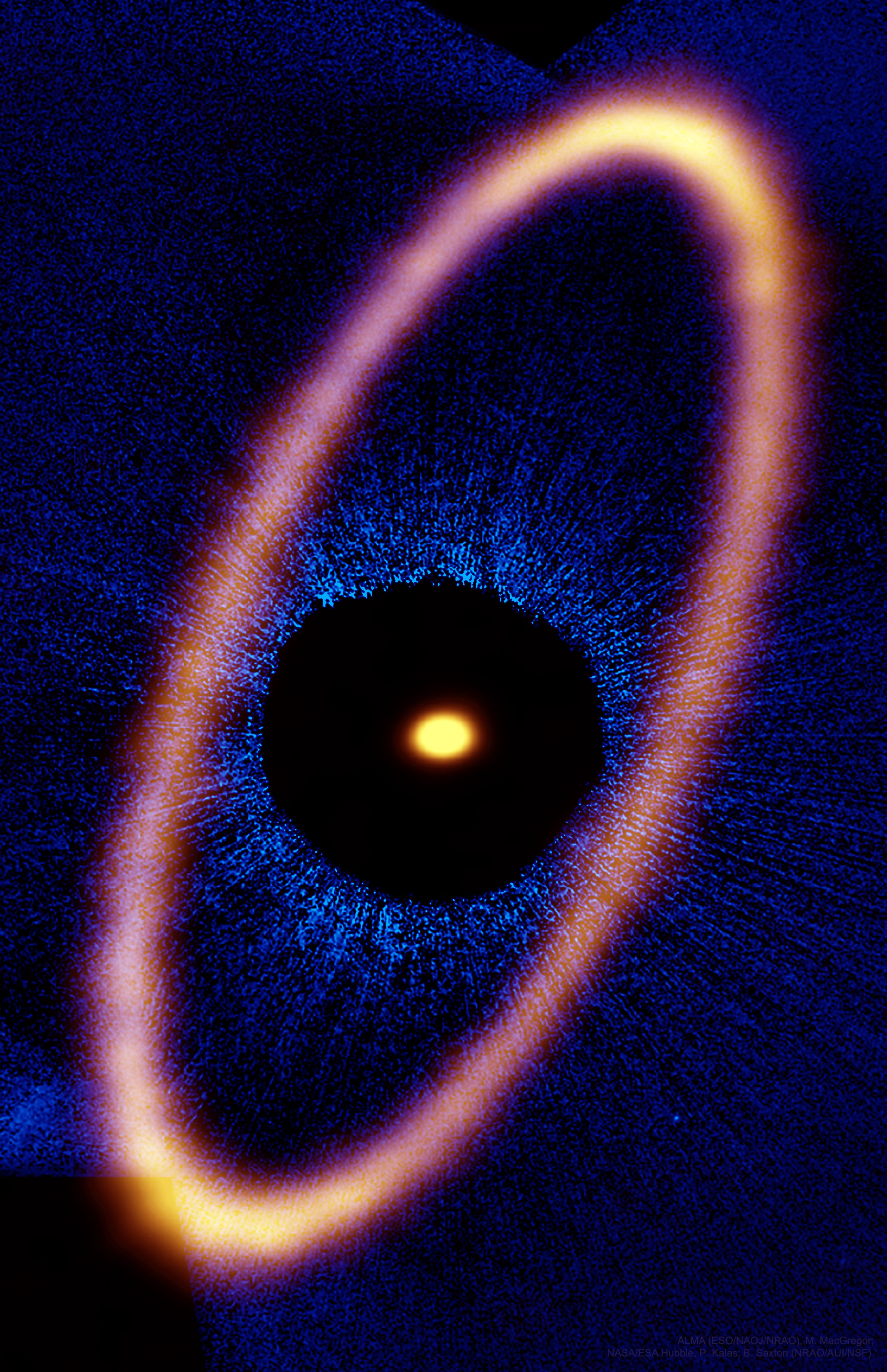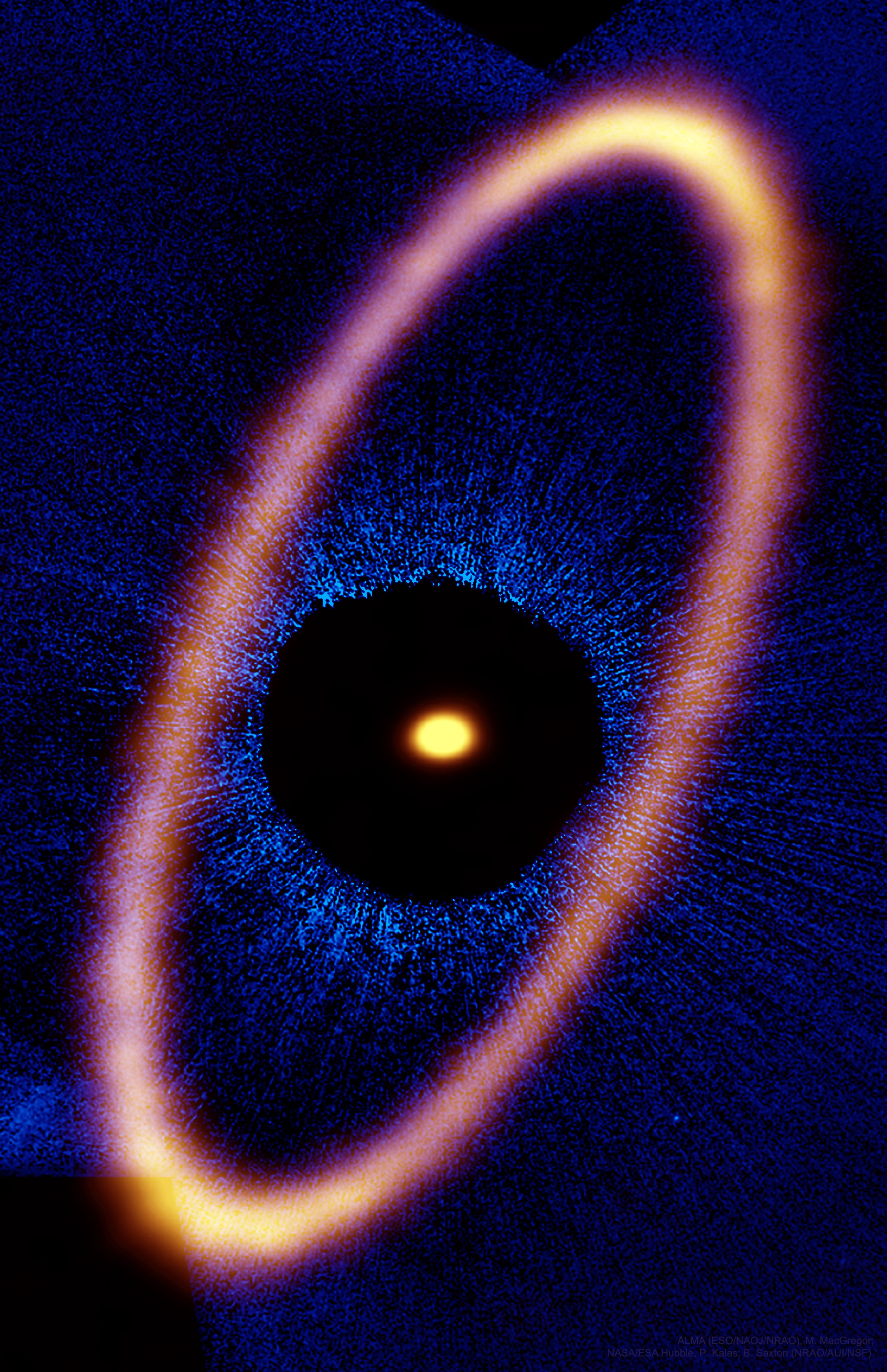
Why is there a large ice ring around Fomalhaut? This interesting star -- easily visible in the night sky -- lies only about 25 light-years away and is known to be orbited by at least one planet, Dagon, as well as several inner dust disks. More intriguing, perhaps, is an outer ring, first discovered about 20 years ago, that has an unusually sharp inner boundary. The featured recent image by the Atacama Large Millimeter Array (ALMA) shows this outer ring with complete and unprecedented detail -- in pink -- superposed on a Hubble image of the Fomalhaut system in blue. A leading theory holds that this ring resulted from numerous violent collisions involving icy comets and planetesimals, the component objects of planets, while the ring boundaries are caused by the gravity of yet unseen planets. If correct, any interior planets in the Fomalhaut system are likely being continually pelted by large meteors and comets -- an onslaught last seen in our own planetary system four billion years ago in an episode called the Late Heavy Bombardment. Free Download: The 2018 APOD Calendar
¿Por qué hay un gran anillo de hielo alrededor de Fomalhaut? Esta interesante estrella — fácilmente visible en el cielo nocturno — se encuentra a solo unos 25 años luz de distancia y se sabe que está orbitada por al menos un planeta, Dagon, así como por varios discos de polvo interiores. Lo más intrigante, quizás, es un anillo exterior, descubierto por primera vez hace aproximadamente 20 años, que tiene un límite interno inusualmente definido. La imagen reciente destacada por el Gran Observatorio Milimétrico de Atacama (ALMA) muestra este anillo exterior con un detalle completo y sin precedentes — en rosa — superpuesto sobre una imagen de Hubble del sistema Fomalhaut en azul. Una teoría principal sostiene que este anillo se originó a partir de numerosas colisiones violentas entre cometas helados y planetesimales, los objetos componentes de los planetas, mientras que los límites del anillo son causados por la gravedad de planetas aún no vistos. Si esta teoría es correcta, cualquier planeta interior en el sistema Fomalhaut probablemente está siendo constantemente bombardeado por grandes meteoros y cometas — una ofensiva que se vio por última vez en nuestro propio sistema planetario hace cuatro mil millones de años en un episodio conocido como la Bombardamiento Pesado Tardío.