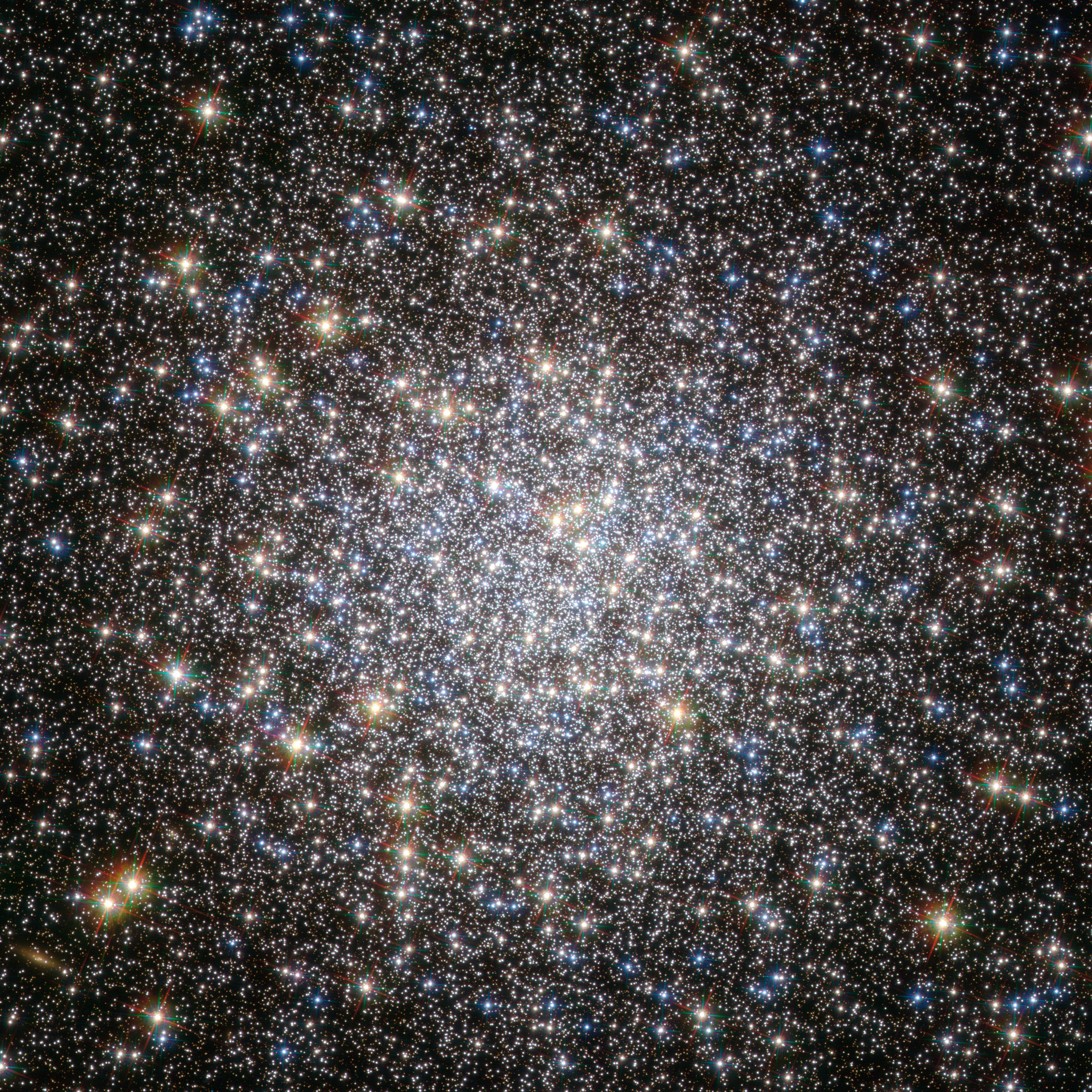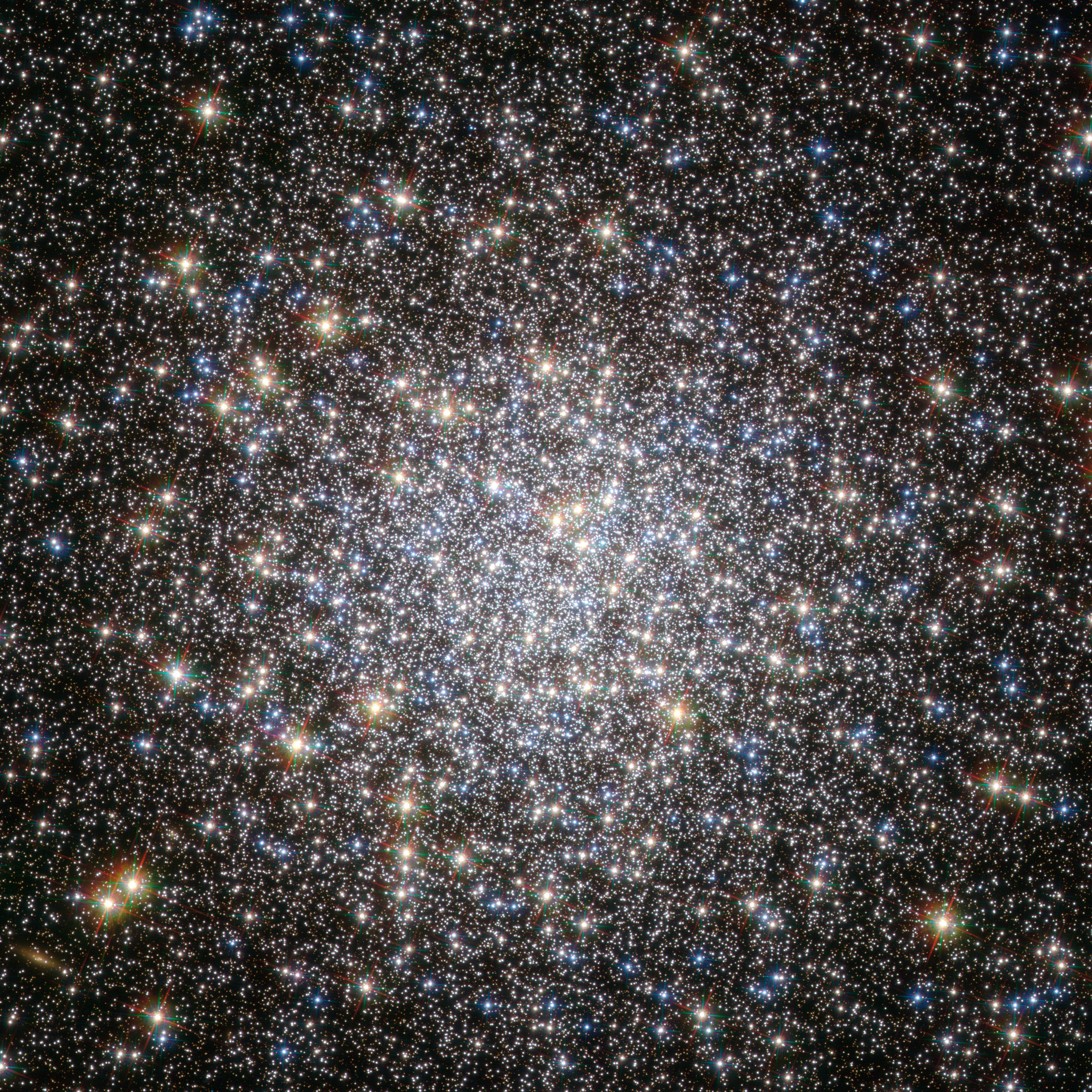
"Beautiful Nebula discovered between the Balance [Libra] & the Serpent [Serpens] ..." begins the description of the 5th entry in 18th century astronomer Charles Messier's famous catalog of nebulae and star clusters. Though it appeared to Messier to be fuzzy and round and without stars, Messier 5 (M5) is now known to be a globular star cluster, 100,000 stars or more, bound by gravity and packed into a region around 165 light-years in diameter. It lies some 25,000 light-years away. Roaming the halo of our galaxy, globular star clusters are ancient members of the Milky Way. M5 is one of the oldest globulars, its stars estimated to be nearly 13 billion years old. The beautiful star cluster is a popular target for Earthbound telescopes. Of course, deployed in low Earth orbit on April 25, 1990, the Hubble Space Telescope has also captured its own stunning close-up view that spans about 20 light-years across the central region of M5. Even close to its dense core the cluster's aging red and blue giant stars and rejuvenated blue stragglers stand out in yellow and blue hues in the sharp color image.
«Nebulosa hermosa descubierta entre la Balanza [Libra] y la Serpiente [Serpens]...» comienza la descripción de la quinta entrada en el famoso catálogo de nebulosas y cúmulos estelares del astrónomo del siglo XVIII Charles Messier. Aunque a Messier le parecía difusa, redonda y sin estrellas, Messier 5 (M5) es ahora conocido como un cúmulo estelar globular, compuesto por 100,000 estrellas o más, unidas por la gravedad y empaquetadas en una región de unos 165 años luz de diámetro. Se encuentra a unos 25,000 años luz de distancia. Navegando por el halo de nuestra galaxia, los cúmulos estelares globulares son miembros antiguos de la Vía Láctea. M5 es uno de los cúmulos globulares más antiguos, sus estrellas estimadas en casi 13,000 millones de años. El hermoso cúmulo estelar es un objetivo popular para telescopios terrestres. Por supuesto, el Telescopio Espacial Hubble, desplegado en órbita baja terrestre el 25 de abril de 1990, también ha capturado su propia imagen impactante que abarca aproximadamente 20 años luz en la región central de M5. Incluso cerca de su núcleo denso, las estrellas envejecidas de color rojo y azul y las rejuvenecidas estrellas estragglers azules destacan en tonos amarillos y azules en la imagen en color nítida.