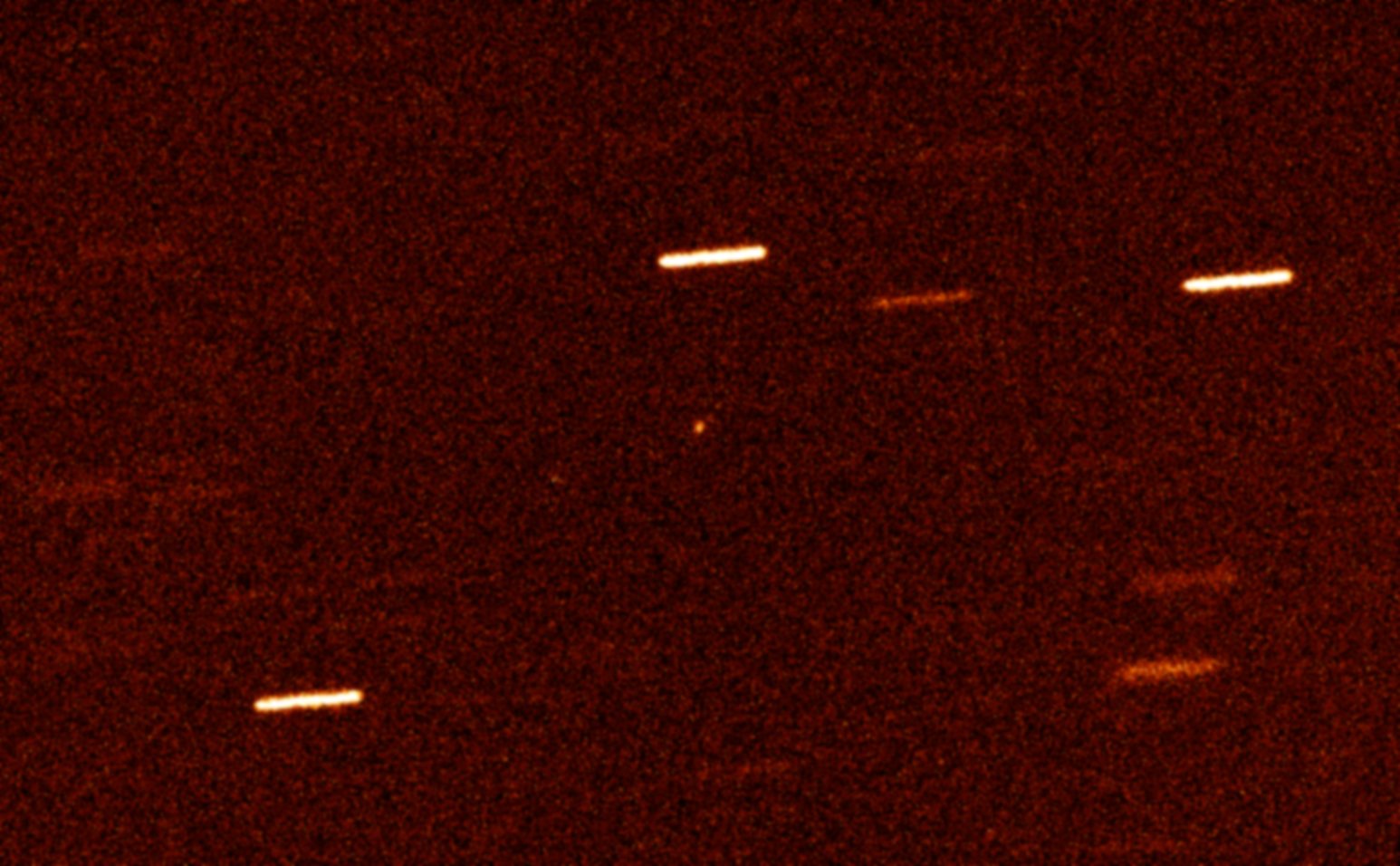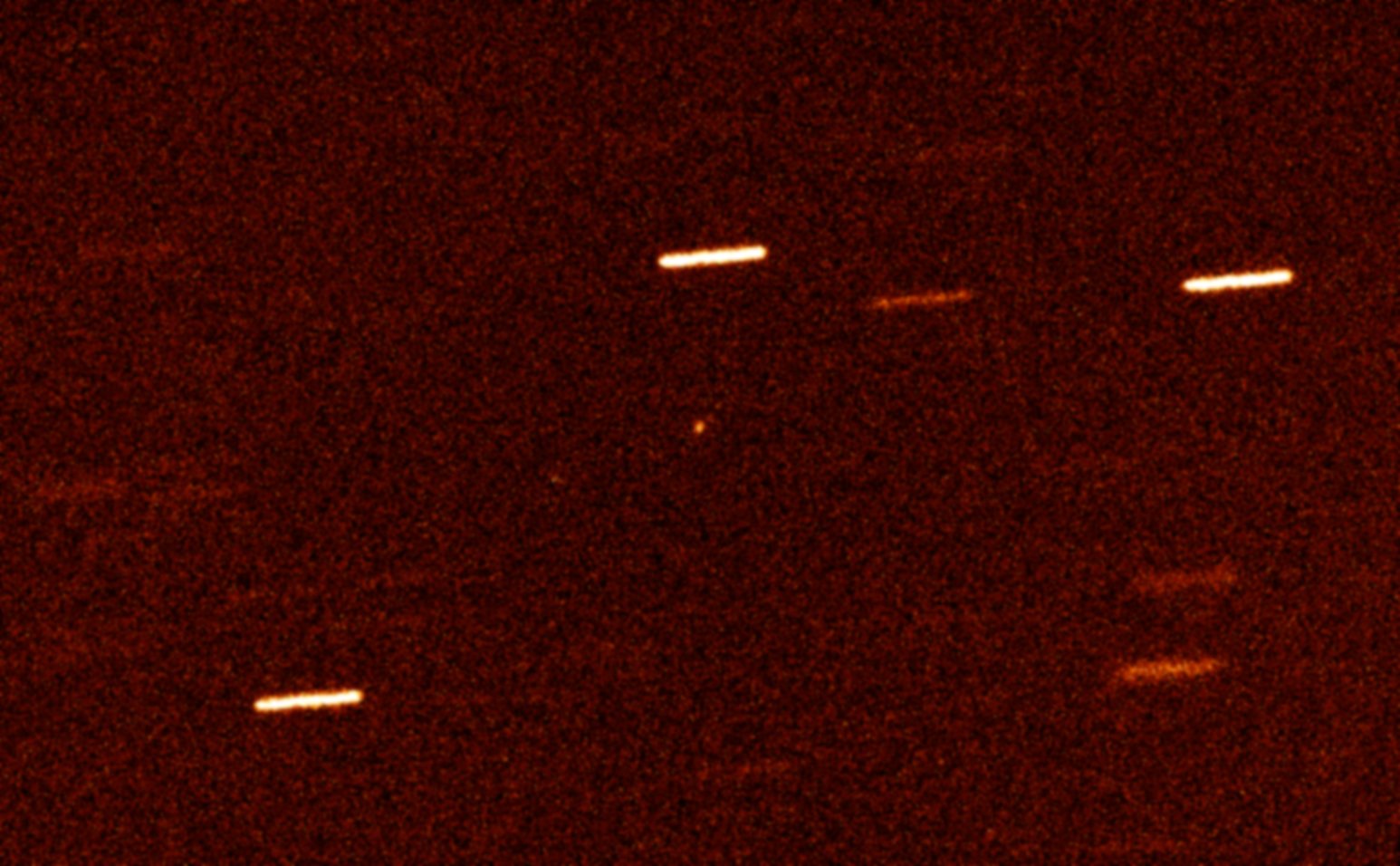
Traveling at high velocity along an extreme hyperbolic orbit and making a hairpin turn as it swung past the Sun, the now designated A/2017 U1 is the first known small body from interstellar space. A point of light centered in this 5 minute exposure recorded with the William Herschel Telescope in the Canary Islands on October 28, the interstellar visitor is asteroid-like with no signs of cometary activity. Faint background stars appear streaked because the massive 4.2 meter diameter telescope is tracking the rapidly moving A/2017 U1 in the field of view. Astronomer Rob Weryk (IfA) first recognized the moving object in nightly Pan-STARRS sky survey data on October 19. A/2017 is presently outbound, never to return to the Solar System, and already only visible from planet Earth in large optical telescopes. Though an interstellar origin has been established based on its orbit, it is still unknown how long the object could have drifted among the stars of the Milky Way. But its interstellar cruise speed would be about 26 kilometers per second. By comparison humanity's Voyager 1 spacecraft travels about 17 kilometers per second through interstellar space.
Viajando a alta velocidad a lo largo de una órbita hiperbólica extremadamente excéntrica y realizando una curva en forma de horquilla al pasar junto al Sol, el ahora designado A/2017 U1 es el primer cuerpo pequeño conocido proveniente del espacio interestelar. Un punto de luz centrado en esta exposición de 5 minutos capturada con el Telescopio William Herschel en las Islas Canarias el 28 de octubre, el visitante interestelar tiene características similares a las de un asteroide, sin señales de actividad cometaria. Las estrellas de fondo aparecen como rayas tenues porque el poderoso telescopio de 4,2 metros de diámetro está rastreando el rápido movimiento de A/2017 U1 en el campo visual. El astrónomo Rob Weryk (IfA) fue el primero en identificar el objeto en movimiento en los datos de la encuesta nocturna de Pan-STARRS el 19 de octubre. A/2017 actualmente se aleja del Sistema Solar, nunca para regresar, y ya solo es visible desde la Tierra mediante telescopios ópticos de gran tamaño. Aunque se ha establecido su origen interestelar basándose en su órbita, aún no se sabe cuánto tiempo podría haber estado errando entre las estrellas de la Vía Láctea. Sin embargo, su velocidad de crucero interestelar sería de aproximadamente 26 kilómetros por segundo. Por comparación, la nave espacial Voyager 1 de la humanidad viaja aproximadamente a 17 kilómetros por segundo a través del espacio interestelar.