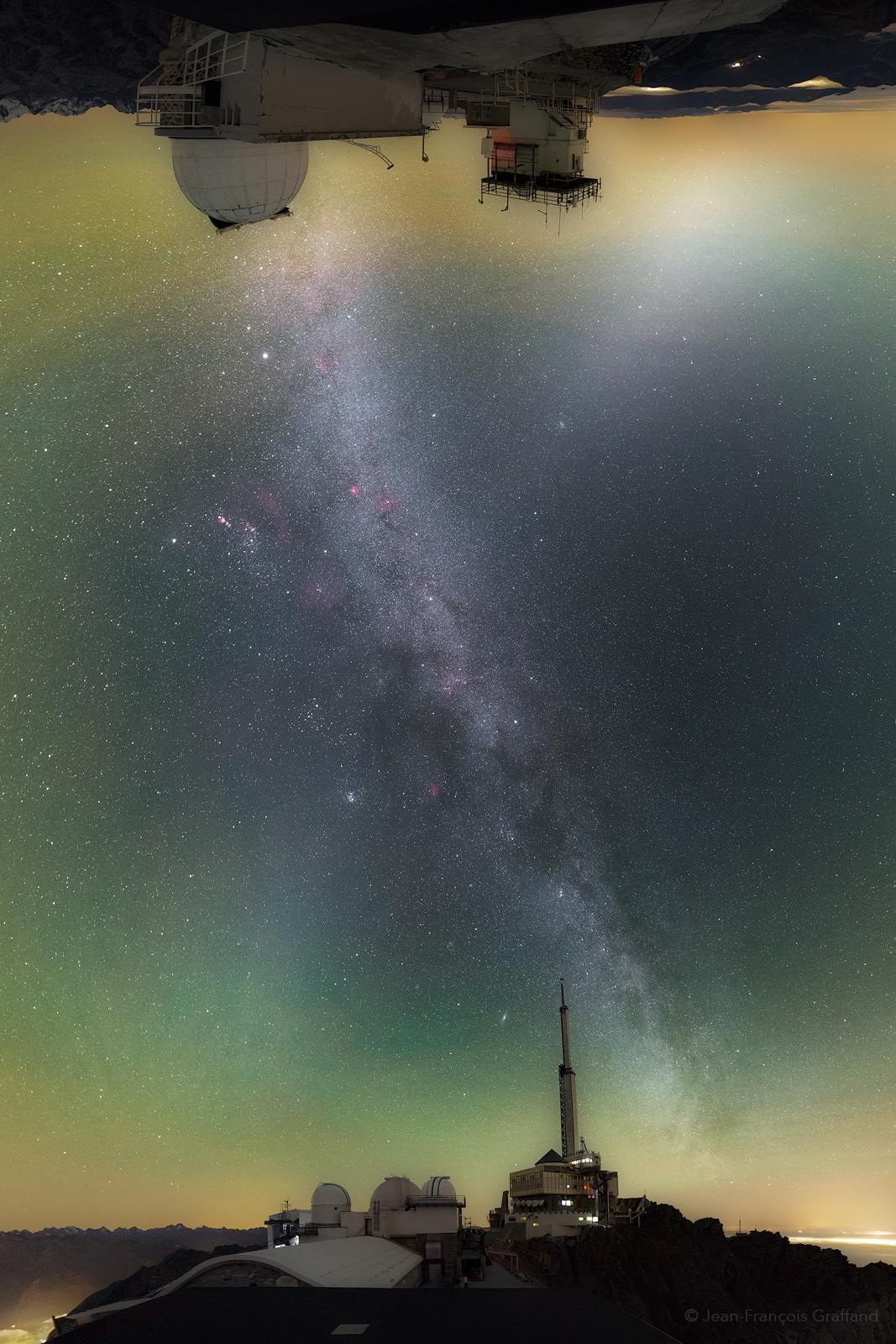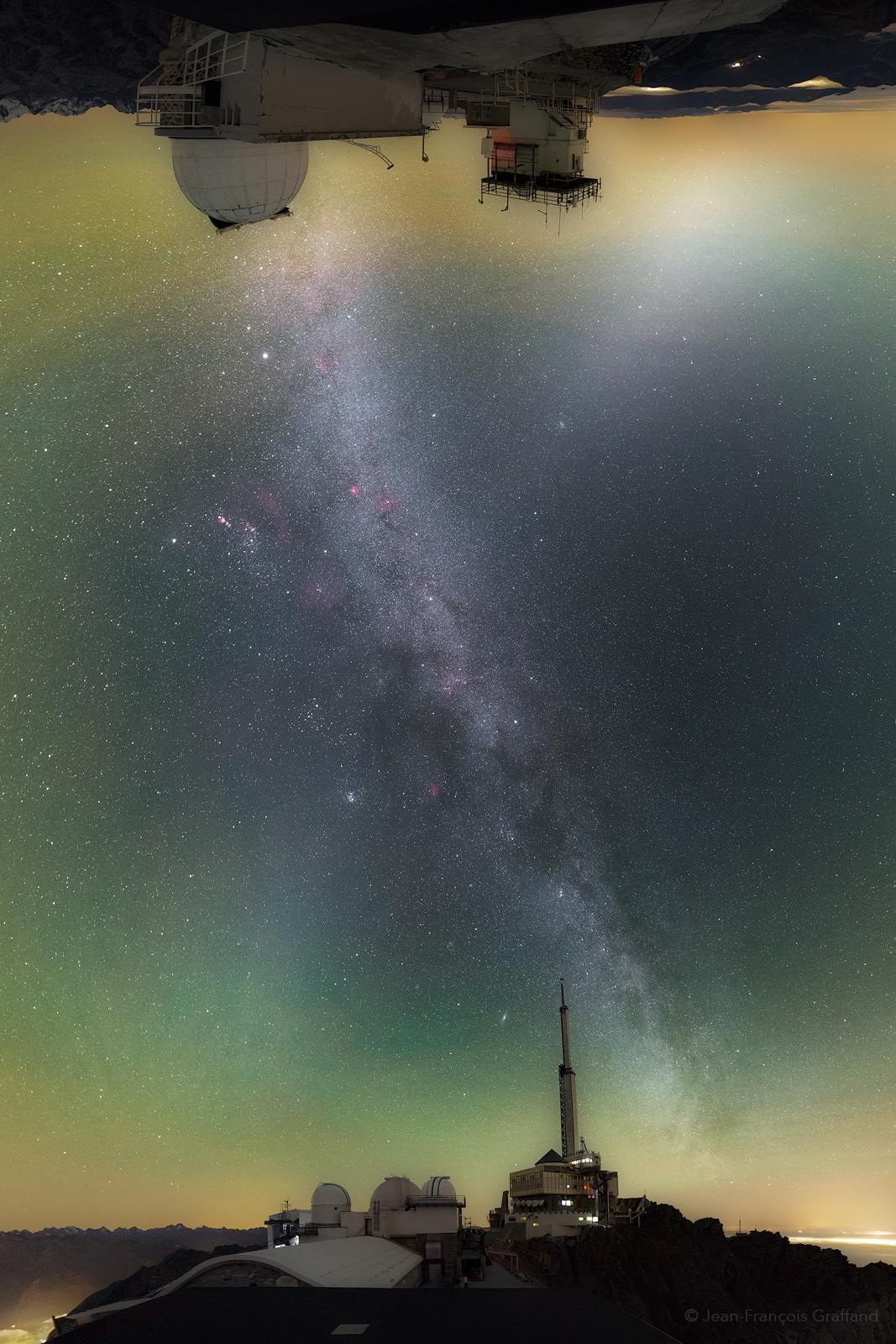
Follow this vertical panoramic view from horizon to horizon and your gaze will sweep through the zenith of a dark night sky over Pic du Midi mountaintop observatory. To make the journey above a sea of clouds, 19 single exposures were taken near the end of night on October 31 and assembled in a mercator projection that renders the two horizons flat. Begin at the top and you're looking east toward the upsidedown dome of the observatory's 1 meter telescope. It's easy to follow the plane of our Milky Way galaxy as it appears to emerge from the dome and angle down toward the far horizon. Just to its right, the sky holds a remarkable diffuse glow of zodiacal light along our Solar System's ecliptic plane. Zodiacal light and Milky Way with star clusters, cosmic dust clouds and faint nebulae, cross near the zenith. Both continue down toward the airglow in the west. They disappear near the western horizon at the bottom, beyond more Pic du Midi observatory domes and a tall communications relay antenna.
Siga esta vista panorámica vertical desde el horizonte hasta el otro horizonte y su mirada recorrerá el cenit de un cielo nocturno oscuro sobre el observatorio del Pic du Midi. Para realizar este viaje sobre una mar de nubes, se tomaron 19 exposiciones individuales al final de la noche del 31 de octubre y se montaron en una proyección mercator que representa los dos horizontes como planos. Comience por la parte superior y se encontrará mirando hacia el este, hacia el domo invertido del telescopio de 1 metro del observatorio. Es fácil seguir el plano de nuestra galaxia Vía Láctea, que parece surgir del domo y dirigirse hacia el horizonte distante. Justo a su derecha, el cielo contiene una notable luminosidad difusa de la luz zodiacal a lo largo del plano ecuatorial de nuestro sistema solar. La luz zodiacal y la Vía Láctea, junto con cúmulos estelares, nubes de polvo cósmico y nebulosas tenues, cruzan cerca del cenit. Ambas continúan descendiendo hacia la luminosidad atmosférica en el oeste. Desaparecen cerca del horizonte occidental en la parte inferior, más allá de otros domos del observatorio Pic du Midi y una alta antena de repetición de comunicaciones.