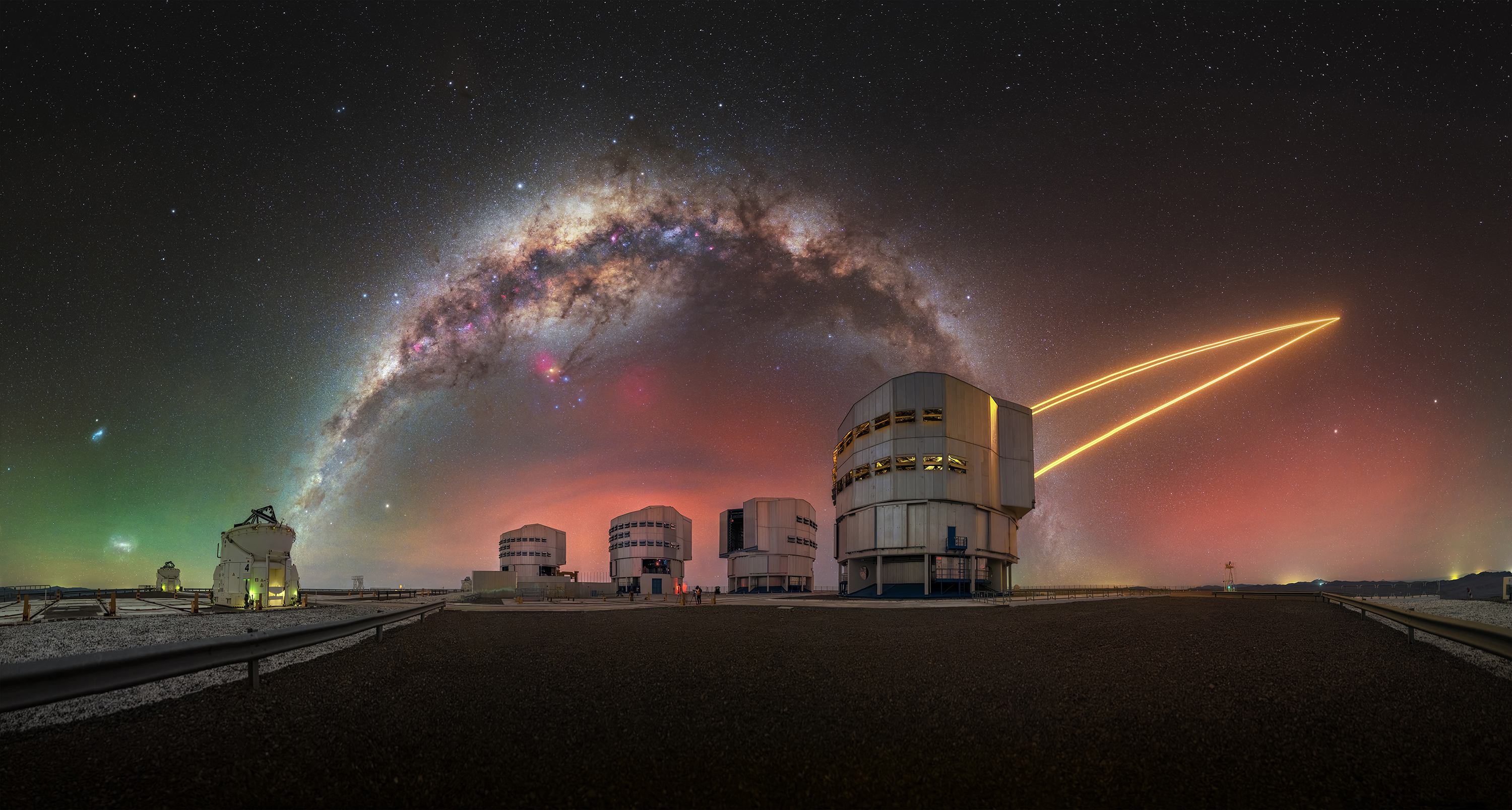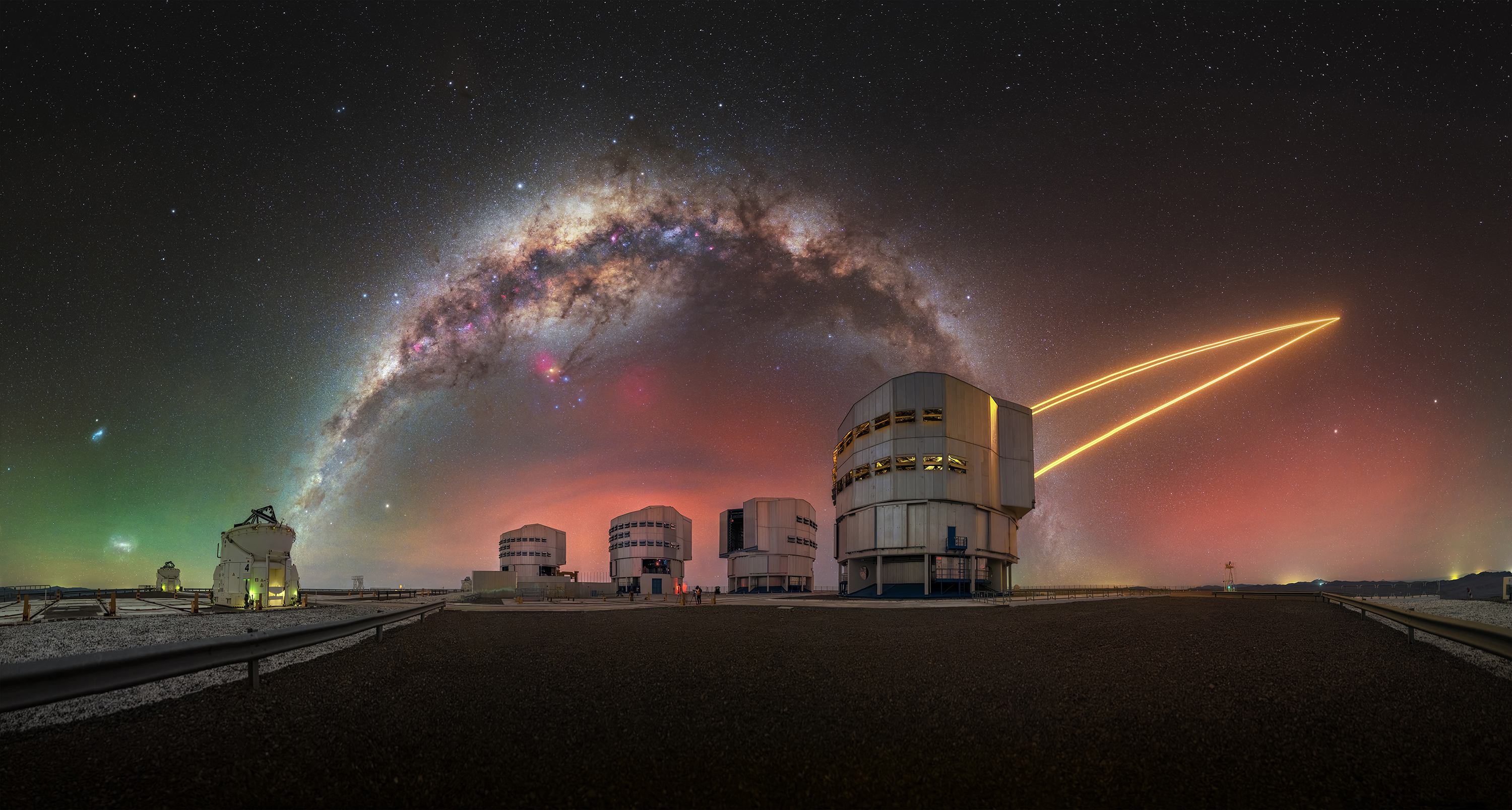
Are lasers from giant telescopes being used to defend the Earth? No. Lasers shot from telescopes are now commonly used to help increase the accuracy of astronomical observations. In some directions, Earth atmosphere-induced fluctuations in starlight can indicate how the air mass over a telescope is changing, but in other directions, no bright star exists. In these directions, astronomers can create an artificial star with a laser. Subsequent observations of the artificial laser guide star can reveal information so detailed about the changing blurring effects of the Earth's atmosphere that much of it can be removed by rapidly flexing a telescope's mirror. Such adaptive optics techniques allow high-resolution ground-based observations of real stars, planets, and nebulas. Pictured here, telescopes at Paranal Observatory in Chile study a colorful sky filled with green airglow and the Magellanic Clouds on the left, red airglow on the right, and the majestic central band of our Milky Way Galaxy arching across the center.
¿Se usan láseres de telescopios gigantes para defender la Tierra? No. Los láseres disparados desde telescopios se utilizan ahora comúnmente para aumentar la precisión de las observaciones astronómicas. En algunas direcciones, las fluctuaciones inducidas por la atmósfera terrestre en la luz de las estrellas pueden indicar cómo está cambiando la masa de aire sobre un telescopio, pero en otras direcciones, no existe una estrella brillante. En estas direcciones, los astrónomos pueden crear una estrella artificial con un láser. Las observaciones posteriores de la estrella guía láser artificial pueden revelar información tan detallada sobre los efectos cambiantes de desenfoque de la atmósfera terrestre que gran parte de ellos puede eliminarse flexionando rápidamente el espejo del telescopio. Técnicas de óptica adaptativa como estas permiten observaciones de alta resolución desde el suelo de estrellas reales, planetas y nebulosas. En la imagen de hoy, los telescopios del Observatorio de Paranal en Chile estudian un cielo colorido lleno de brillo atmosférico verde a la izquierda, brillo atmosférico rojo a la derecha, y la majestuosa banda central de nuestra Galaxia Vía Láctea arqueándose por el centro.