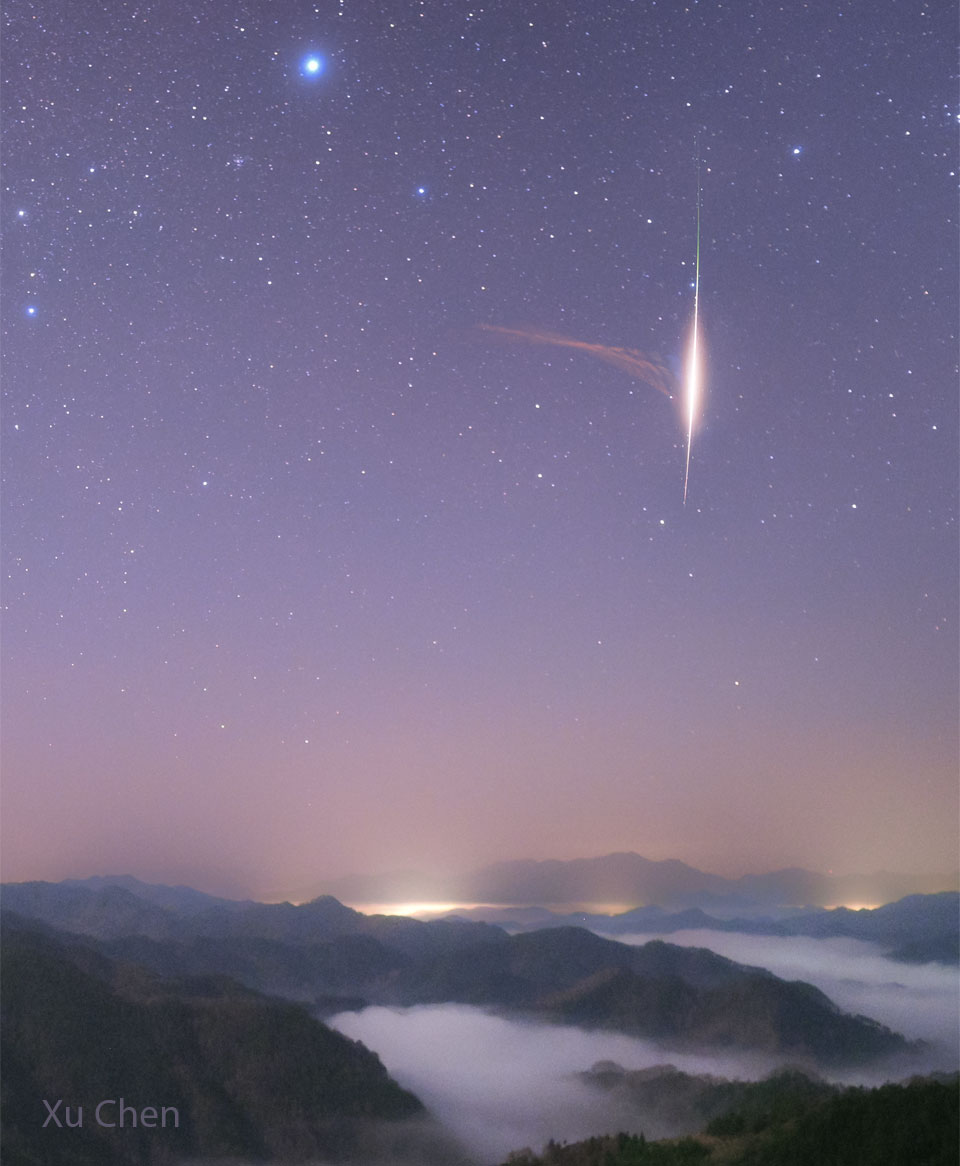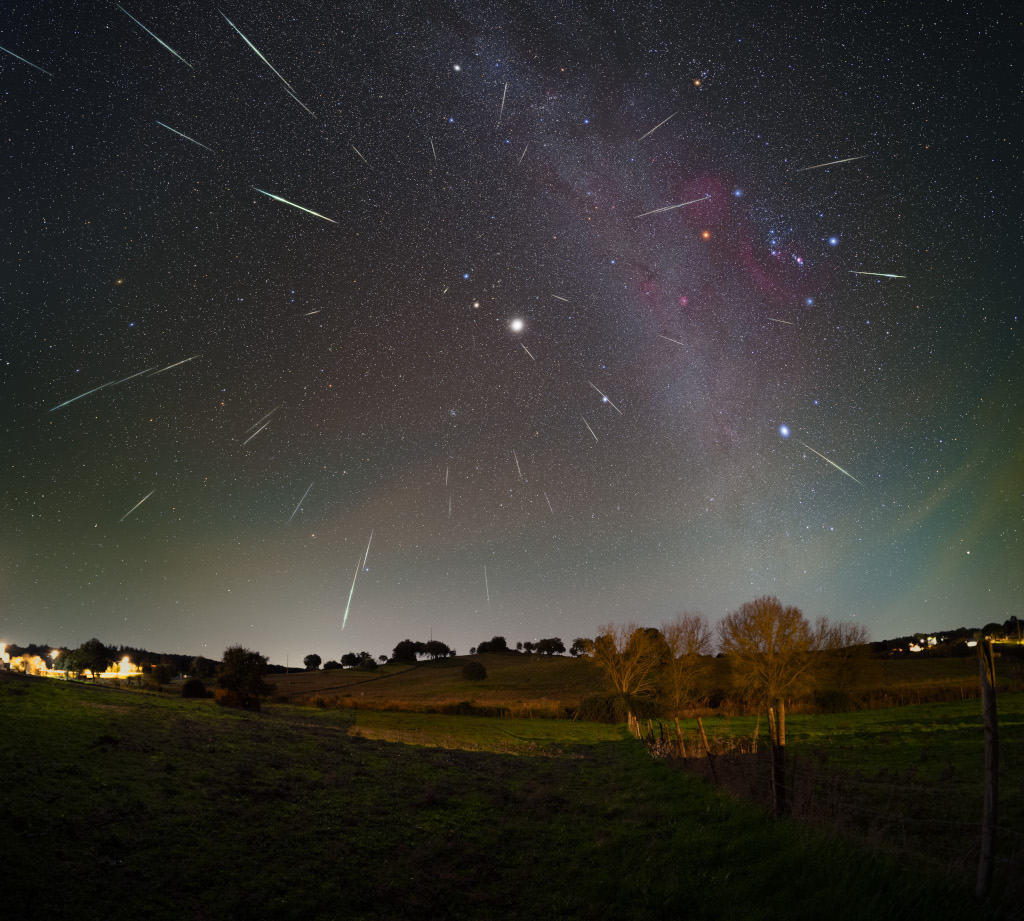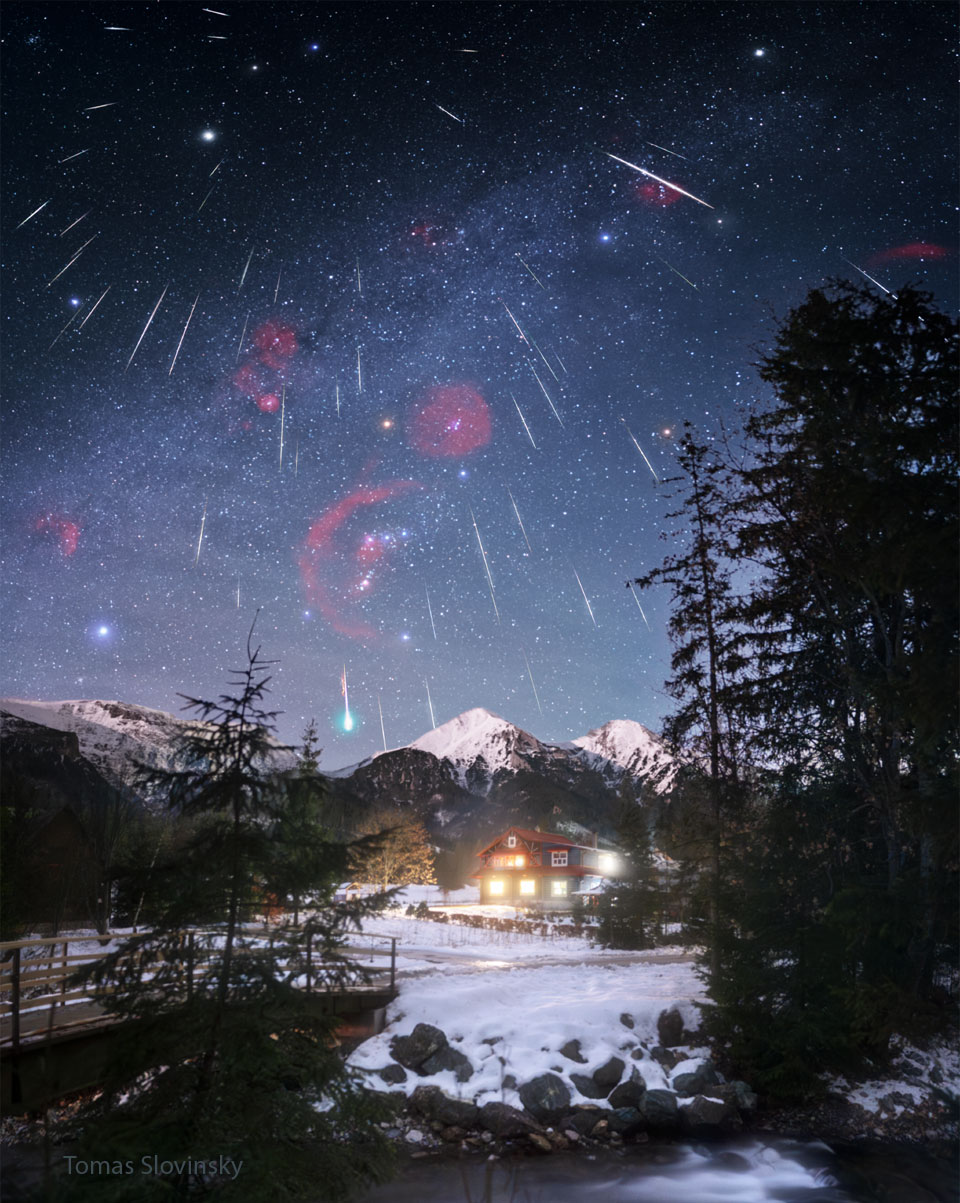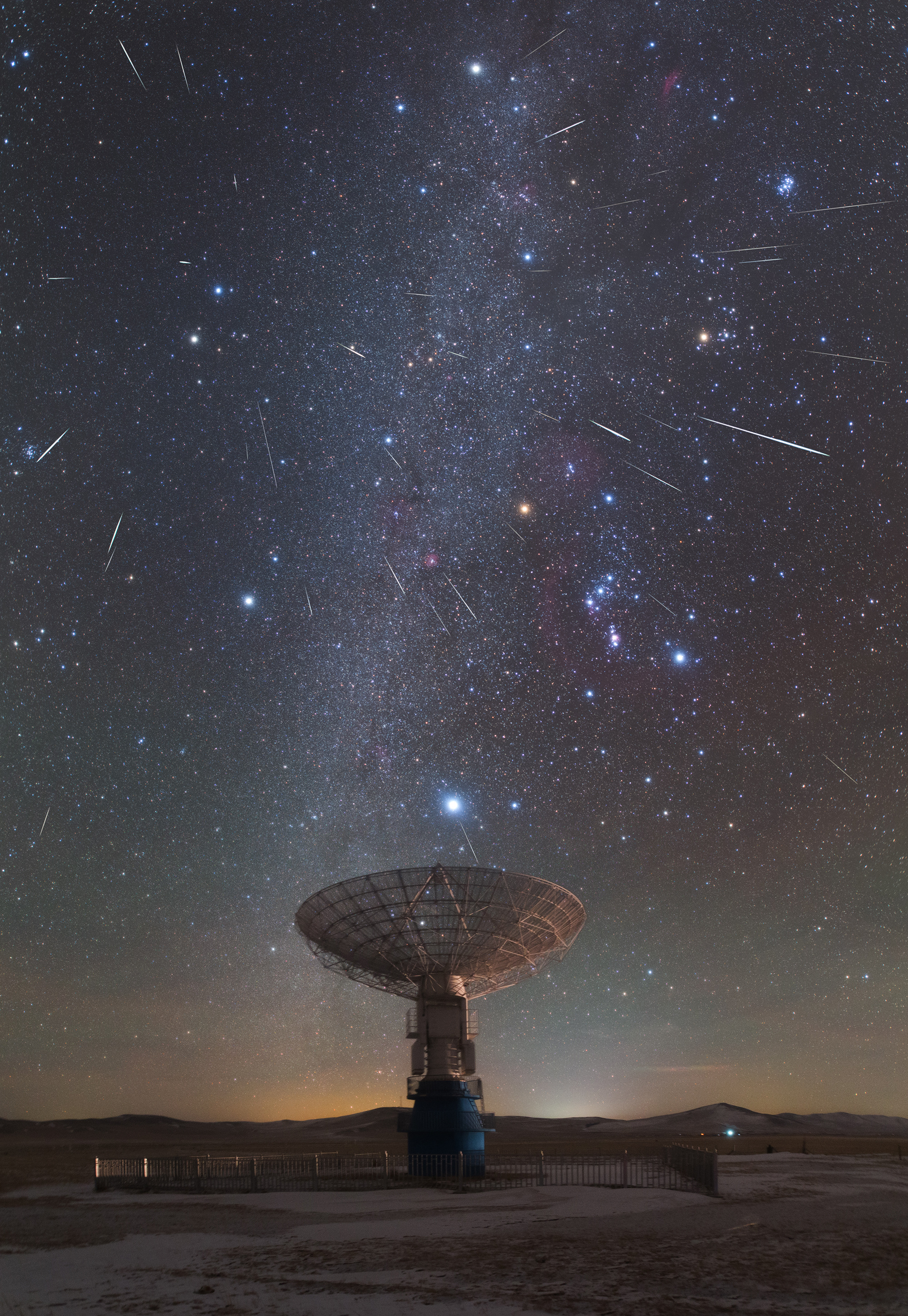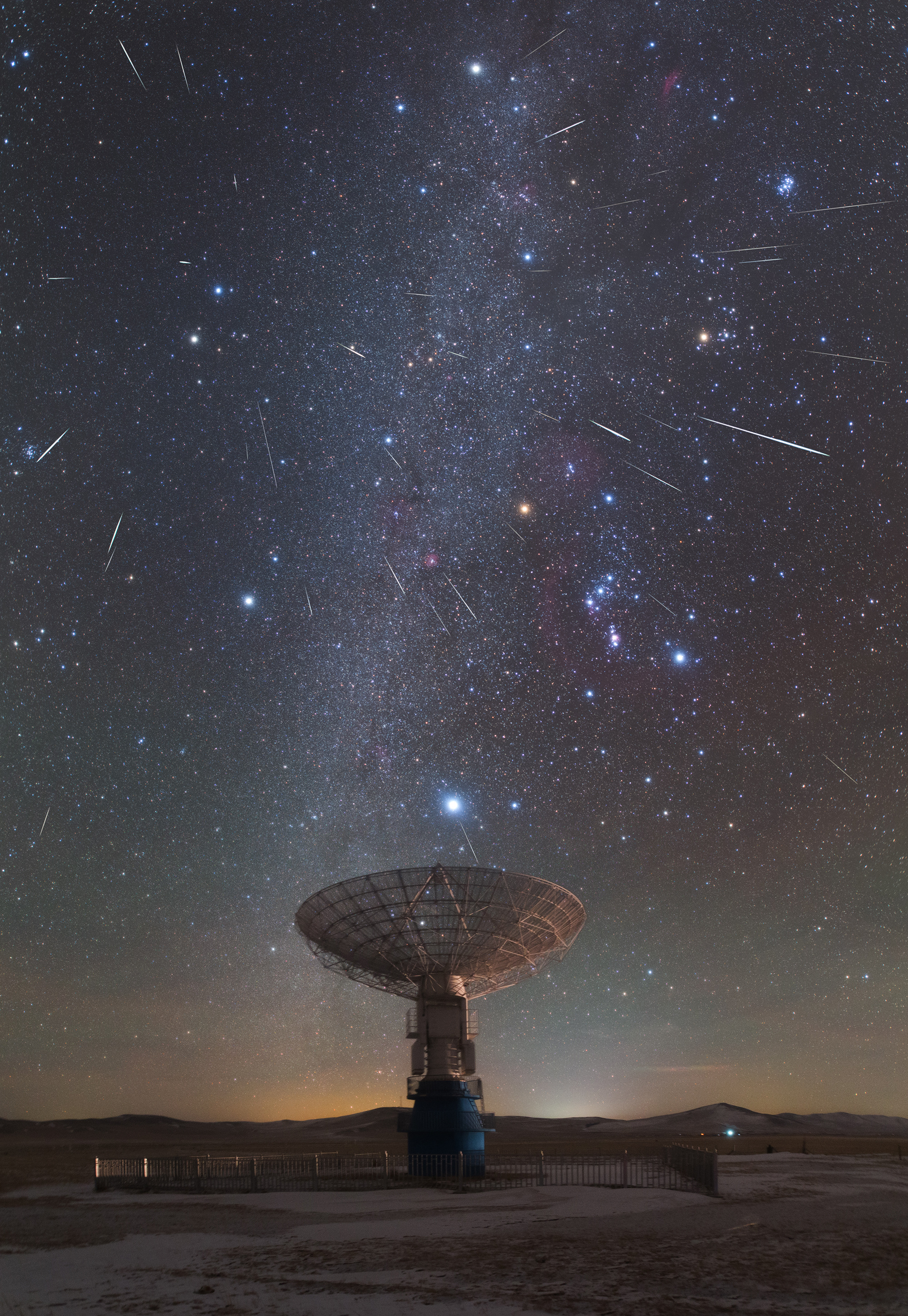
rth's annual Geminid meteor shower did not disappoint as our fair planet plowed through dust from active asteroid 3200 Phaethon. Captured in this northern hemisphere nightscape, the meteors stream away from the shower's radiant in Gemini. To create the image, 37 individual frames recording meteor streaks were taken over period of 8.5 hours during the night of December 12/13. In the final composite they were selected and registered against the starry sky above a radio telescope dish of MUSER, a solar-dedicated radio telescope array at astronomically-named Mingantu Station in Inner Mongolia, China, about 400 kilometers from Beijing. Sirius, alpha star of Canis Major, shines brightly just above the radio dish and the Milky Way stretches toward the zenith. Yellowish Betelgeuse is a standout in Orion to the right of the northern Milky Way. The shower's radiant is at top left, high above the horizon near Castor and Pollux the twin stars of Gemini. The radiant effect is due to perspective as the parallel meteor tracks appear to converge in the distance. Gemini's meteors enter Earth's atmosphere traveling at about 22 kilometers per second. Submitted to APOD: Best images (so far) of the Geminid Meteor Shower 2017.
La lluvia de meteoros anual de los Geminidos no decepcionó al atravesar nuestro planeta la polvora procedente del asteroide activo 3200 Phaethon. Capturada en este paisaje nocturno del hemisferio norte, los meteoros se alejan del punto radiante de la lluvia en Géminis. Para crear la imagen, se tomaron 37 marcos individuales que registraron las trayectorias de los meteoros durante un período de 8,5 horas durante la noche del 12/13 de diciembre. En la composición final, se seleccionaron y registraron contra el cielo estrellado sobre el plato de una antena de radio de MUSER, una instalación dedicada a la radioastronomía en la estación astronómicamente nombrada de Mingantu, en la Inner Mongolia, China, aproximadamente a 400 kilómetros de Pekín. Sirio, la estrella alfa de Canis Major, brilla intensamente justo por encima del plato de radio y la Vía Láctea se extiende hacia el cenit. Betelgeuse, de color amarillento, destaca en Orión, a la derecha de la Vía Láctea del norte. El punto radiante de la lluvia se encuentra en la parte superior izquierda, alto sobre el horizonte cerca de Castor y Pollux, las dos estrellas gemelas de Géminis. El efecto del punto radiante se debe a la perspectiva, ya que las trayectorias paralelas de los meteoros parecen converger a lo lejos. Los meteoros de Géminis entran en la atmósfera terrestre viajando a aproximadamente 22 kilómetros por segundo.