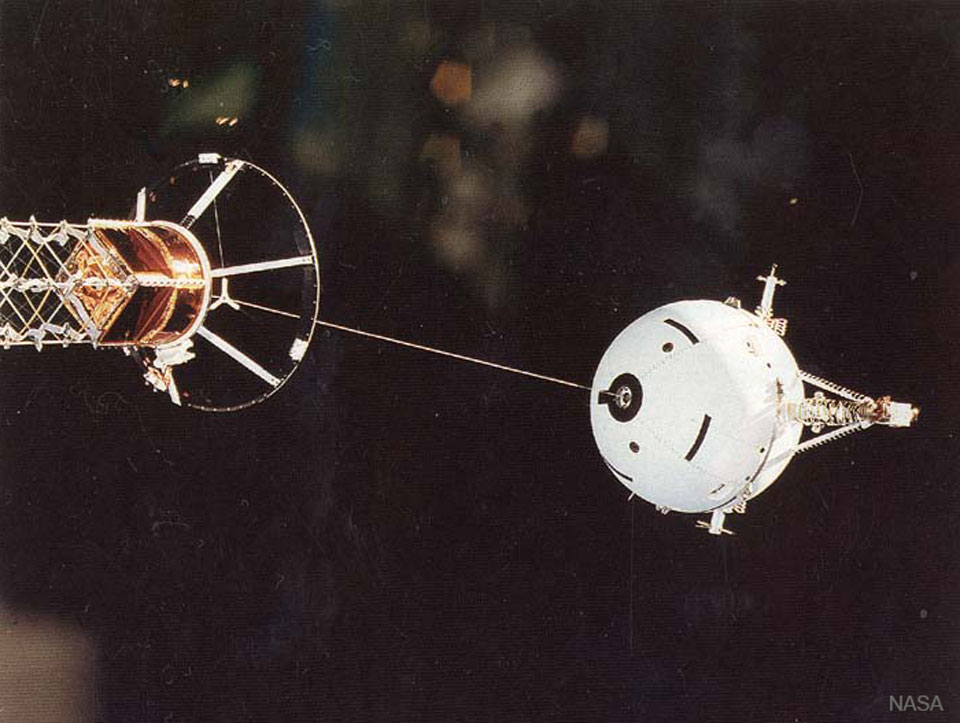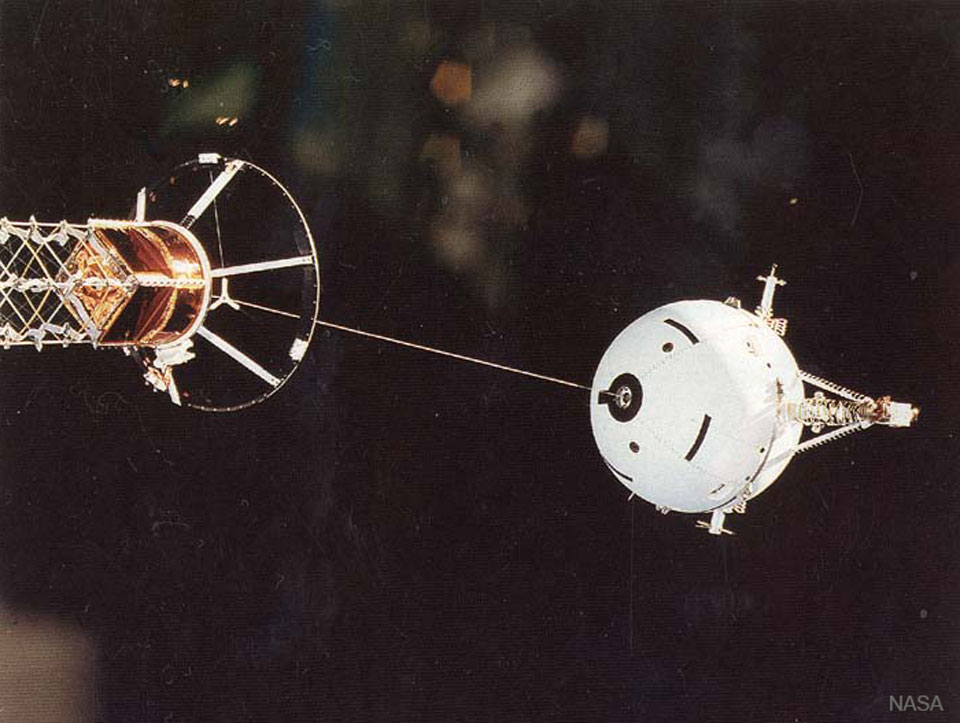
One of the greatest unrequited legends of outer space is the tether. Tethers, long strands of material, hold the promise of stabilizing satellites, generating electricity, and allowing easy transportation. Possibly the most ambitious vision of the space tether is the space elevator popularized by Arthur C. Clarke, where a tether is constructed that connects the ground to geosynchronous orbit. One problem is strength - it is difficult to make a long useful tether that does not snap. Pictured here is the deployment of the Tethered Satellite System 1 (TSS-1) by the space shuttle Altantis in 1992. Like other tested tethers, TSS-1 failed to live up to its promise, although many valuable lessons were learned. Free APOD Lecture: January 9 in DC
Una de las leyendas más deseadas pero no correspondidas del espacio exterior es la de las cuerdas. Las cuerdas, largos hilos de material, prometen estabilizar satélites, generar electricidad y permitir un transporte sencillo. Posiblemente la visión más ambiciosa de la cuerda espacial es el ascensor espacial popularizado por Arthur C. Clarke, donde se construye una cuerda que conecta la tierra con la órbita geoestacionaria. Un problema es la resistencia - es difícil fabricar una cuerda útil larga que no se rompa. En la imagen se muestra el despliegue del Sistema de Satélite Apretado 1 (TSS-1) por el transbordador espacial Atlantis en 1992. Al igual que otras cuerdas probadas, el TSS-1 no cumplió con sus promesas, aunque se aprendieron muchas lecciones valiosas.