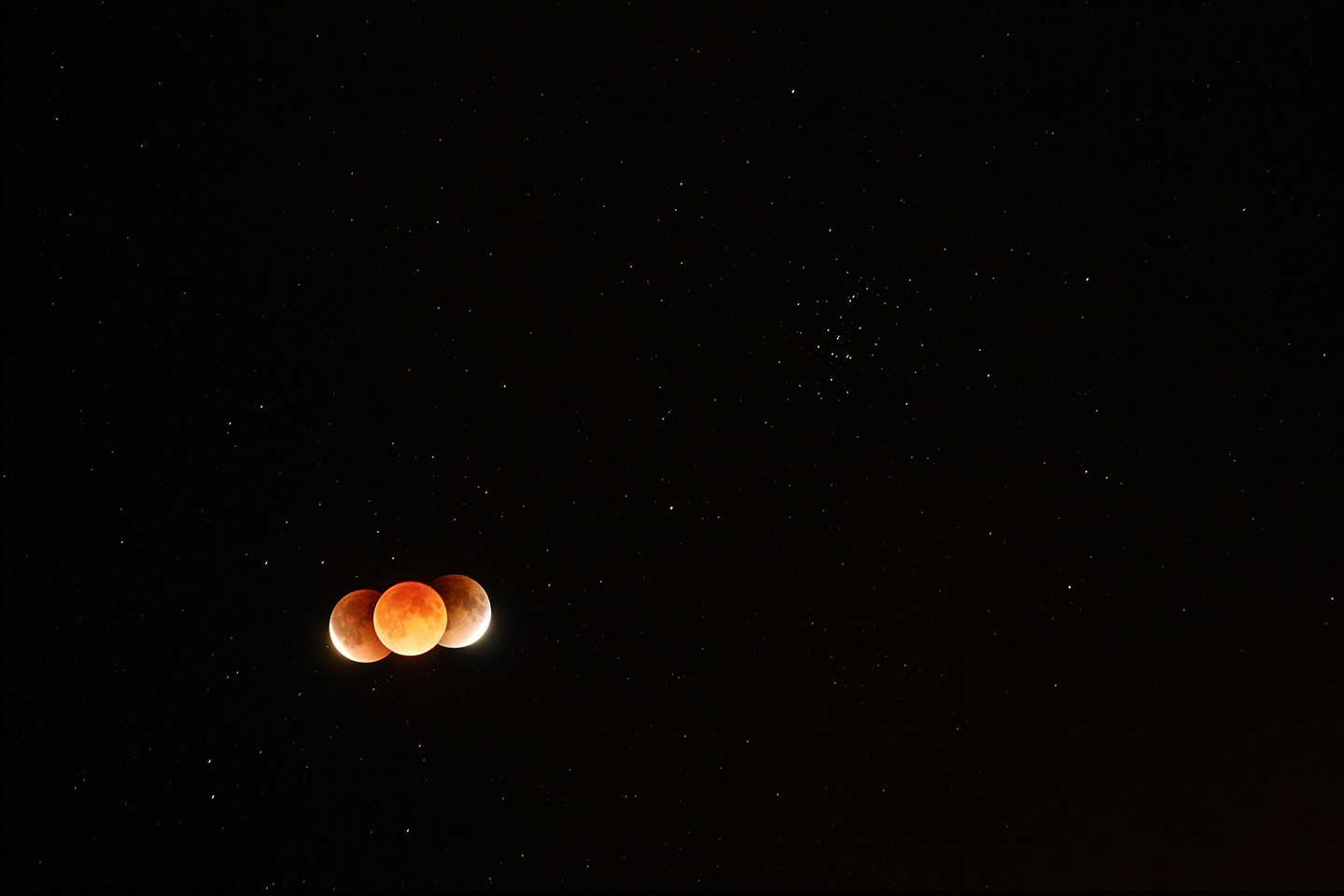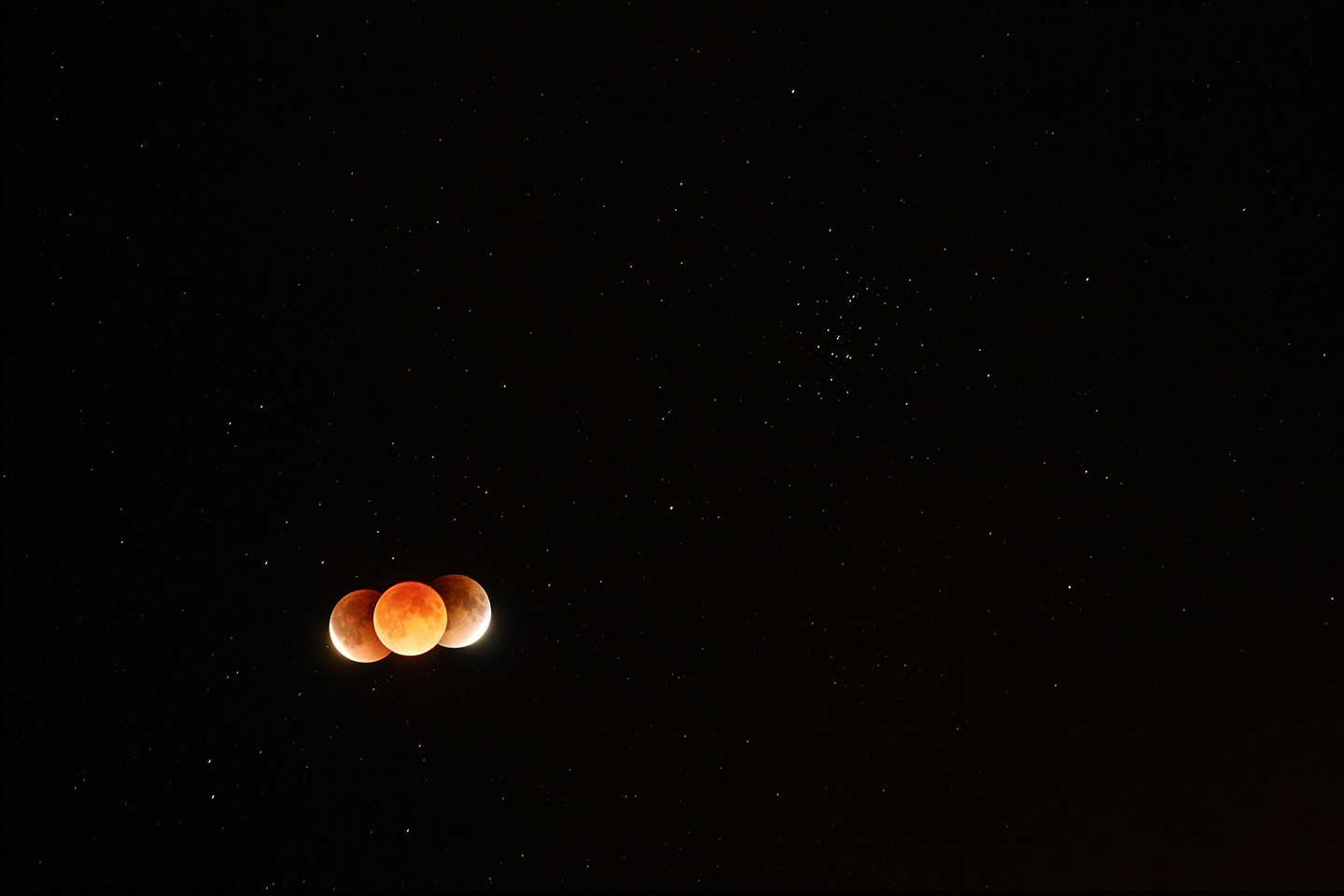
The Earth's dark umbral shadow is shaped like a cone extending into space. Of course its circular cross section at the distance of the Moon is more easily seen during a lunar eclipse. In fact, in this composite telephoto image from Earth's night side on January 31, the Earth's shadow has taken on a reddish tinge. The extent of the shadow along the lunar orbit is illustrated by aligning three frames taken just before the start, near the middle of, and just after the end of the total eclipse phase that lasted about 76 minutes. At the upper right and more easily seen during the eclipse's darker total phase is M44, one of the closest large star clusters. A mere 600 light-years away, M44 is also known as the Praesepe or the Beehive Cluster.
La oscura sombra umbral de la Tierra tiene forma de cono que se extiende hacia el espacio. Por supuesto, su sección circular a la distancia de la Luna es más fácil de ver durante un eclipse lunar. De hecho, en esta imagen compuesta tomada desde el lado nocturno de la Tierra el 31 de enero, la sombra terrestre adquirió un tono rojizo. El alcance de la sombra a lo largo de la órbita lunar se ilustra alineando tres imágenes tomadas justo antes del inicio, cerca del medio y justo después del final de la fase de eclipse total, que duró aproximadamente 76 minutos. En la parte superior derecha y más fácilmente visible durante la fase total más oscura del eclipse se encuentra M44, uno de los cúmulos estelares más cercanos y grandes. A solo 600 años luz de distancia, M44 también se conoce como Praesepe o el Cúmulo de la Colmena.