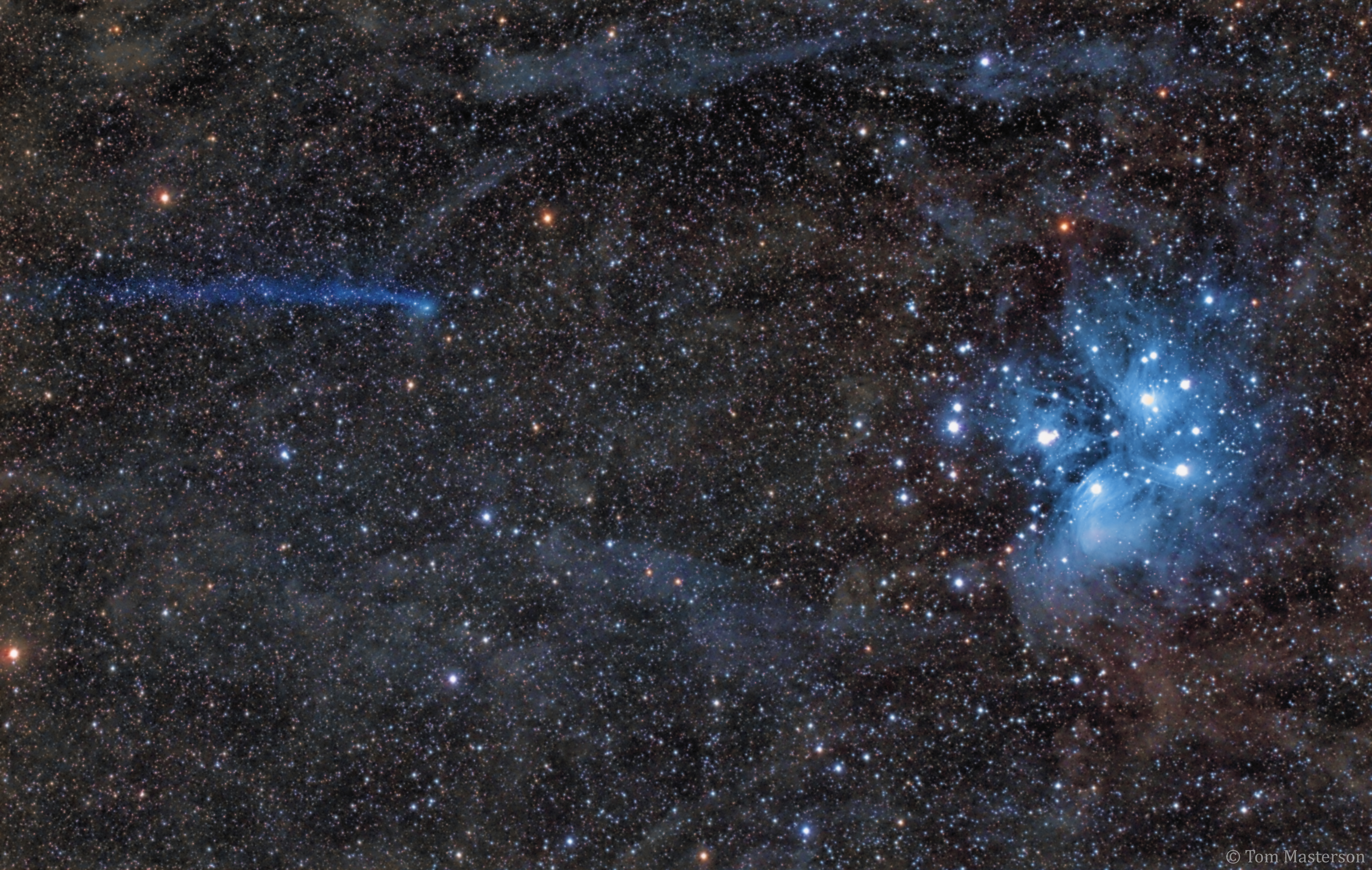
What's that heading for the Pleiades star cluster? It appears to be Comet C/2016 R2 (PanSTARRS), but here, appearances are deceiving. On the right and far in the background, the famous Pleiades star cluster is dominated by blue light from massive young stars. On the left and visiting the inner Solar System is Comet PanSTARRS, a tumbling block of ice from the outer Solar System that currently sports a long ion tail dominated by blue light from an unusually high abundance of ionized carbon monoxide. Comet PanSTARRS is actually moving toward the top of the image, and its ion tail points away from the Sun but is affected by a complex solar wind of particles streaming out from the Sun. Visible through a small telescope, the comet is fading as it recedes from the Earth, even though it reaches its closest point to the Sun in early May.
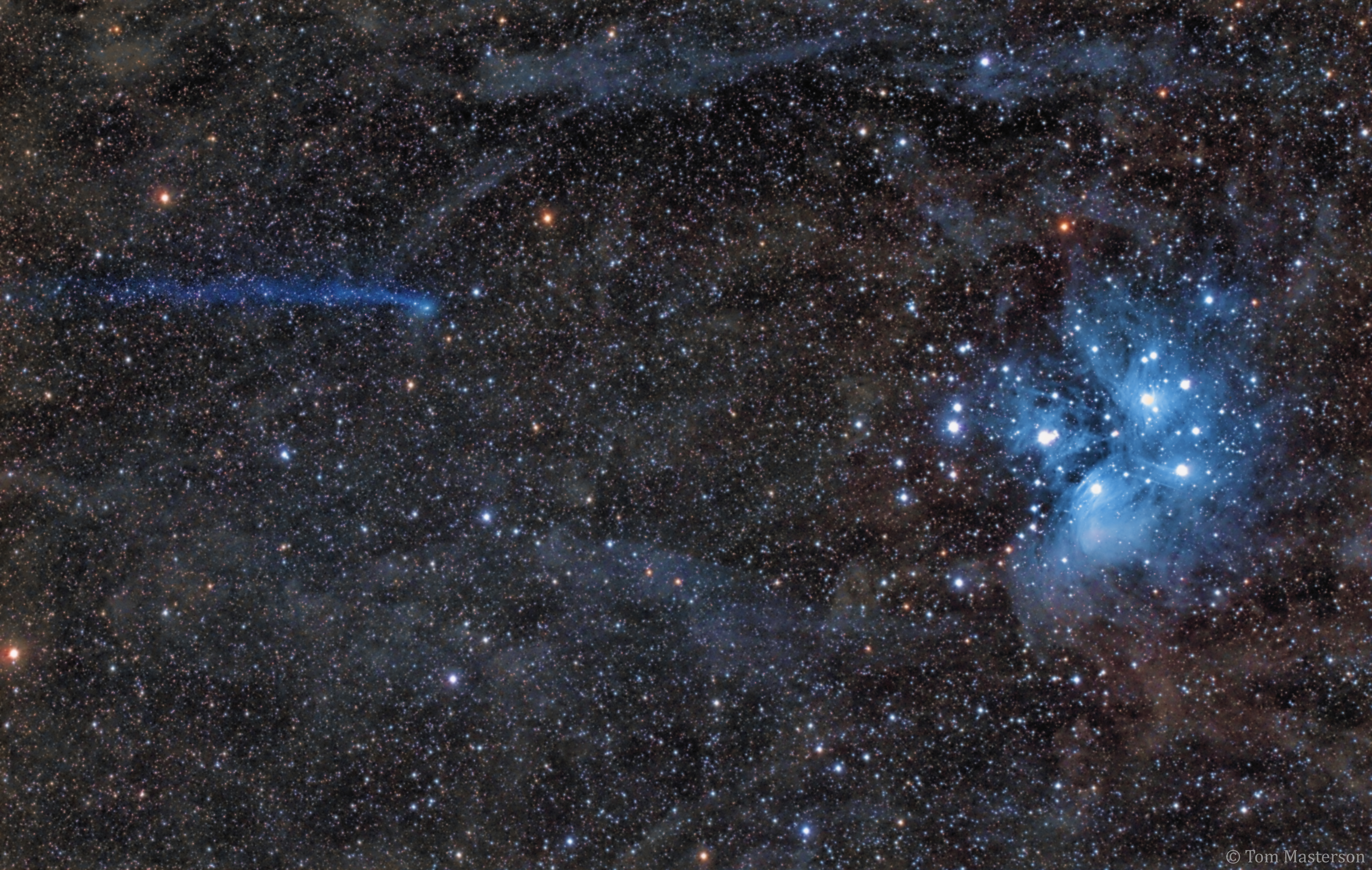
¿Qué se dirige hacia el cúmulo estelar de las Pléyades? Aparentemente es el cometa C/2016 R2 (PanSTARRS), pero aquí, las apariencias engañan. A la derecha y en el fondo lejano, el famoso cúmulo de las Pléyades es dominado por la luz azul de estrellas jóvenes y masivas. A la izquierda y visitando el sistema solar interior, está el cometa PanSTARRS, un bloque giratorio de hielo del sistema solar exterior que actualmente tiene una larga cola iónica dominada por luz azul proveniente de una inusualmente alta abundancia de monóxido de carbono ionizado. El cometa PanSTARRS se está realmente moviendo hacia la parte superior de la imagen, y su cola iónica apunta alejándose del Sol, pero es afectada por un complejo viento solar de partículas que fluyen desde el Sol. Visible a través de un telescopio pequeño, el cometa se está desvaneciendo a medida que se aleja de la Tierra, aunque alcanzará su punto más cercano al Sol a principios de mayo.