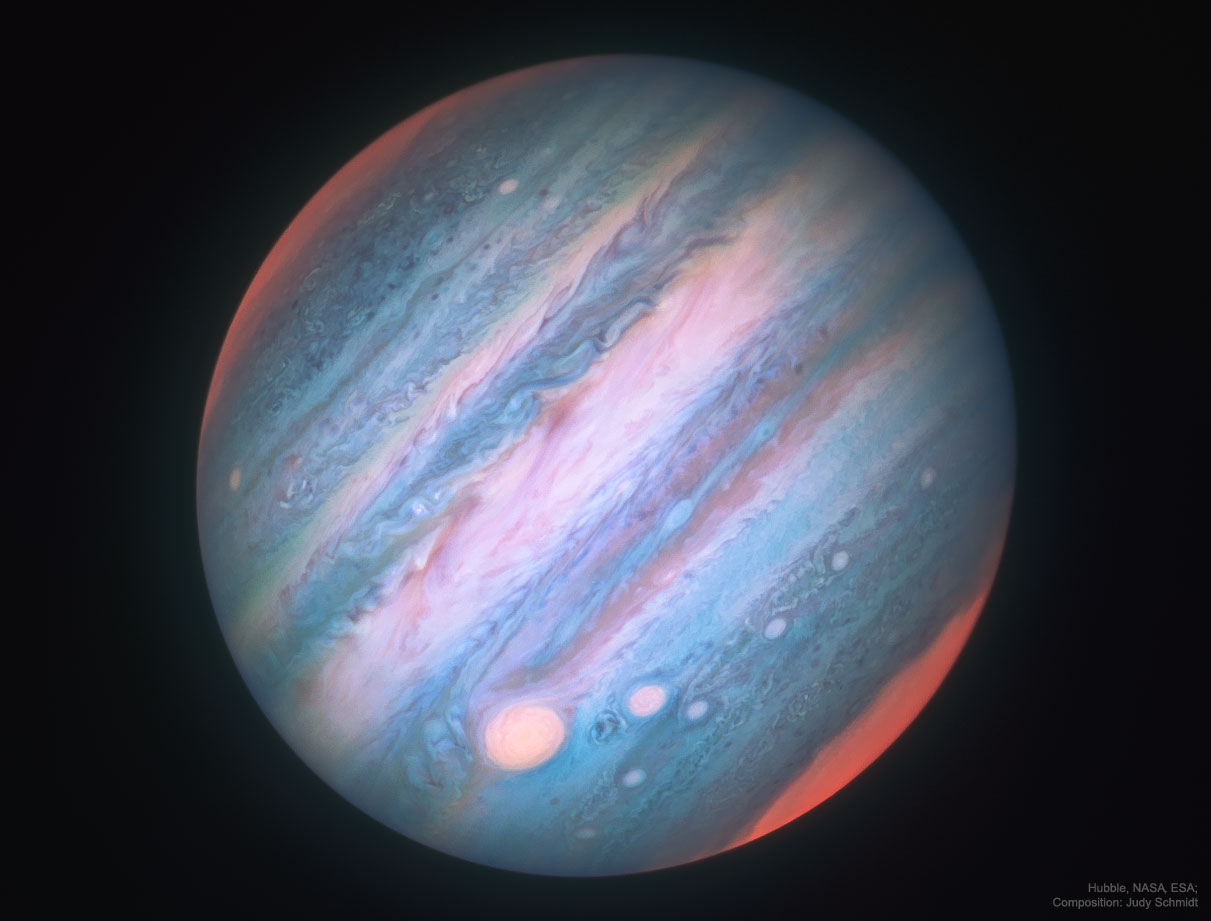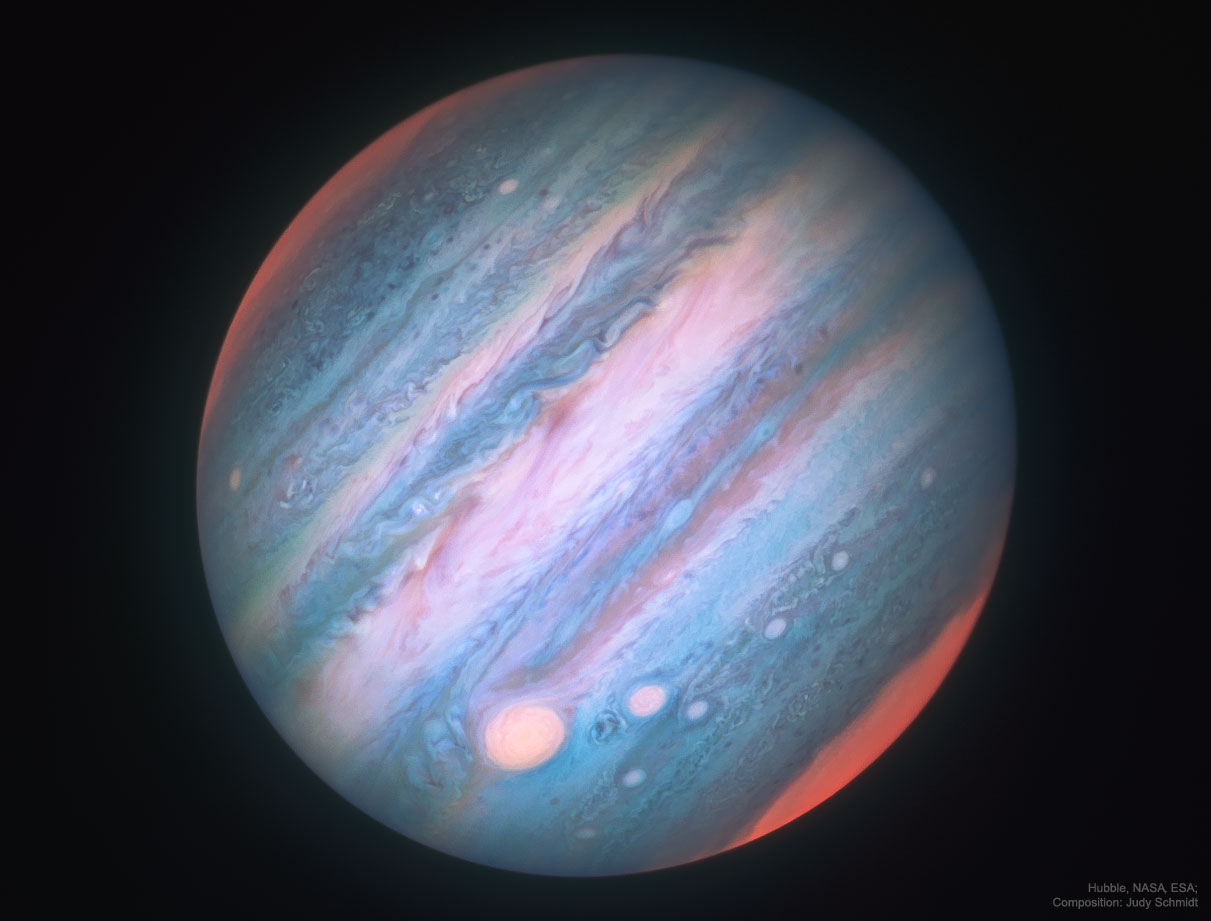
Jupiter looks a bit different in infrared light. To better understand Jupiter's cloud motions and to help NASA's robotic Juno spacecraft understand the planetary context of the small fields that it sees, the Hubble Space Telescope is being directed to regularly image the entire Jovian giant. The colors of Jupiter being monitored go beyond the normal human visual range to include both ultraviolet and infrared light. Featured here in 2016, three bands of near-infrared light have been digitally reassigned into a mapped color image. Jupiter appears different in infrared partly because the amount of sunlight reflected back is distinct, giving differing cloud heights and latitudes discrepant brightnesses. Nevertheless, many familiar features on Jupiter remain, including the light zones and dark belts that circle the planet near the equator, the Great Red Spot on the lower left, and the string-of-pearls storm systems south of the Great Red Spot. The poles glow because high altitude haze there is energized by charged particles from Jupiter's magnetosphere. Juno has now completed 10 of 12 planned science orbits of Jupiter and continues to record data that are helping humanity to understand not only Jupiter's weather but what lies beneath Jupiter's thick clouds.
Júpiter se ve un poco diferente en luz infrarroja. Para comprender mejor los movimientos de las nubes de Júpiter y ayudar a la nave espacial robótica Juno de la NASA a entender el contexto planetario de los pequeños campos que observa, se está utilizando el Telescopio Espacial Hubble para tomar imágenes regulares de todo el gigante joviano. Los colores de Júpiter que se monitorean van más allá del rango normal de visión humana y incluyen tanto luz ultravioleta como infrarroja. En la imagen destacada de 2016, tres bandas de luz infrarroja cercana han sido reasignadas digitalmente en una imagen de color mapeado. Júpiter aparece diferente en infrarrojo en parte porque la cantidad de luz solar reflejada es distinta, lo que da a diferentes alturas y latitudes de las nubes brillos desiguales. Sin embargo, muchas características familiares en Júpiter siguen estando presentes, incluyendo las zonas claras y las cinturillas oscuras que rodean el planeta cerca del ecuador, la Gran Mancha Roja en la parte inferior izquierda, y los sistemas de tormentas en cadena al sur de la Gran Mancha Roja. Los polos brillan porque la niebla de alta altitud allí es energizada por partículas cargadas del magnetosfera de Júpiter. Juno ha completado 10 de los 12 órbitas científicas planeadas alrededor de Júpiter y continúa registrando datos que ayudan a la humanidad a entender no solo el clima de Júpiter, sino también lo que hay debajo de sus densas nubes.