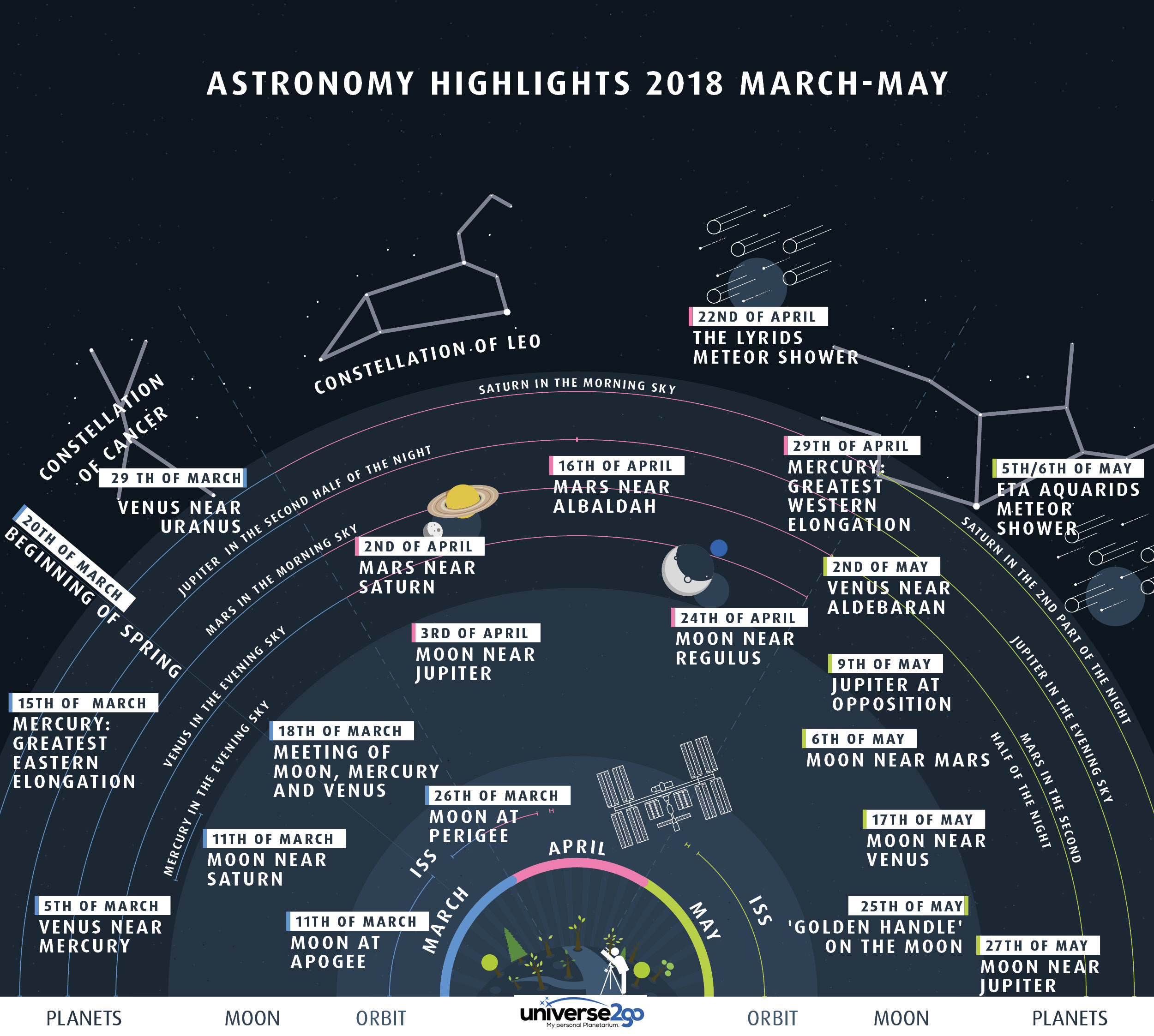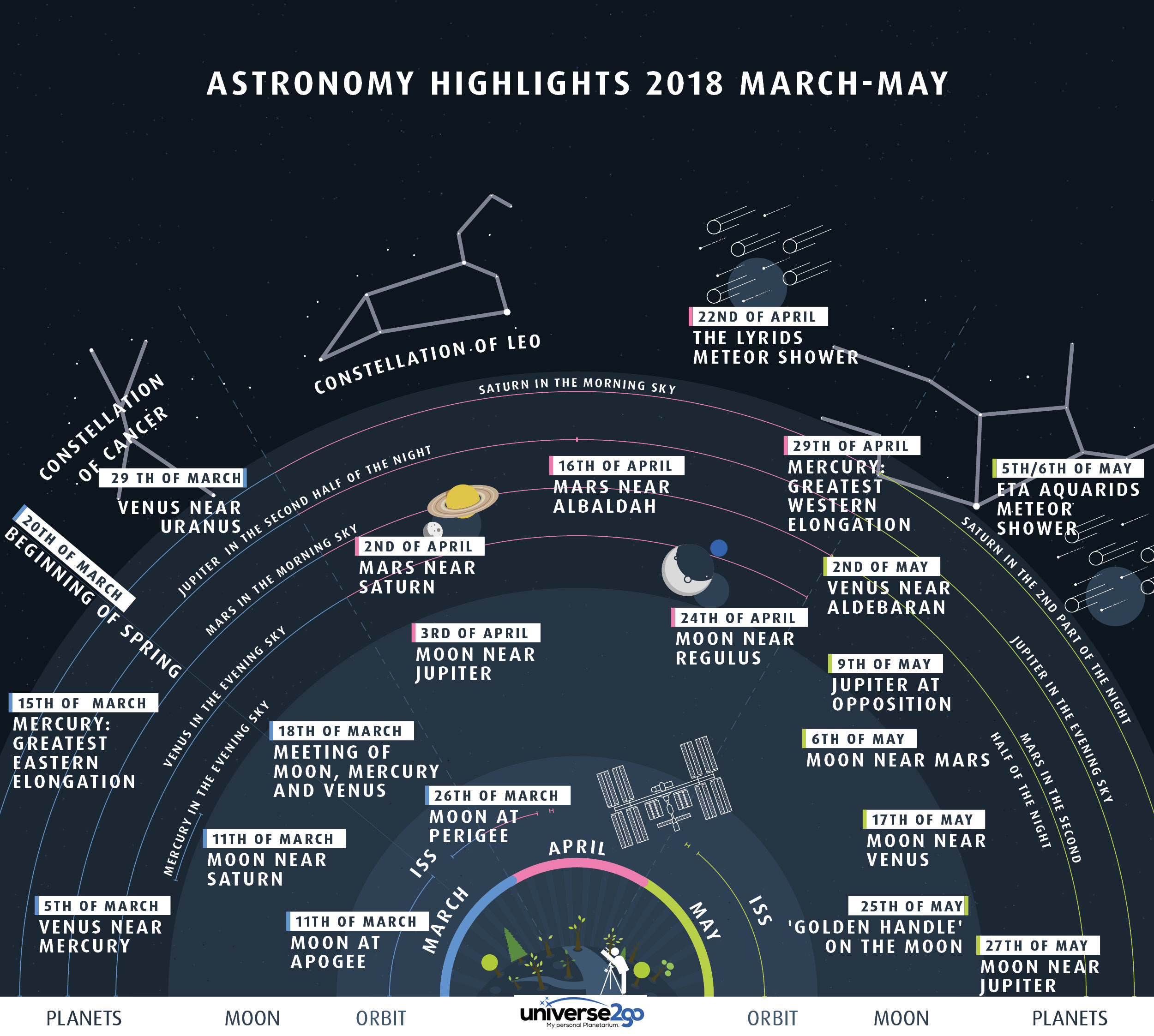
What might you see in the night sky over the next few months? The featured graphic gives a few highlights. Viewed as a clock face centered at the bottom, sky events in March fan out toward the left, April toward the top, and May toward the right. Objects relatively close to Earth are illustrated, in general, as nearer to the cartoon figure with the telescope at the bottom center -- although almost everything pictured can be seen without a telescope. Sky highlights this season include a bright Venus in the evening sky during March, the Lyrids meteor shower during April, and Jupiter entering the evening sky during May. As true in every season, the International Space Station (ISS) can be sometimes be found drifting across your sky if you know just when and where to look. News: Stephen Hawking Dies at 76
¿Qué podrías ver en el cielo nocturno en los próximos meses? El gráfico destacado muestra algunos de los eventos más importantes. Visto como una cara de reloj centrada en la parte inferior, los eventos celestes de marzo se extienden hacia la izquierda, los de abril hacia la parte superior y los de mayo hacia la derecha. En general, los objetos relativamente cercanos a la Tierra se ilustran más cerca de la figura en dibujo con el telescopio en el centro inferior, aunque casi todo lo que se muestra se puede observar a simple vista. Entre los eventos destacados de esta temporada se encuentra un brillante Venus en el cielo nocturno durante marzo, la lluvia de meteoros Lyrids durante abril y Júpiter apareciendo en el cielo nocturno durante mayo. Como ocurre en cada temporada, la Estación Espacial Internacional (ISS) puede verse ocasionalmente cruzando tu cielo si sabes exactamente cuándo y dónde mirar.