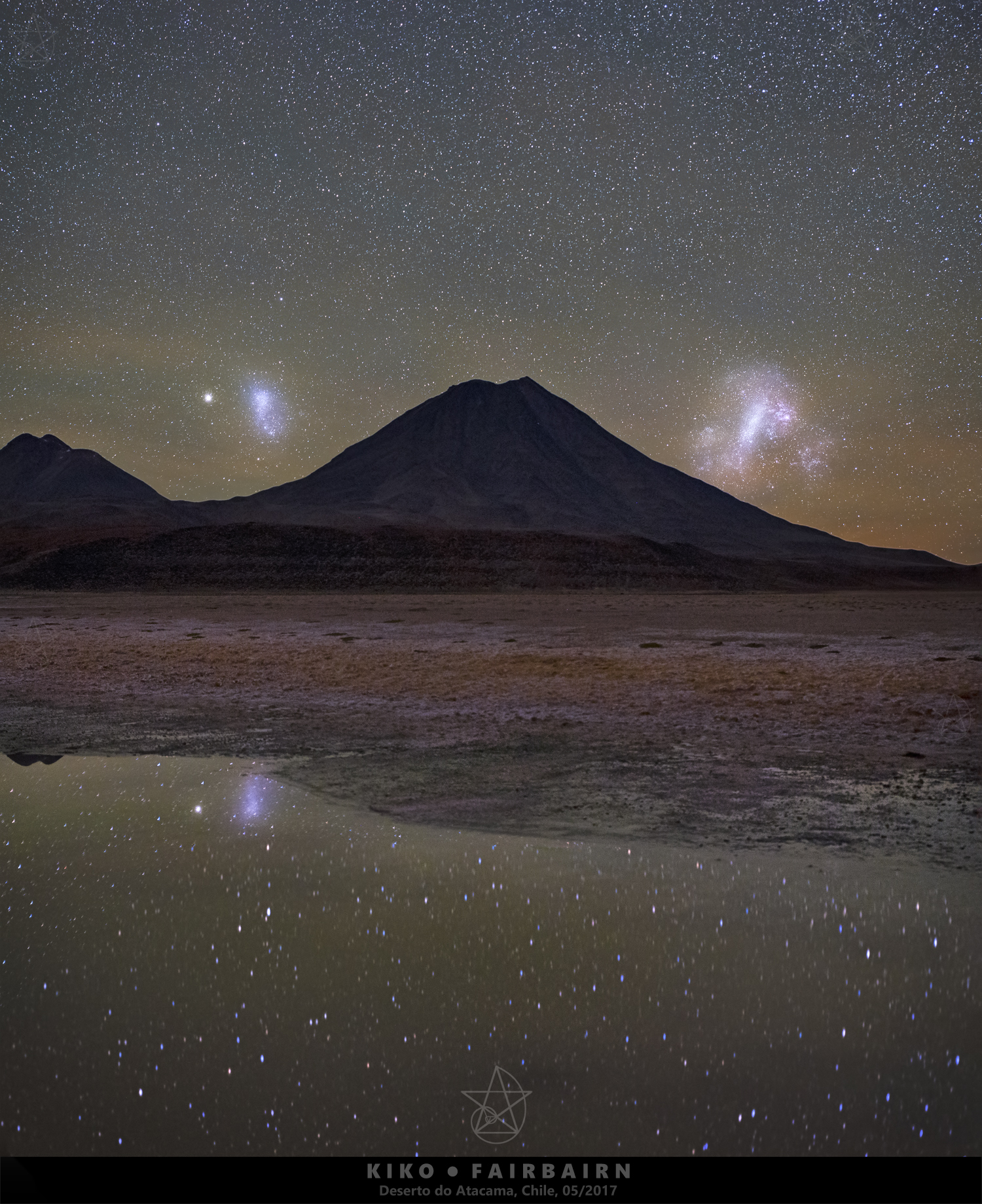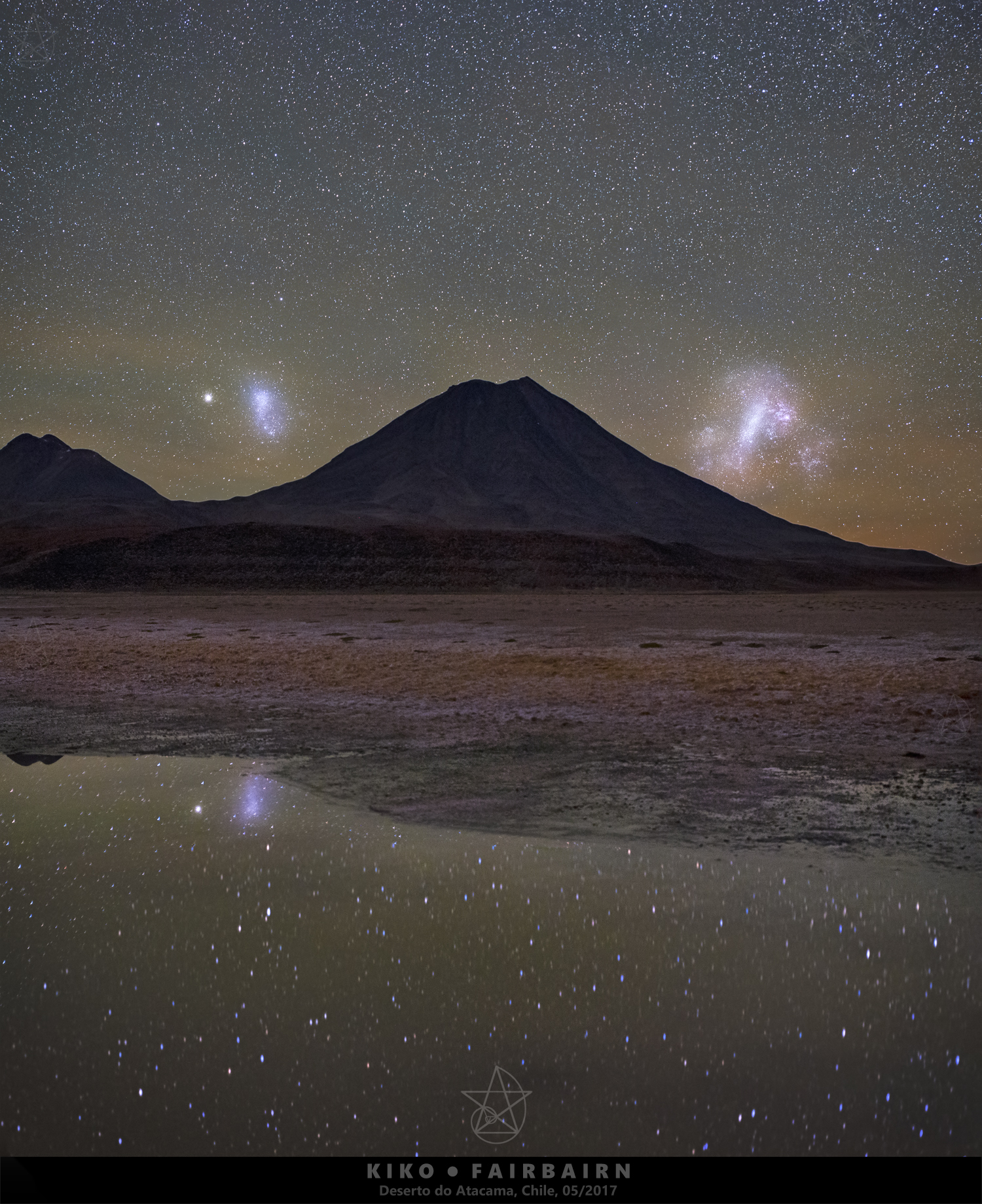
Flanked by satellite galaxies of the Milky Way a volcanic peak rises from this rugged horizon. The southern night skyscape looks toward the south over Laguna Lejia and the altiplano of the Antofagasta Region of northern Chile. Extending the view across extragalactic space, the Large (right) and Small Magellanic Clouds are so named for the 16th century Portuguese explorer Ferdinand Magellan, leader of planet Earth's first circumnavigation. The larger cloud lies some 180,000 light-years, and the smaller 210,000 light-years beyond the mountaintop. Left of the Small Cloud of Magellan and also reflected in the foreground watery shallows on that starry night, 47 Tucanae shines like a bright star. A globular star cluster that roams the halo of the Milky Way, 47 Tucanae is about 13,000 light-years away.
Flanqueado por galaxias satélite de la Vía Láctea, un pico volcánico emerge de este horizonte accidentado. El paisaje nocturno del sur mira hacia el sur sobre la Laguna Lejia y el altiplano de la Región de Antofagasta en el norte de Chile. Extendiendo la vista a través del espacio extragaláctico, las Nubes de Magallanes (la mayor a la derecha y la menor a la izquierda) reciben su nombre en honor al explorador portugués del siglo XVI, Fernando de Magallanes, líder del primer viaje de circunnavegación de la Tierra. La nube más grande se encuentra a unos 180 000 años luz, y la más pequeña a 210 000 años luz del pico montañoso. A la izquierda de la Pequeña Nube de Magallanes y también reflejada en las aguas poco profundas del primer plano en esa noche estrellada, brilla como una estrella brillante 47 Tucanae. Un cúmulo globular que se desplaza por el halo de la Vía Láctea, 47 Tucanae se encuentra a unos 13 000 años luz de distancia.