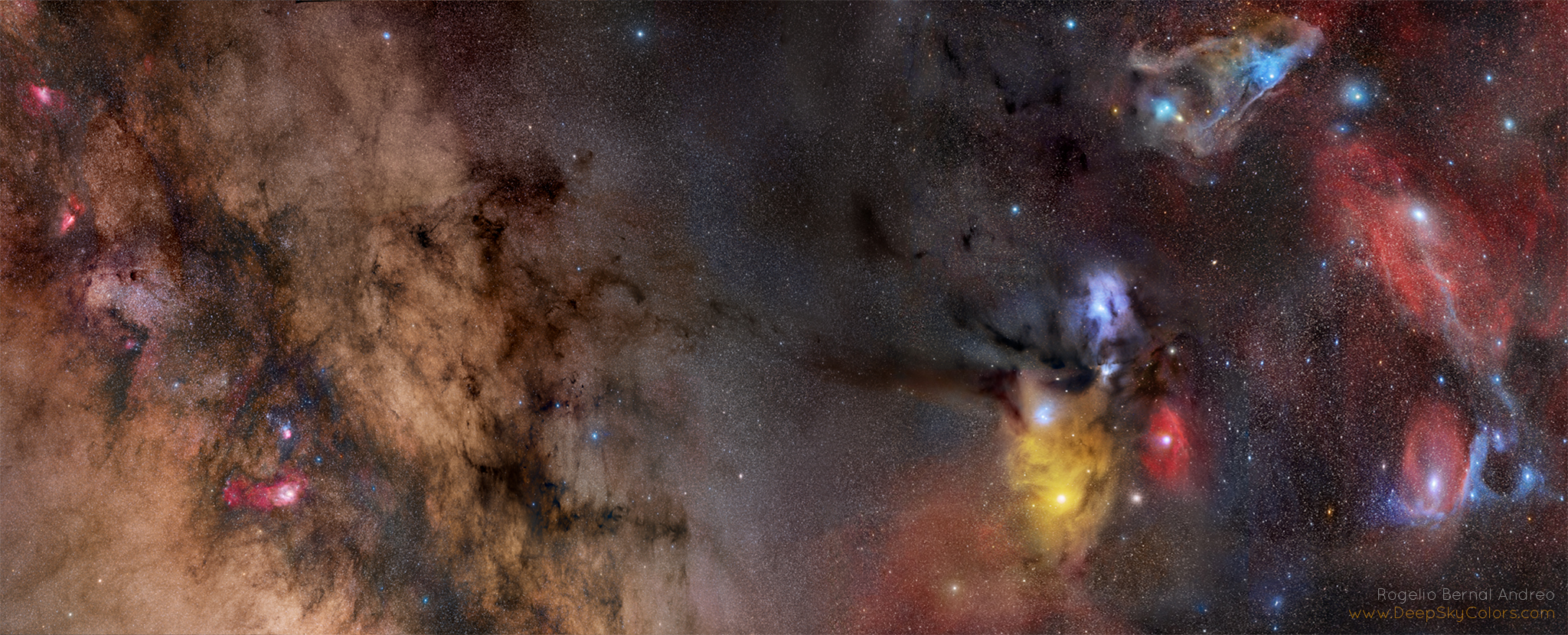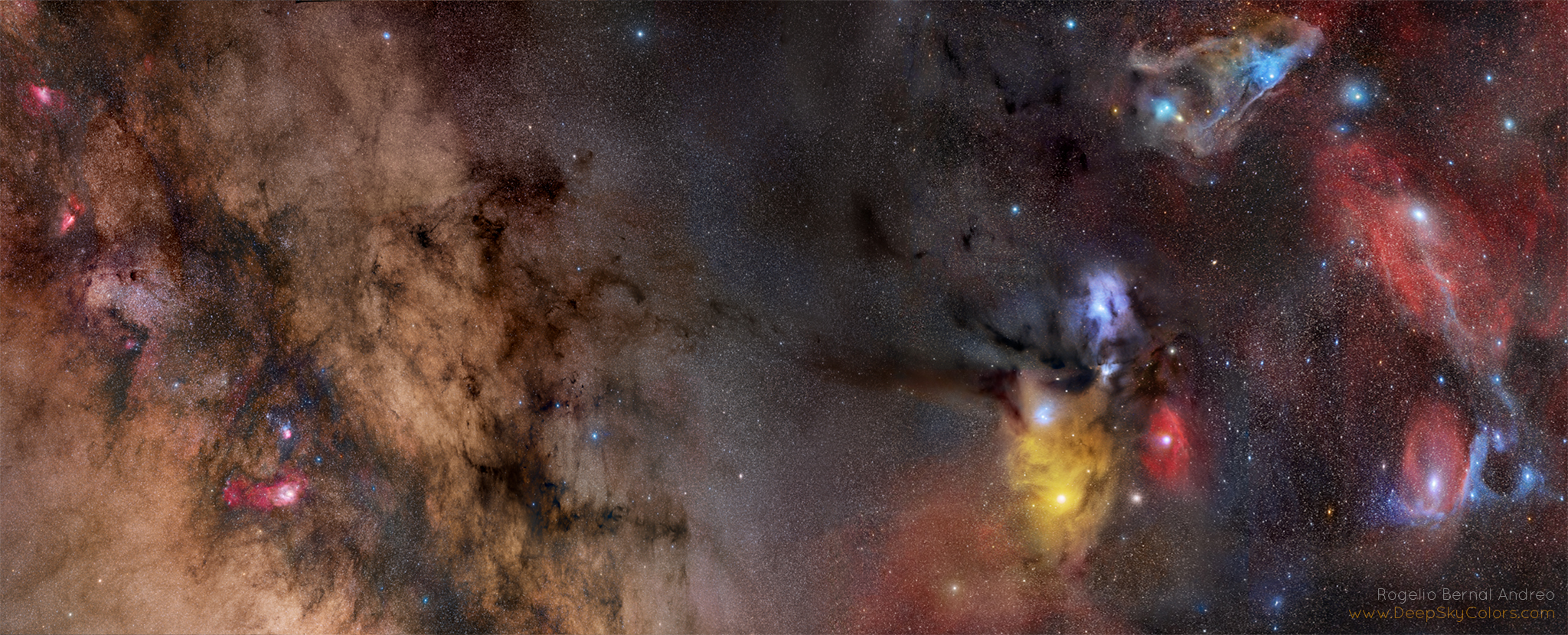
Behold one of the most photogenic regions of the night sky, captured impressively. Featured, the band of our Milky Way Galaxy runs diagonally along the far left, while the colorful Rho Ophiuchus region including the bright orange star Antares is visible just right of center, and the nebula Sharpless 1 (Sh2-1) appears on the far right. Visible in front of the Milk Way band are several famous nebulas including the Eagle Nebula (M16), the Trifid Nebula (M20), and the Lagoon Nebula (M8). Other notable nebulas include the Pipe and Blue Horsehead. In general, red emanates from nebulas glowing in the light of exited hydrogen gas, while blue marks interstellar dust preferentially reflecting the light of bright young stars. Thick dust appears otherwise dark brown. Large balls of stars visible include the globular clusters M4, M9, M19, M28, and M80, each marked on the annotated companion image. This extremely wide field -- about 50 degrees across -- spans the constellations of Sagittarius is on the lower left, Serpens on the upper left, Ophiuchus across the middle, and Scorpius on the right. It took over 100 hours of sky imaging, combined with meticulous planning and digital processing, to create this image.
Contemple una de las regiones más fotogénicas del cielo nocturno, capturada de manera impresionante. Destacada, la banda de nuestra Galaxia Vía Láctea se extiende diagonalmente a lo largo de la parte inferior izquierda, mientras que la región colorida de Rho Ophiuchus, incluyendo la brillante estrella naranja Antares, es visible justo a la derecha del centro, y la nebulosa Sharpless 1 (Sh2-1) aparece en la parte superior derecha. Delante de la banda de la Vía Láctea se encuentran varias nebulosas famosas, incluyendo la Nebulosa del Águila (M16), la Nebulosa Trífida (M20) y la Nebulosa del Lago (M8). Otras nebulosas notables incluyen la Pipe y la Cabecilla Azul. En general, el color rojo emana de las nebulosas que brillan con la luz del hidrógeno excitado, mientras que el azul marca el polvo interestelar que refleja preferentemente la luz de estrellas jóvenes y brillantes. El polvo denso aparece de color marrón oscuro. Grandes grupos de estrellas visibles incluyen los cúmulos globulares M4, M9, M19, M28 y M80, cada uno marcado en la imagen anotada complementaria. Este campo extremadamente amplio, que abarca unos 50 grados, abarca las constelaciones de Sagitario en la parte inferior izquierda, Serpiente en la parte superior izquierda, Ofiuco a través del centro y Escorpión a la derecha. Tomó más de 100 horas de imágenes del cielo, combinadas con una planificación minuciosa y un procesamiento digital, para crear esta imagen.