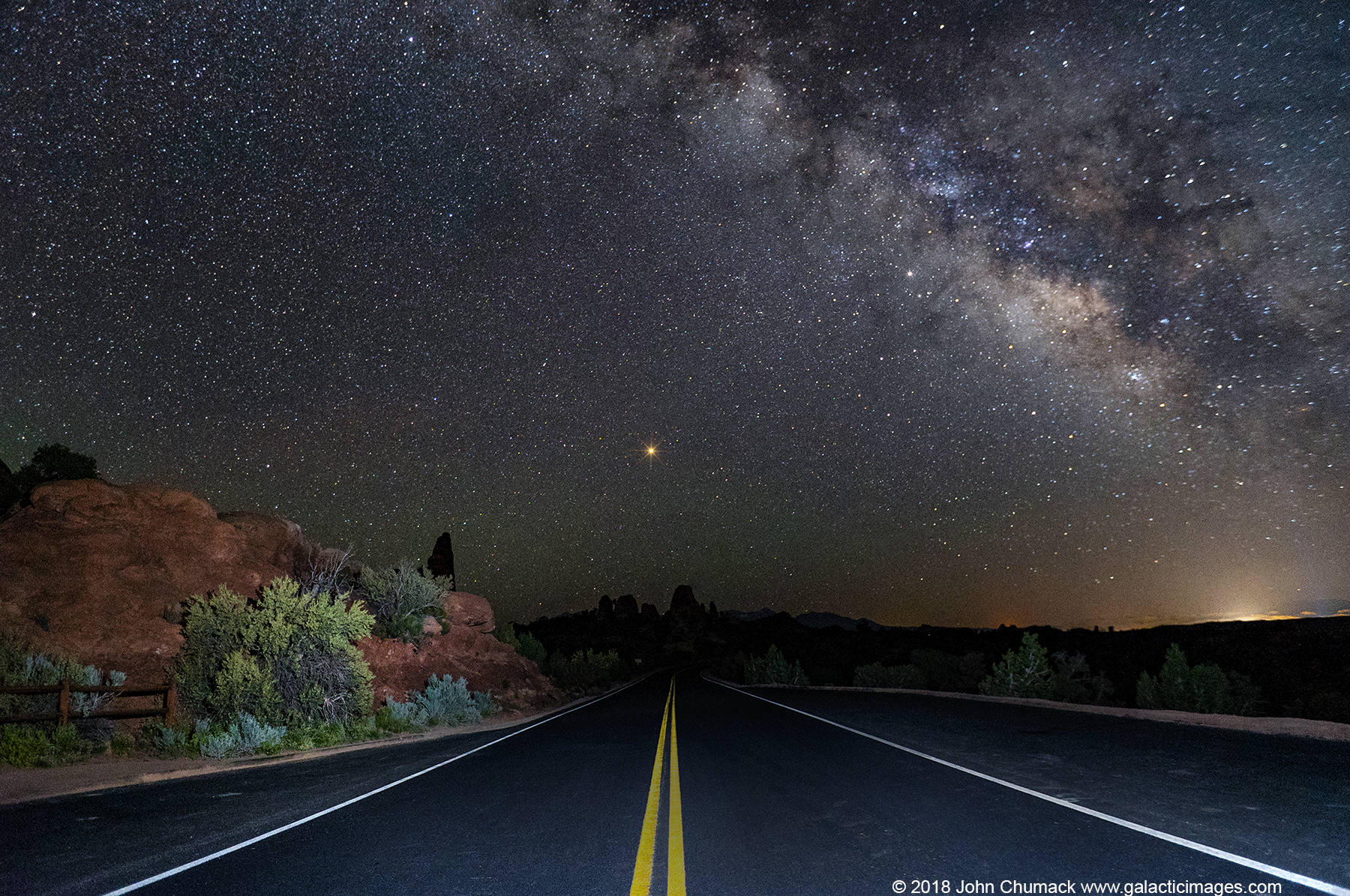
What's that light at the end of the road? Mars. This is a good month to point out Mars to your friends and family because our neighboring planet will not only be its brightest in 15 years, it will be visible for much of night. During this month, Mars will be about 180 degrees around from the Sun, and near the closest it ever gets to planet Earth. In terms of orbits, Mars is also nearing the closest point to the Sun in its elliptical orbit, just as Earth moves nearly between it and the Sun -- an alignment known as perihelic opposition. In terms of viewing, orange Mars will rise in the east just as the Sun sets in the west, on the opposite side of the sky. Mars will climb in the sky during the night, reach its highest near midnight, and then set in the west just as the Sun begins to rise in the east. The red planet was captured setting beyond a stretch of road in Arches National Park in mid-May near Moab, Utah, USA.
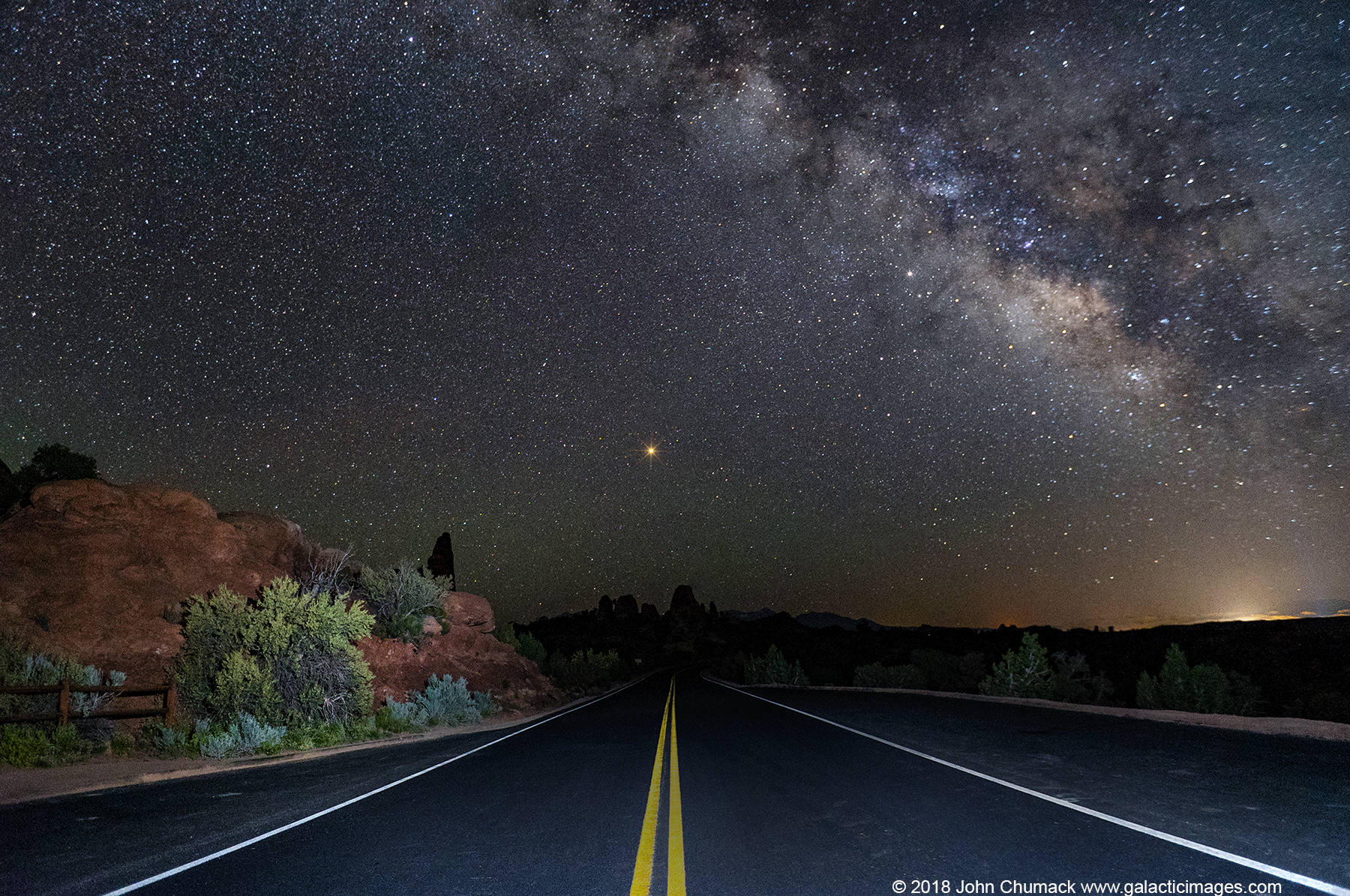
¿Qué luz hay al final del camino? Marte. Este es un buen mes para mostrarle Marte a tus amigos y familiares, ya que nuestro planeta vecino no solo será el más brillante en 15 años, sino que también será visible durante gran parte de la noche. Durante este mes, Marte estará a unos 180 grados del Sol, y cerca del punto más cercano que nunca llega a la Tierra. En términos de órbitas, Marte también se acerca al punto más cercano al Sol en su órbita elíptica, justo cuando la Tierra se mueve casi entre Marte y el Sol — una alineación conocida como oposición perihelio. En términos de observación, Marte de color naranja saldrá por el este justo cuando el Sol se ponga por el oeste, en el lado opuesto del cielo. Marte subirá en el cielo durante la noche, alcanzará su punto más alto cerca de la medianoche, y luego se pondrá por el oeste justo cuando el Sol comience a salir por el este. El planeta rojo fue capturado poniéndose más allá de un tramo de carretera en el Parque Nacional de Arches a mediados de mayo cerca de Moab, Utah, EE.UU.