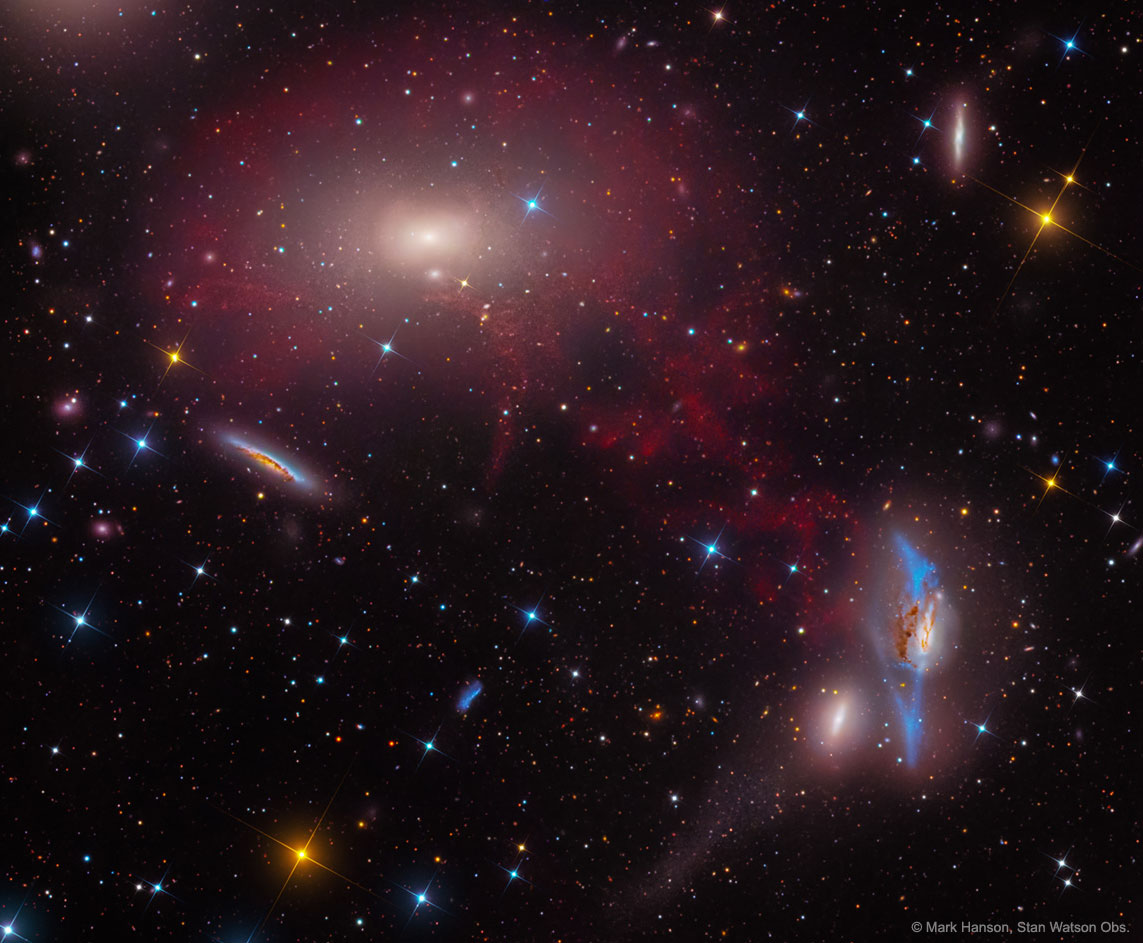
Is there a bridge of gas connecting these two great galaxies? Quite possibly, but it is hard to be sure. M86 on the upper left is a giant elliptical galaxy near the center of the nearby Virgo Cluster of galaxies. Our Milky Way Galaxy is falling toward the Virgo Cluster, located about 50 million light years away. To the lower right of M86 is unusual spiral galaxy NGC 4438, which, together with angular neighbor NGC 4435, are known as the Eyes Galaxies (also Arp 120). Featured here is one of the deeper images yet taken of the region, indicating that red-glowing gas surrounds M86 and seemingly connects it to NGC 4438. The image spans about the size of the full moon. It is also known, however, that cirrus gas in our own Galaxy is superposed in front of the Virgo cluster, and observations of the low speed of this gas seem more consistent with this Milky Way origin hypothesis. A definitive answer may come from future research, which may also resolve how the extended blue arms of NGC 4438 were created. Open Science: Browse 1,750+ codes in the Astrophysics Source Code Library
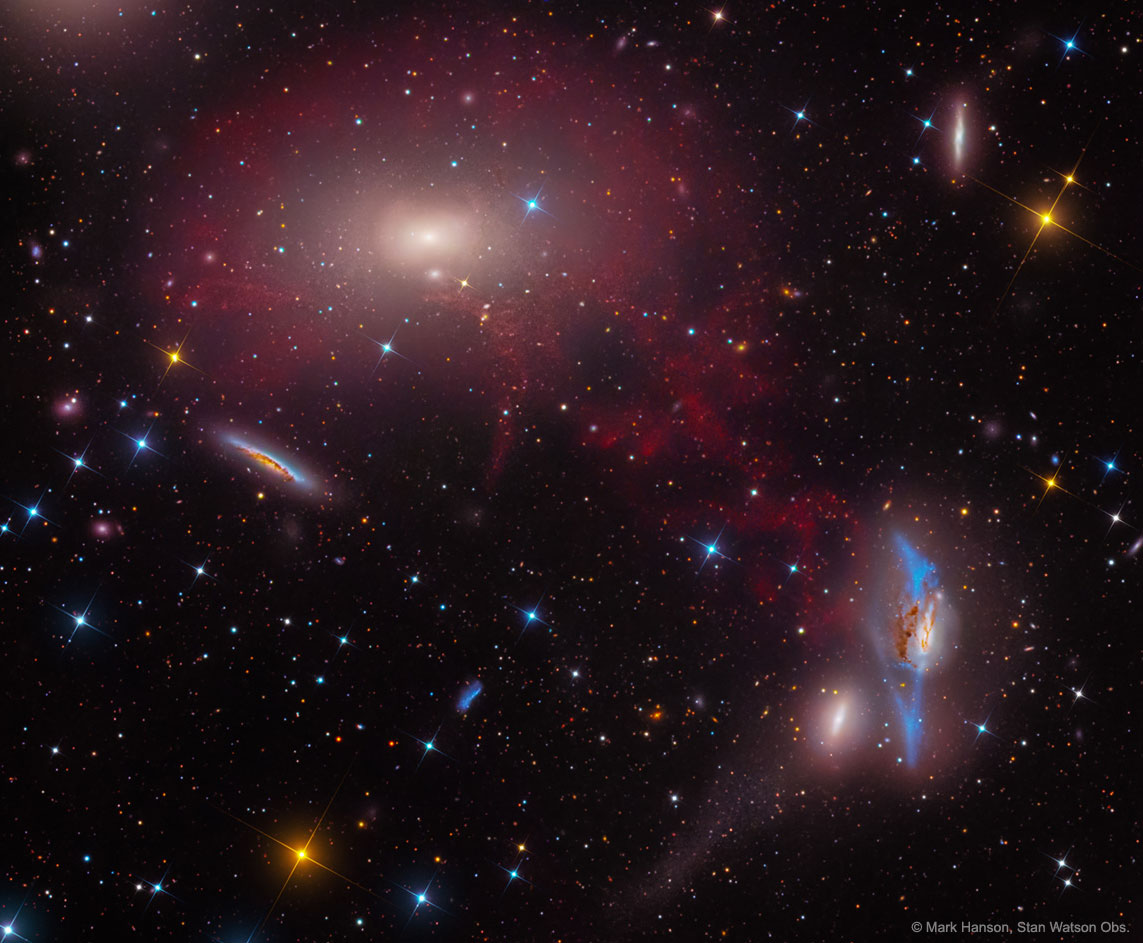
¿Existe un puente de gas conectando estas dos grandes galaxias? Es muy probable, pero es difícil estar seguros. M86, en la parte superior izquierda, es una galaxia elíptica gigante cerca del centro del Grupo de Virgo, una agrupación de galaxias relativamente cercana. Nuestra galaxia, la Vía Láctea, se está acercando al Grupo de Virgo, que se encuentra a unos 50 millones de años luz de distancia. En la parte inferior derecha de M86 se encuentra la inusual galaxia espiral NGC 4438, que junto con su vecina angular NGC 4435, se conocen como las Galaxias Ojos (también Arp 120). En esta imagen se muestra una de las exposiciones más profundas tomadas hasta la fecha de esta región, indicando que un gas que brilla en rojo rodea a M86 y parece conectarla con NGC 4438. La imagen abarca aproximadamente el tamaño de la luna llena. También se sabe que hay gas cirroso en nuestra propia galaxia superpuesto frente al Grupo de Virgo, y observaciones de la baja velocidad de este gas parecen ser más consistentes con la hipótesis de origen en la Vía Láctea. Una respuesta definitiva podría surgir de investigaciones futuras, que también podrían resolver cómo se formaron los brazos azules extendidos de NGC 4438.