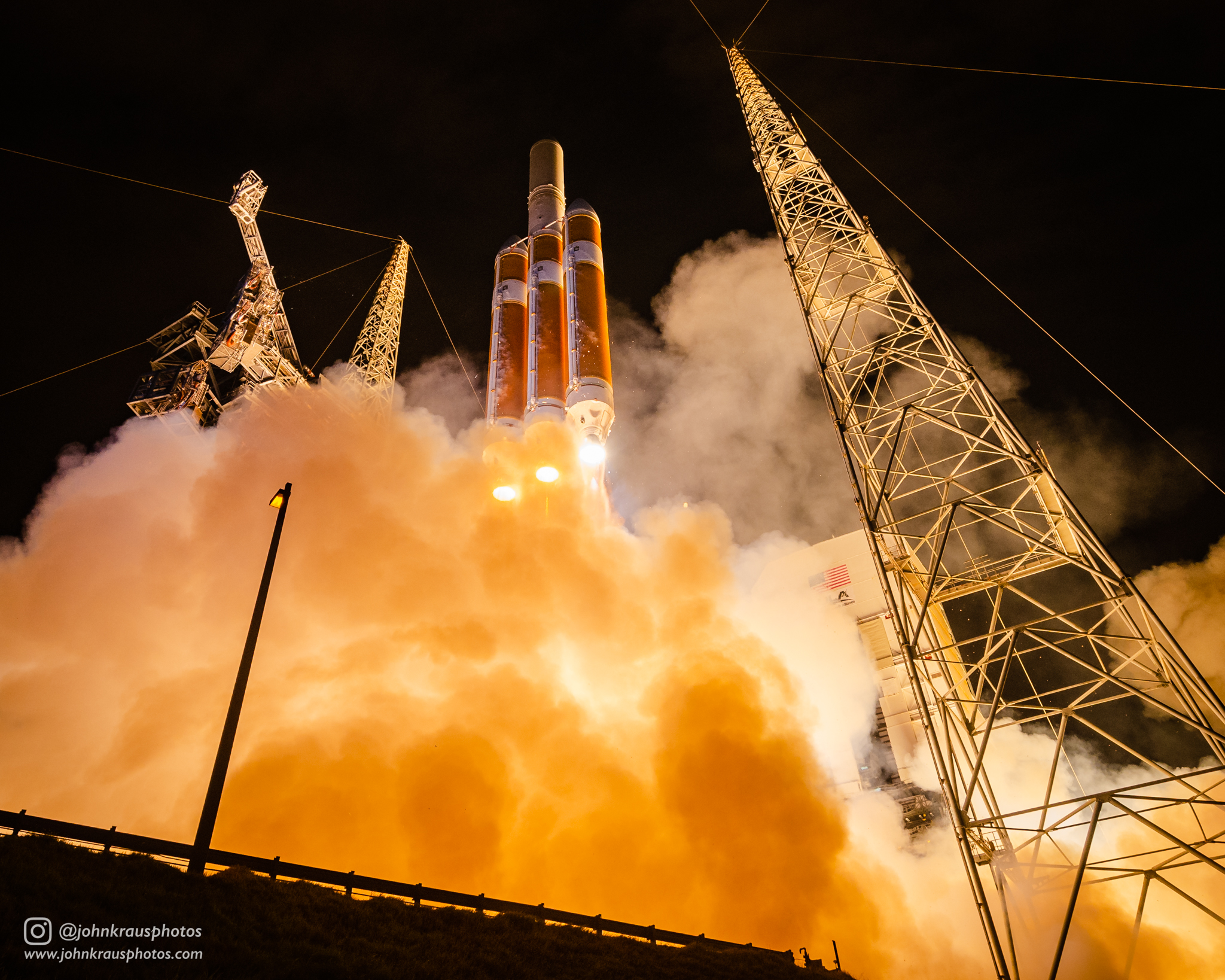
When is the best time to launch a probe to the Sun? The now historic answer -- which is not a joke because this really happened this past weekend -- was at night. Night, not only because NASA's Parker Solar Probe's (PSP) launch window to its planned orbit occurred, in part, at night, but also because most PSP instruments will operate in the shadow of its shield -- in effect creating its own perpetual night near the Sun. Before then, years will pass as the PSP sheds enough orbital energy to approach the Sun, swinging past Venus seven times. Eventually, the PSP is scheduled to pass dangerously close to the Sun, within 9 solar radii, the closest ever. This close, the temperature will be 1,400 degrees Celsius on the day side of the PSP's Sun shield -- hot enough to melt many forms of glass. On the night side, though, it will be near room temperature. A major goal of the PSP's mission to the Sun is to increase humanity's understanding of the Sun's explosions that impact Earth's satellites and power grids. Pictured is the night launch of the PSP aboard the United Launch Alliances' Delta IV Heavy rocket early Sunday morning. Gallery: Best Submitted Images of PSP Launch
¿Cuál es el mejor momento para lanzar una sonda hacia el Sol? La respuesta histórica — que no es un chiste, ya que realmente ocurrió este fin de semana — fue de noche. No solo porque la ventana de lanzamiento de la sonda solar Parker (PSP) para su órbita planeada tuvo lugar, en parte, durante la noche, sino también porque la mayoría de los instrumentos de la PSP operarán en la sombra de su escudo, creando de hecho su propia noche perpetua cerca del Sol. Antes de eso, pasarán años mientras la PSP pierde suficiente energía orbital para acercarse al Sol, pasando por Venus siete veces. Finalmente, la PSP está programada para acercarse peligrosamente al Sol, dentro de 9 radios solares, la distancia más cercana jamás alcanzada. A esa distancia, la temperatura será de 1400 grados Celsius en el lado diurno del escudo solar de la PSP, lo suficientemente caliente como para fundir muchas formas de vidrio. Sin embargo, en el lado nocturno, la temperatura será cercana a la ambiente. Un objetivo principal de la misión de la PSP al Sol es aumentar la comprensión humana de las explosiones solares que impactan en los satélites y redes eléctricas de la Tierra. En la imagen se muestra el lanzamiento nocturno de la PSP a bordo del cohete Delta IV Heavy de United Launch Alliance, temprano en la mañana del domingo.