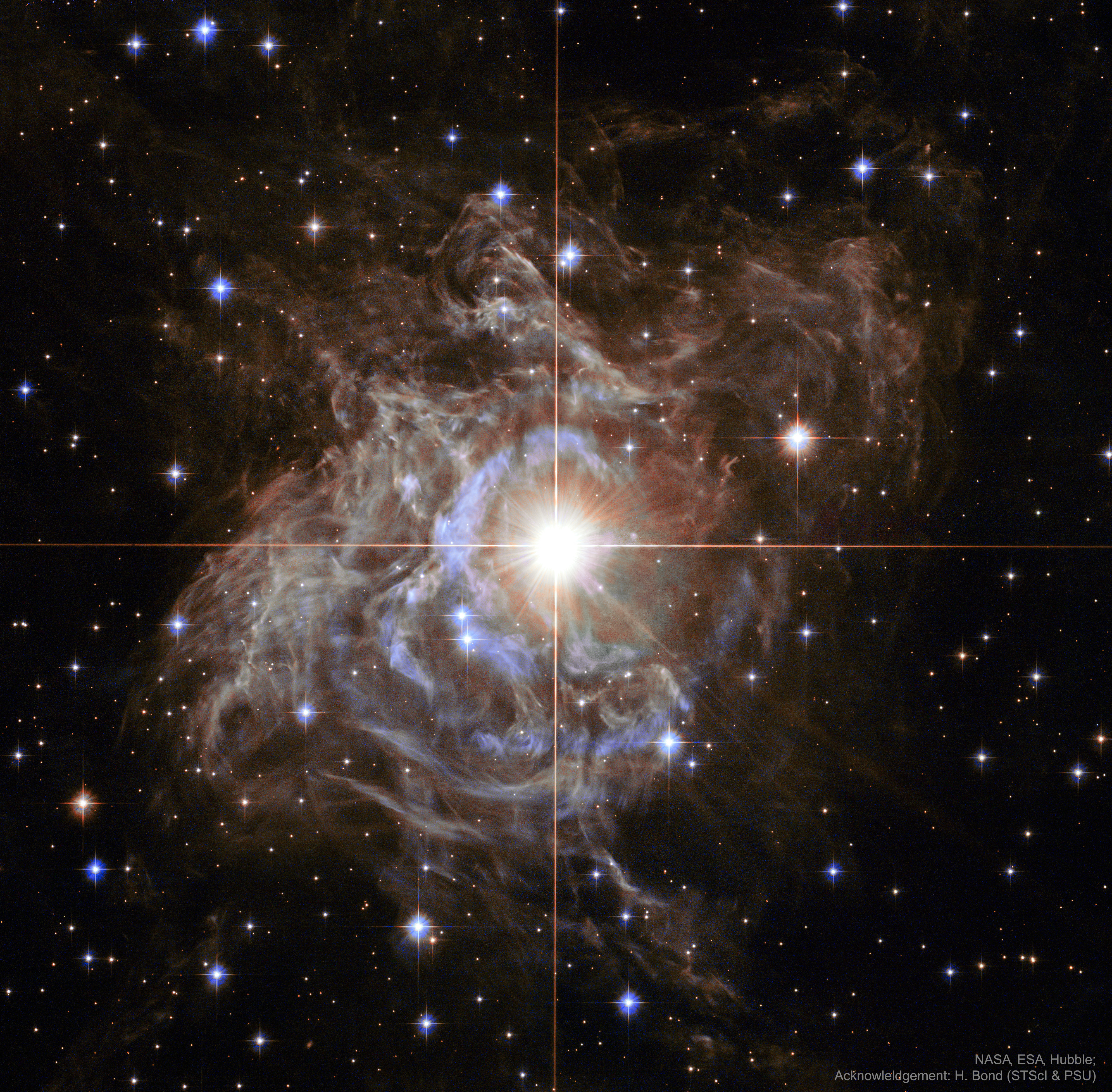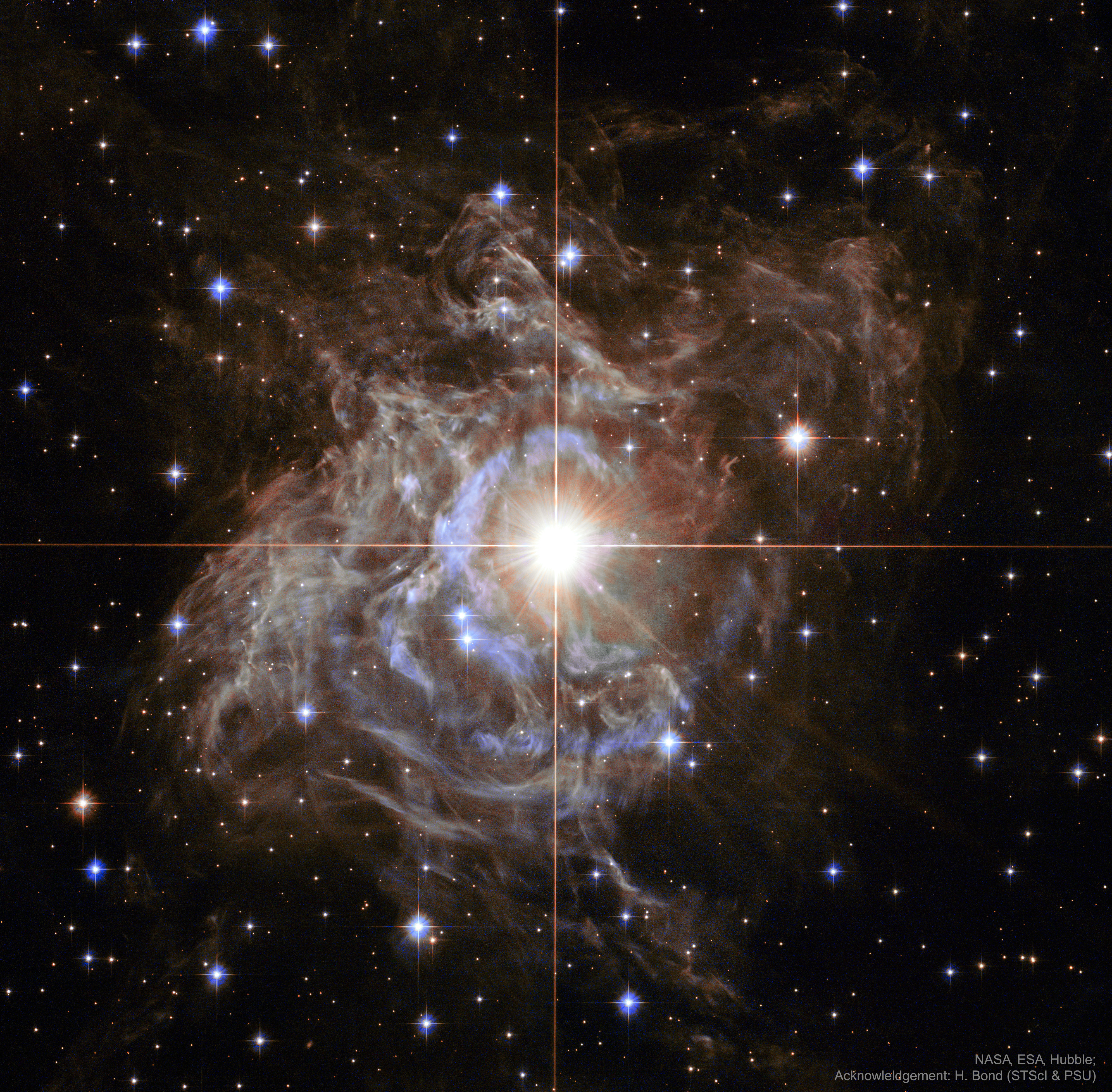
In the center is one of the most important stars on the sky. This is partly because, by coincidence, it is surrounded by a dazzling reflection nebula. Pulsating RS Puppis, the brightest star in the image center, is some ten times more massive than our Sun and on average 15,000 times more luminous. In fact, RS Pup is a Cepheid type variable star, a class of stars whose brightness is used to estimate distances to nearby galaxies as one of the first steps in establishing the cosmic distance scale. As RS Pup pulsates over a period of about 40 days, its regular changes in brightness are also seen along the nebula delayed in time, effectively a light echo. Using measurements of the time delay and angular size of the nebula, the known speed of light allows astronomers to geometrically determine the distance to RS Pup to be 6,500 light-years, with a remarkably small error of plus or minus 90 light-years. An impressive achievement for stellar astronomy, the echo-measured distance also more accurately establishes the true brightness of RS Pup, and by extension other Cepheid stars, improving the knowledge of distances to galaxies beyond the Milky Way. The featured image was taken by the Hubble Space Telescope.
En el centro se encuentra una de las estrellas más importantes del cielo. Esto es en parte porque, por casualidad, está rodeada por un nebulosa de reflexión deslumbrante. RS Puppis, la estrella más brillante en el centro de la imagen, tiene aproximadamente diez veces más masa que nuestro Sol y, en promedio, 15 000 veces más luminosidad. De hecho, RS Pup es una estrella variable del tipo Cefeida, una clase de estrellas cuya brillantez se utiliza para estimar distancias a galaxias cercanas, como uno de los primeros pasos para establecer la escala de distancias cósmicas. A medida que RS Pup pulsa con un período de aproximadamente 40 días, sus cambios regulares en brillo también se ven a lo largo de la nebulosa con un retraso en el tiempo, efectivamente un eco de luz. Usando mediciones del retraso temporal y del tamaño angular de la nebulosa, la velocidad conocida de la luz permite a los astrónomos determinar geométricamente la distancia a RS Pup, que es de 6 500 años luz, con un error notablemente pequeño de más o menos 90 años luz. Un logro impresionante para la astronomía estelar, la distancia medida mediante el eco también establece con mayor precisión el brillo real de RS Pup, y por extensión otras estrellas Cefeidas, mejorando el conocimiento de las distancias a galaxias más allá de la Vía Láctea. La imagen destacada fue tomada por el Telescopio Espacial Hubble.