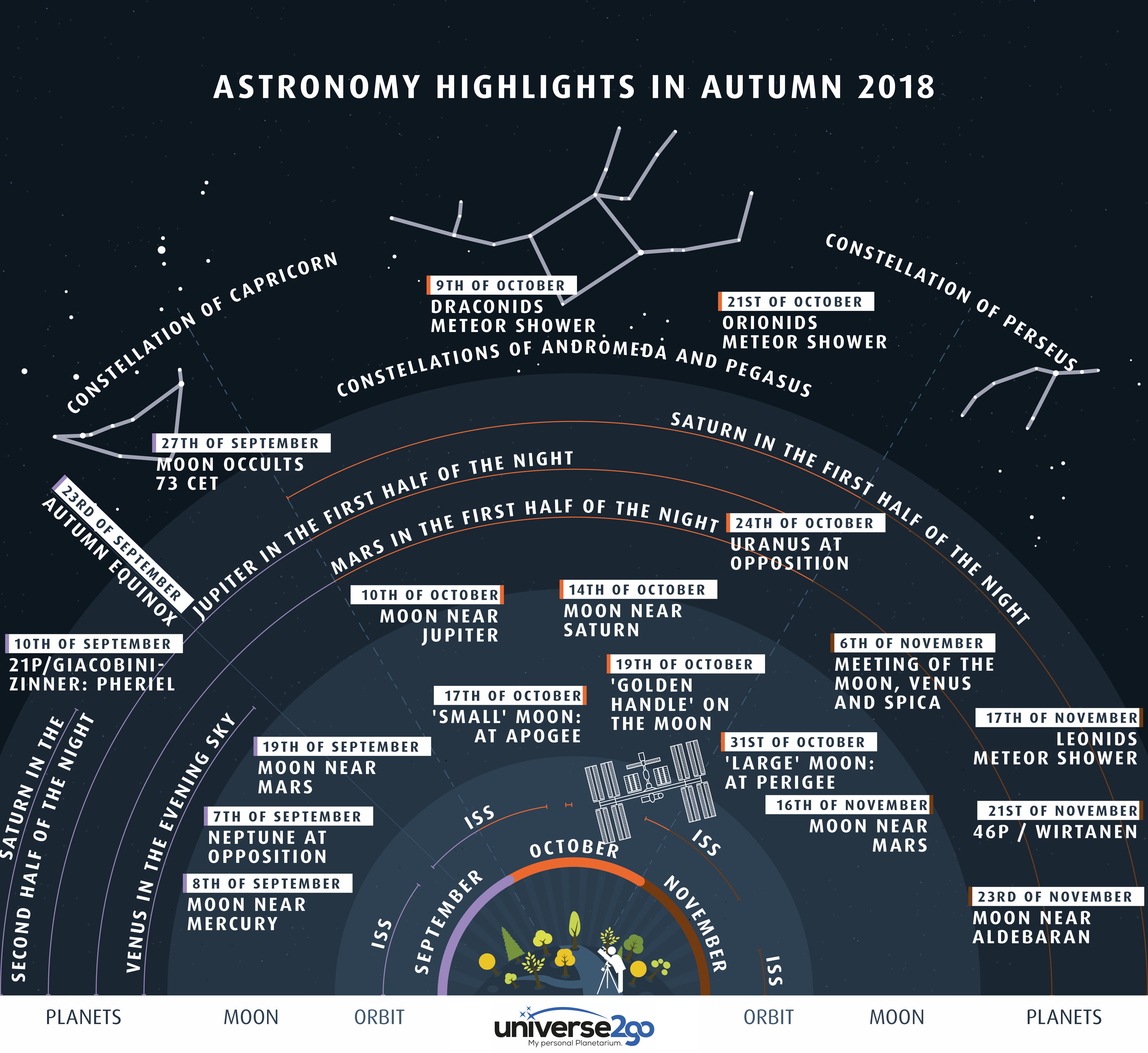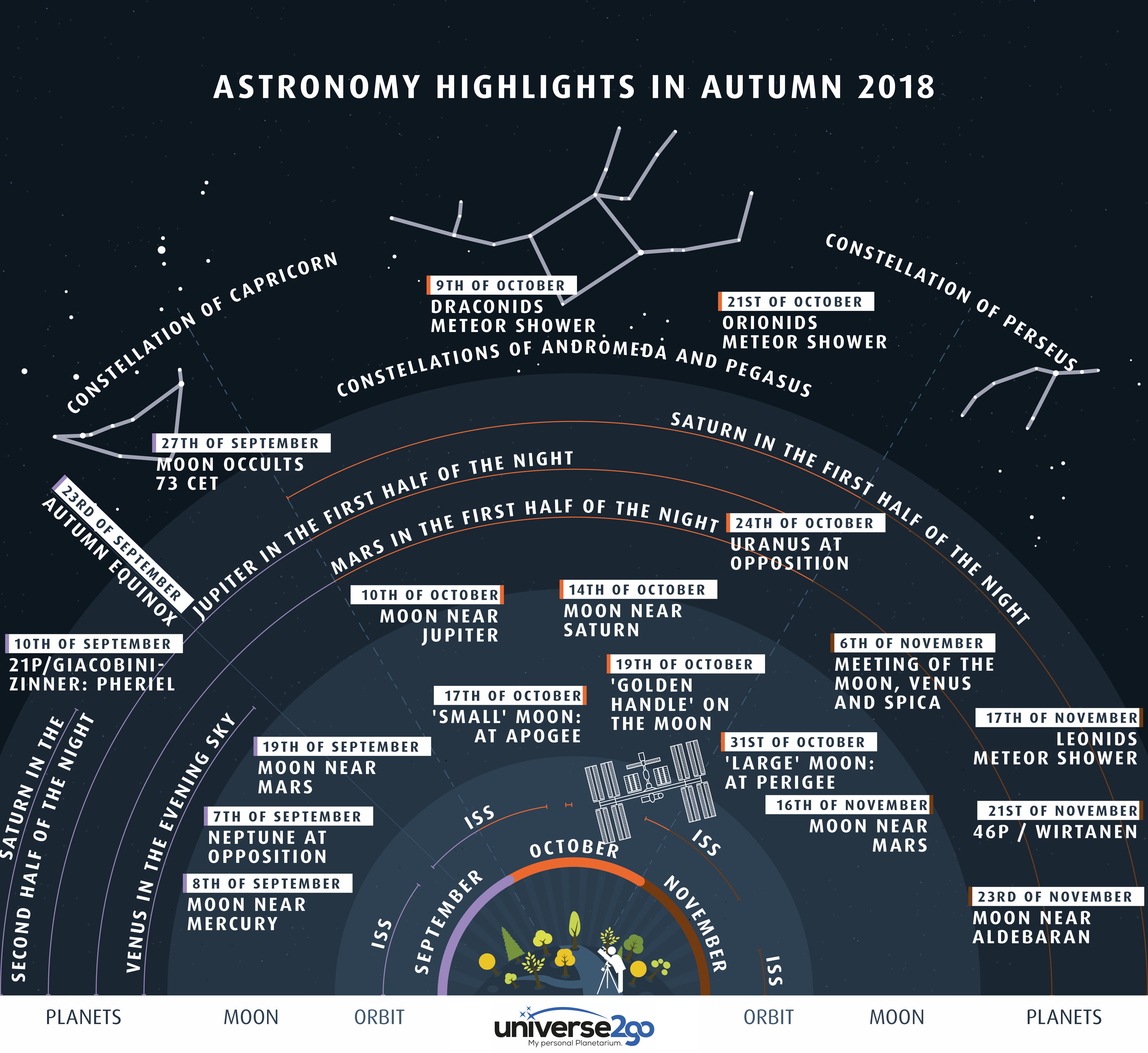
What can you see in the night sky this season? The featured graphic gives a few highlights for Earth's northern hemisphere. Viewed as a clock face centered at the bottom, early (northern) autumn sky events fan out toward the left, while late autumn events are projected toward the right. Objects relatively close to Earth are illustrated, in general, as nearer to the cartoon figure with the telescope at the bottom center -- although almost everything pictured can be seen without a telescope. As happens during any season, constellations appear the same year to year, and, as usual, the Leonids meteor shower will peak in mid-November. Also as usual, the International Space Station (ISS) can be seen, at times, as a bright spot drifting across the sky after sunset. Planets visible after sunset this autumn include Jupiter and Mars, and during late autumn, Saturn.
¿Qué puedes ver en el cielo nocturno esta temporada? El gráfico destacado muestra algunos elementos clave para el hemisferio norte de la Tierra. Visto como una cara de reloj centrada en la parte inferior, los eventos del cielo de otoño (norteño) se extienden hacia la izquierda, mientras que los eventos del final del otoño se proyectan hacia la derecha. En general, los objetos relativamente cercanos a la Tierra se ilustran más cerca de la figura con el telescopio en el centro inferior, aunque casi todo lo que se muestra se puede ver sin telescopio. Como ocurre en cualquier temporada, las constelaciones aparecen igual año tras año, y, como es habitual, la lluvia de meteoros de los Leónidas alcanzará su máximo a mediados de noviembre. También como es habitual, la Estación Espacial Internacional (ISS) puede verse, en ocasiones, como un punto brillante que cruza el cielo después de la puesta de sol. Los planetas visibles después de la puesta de sol este otoño incluyen a Júpiter y Marte, y durante el final del otoño, a Saturno.