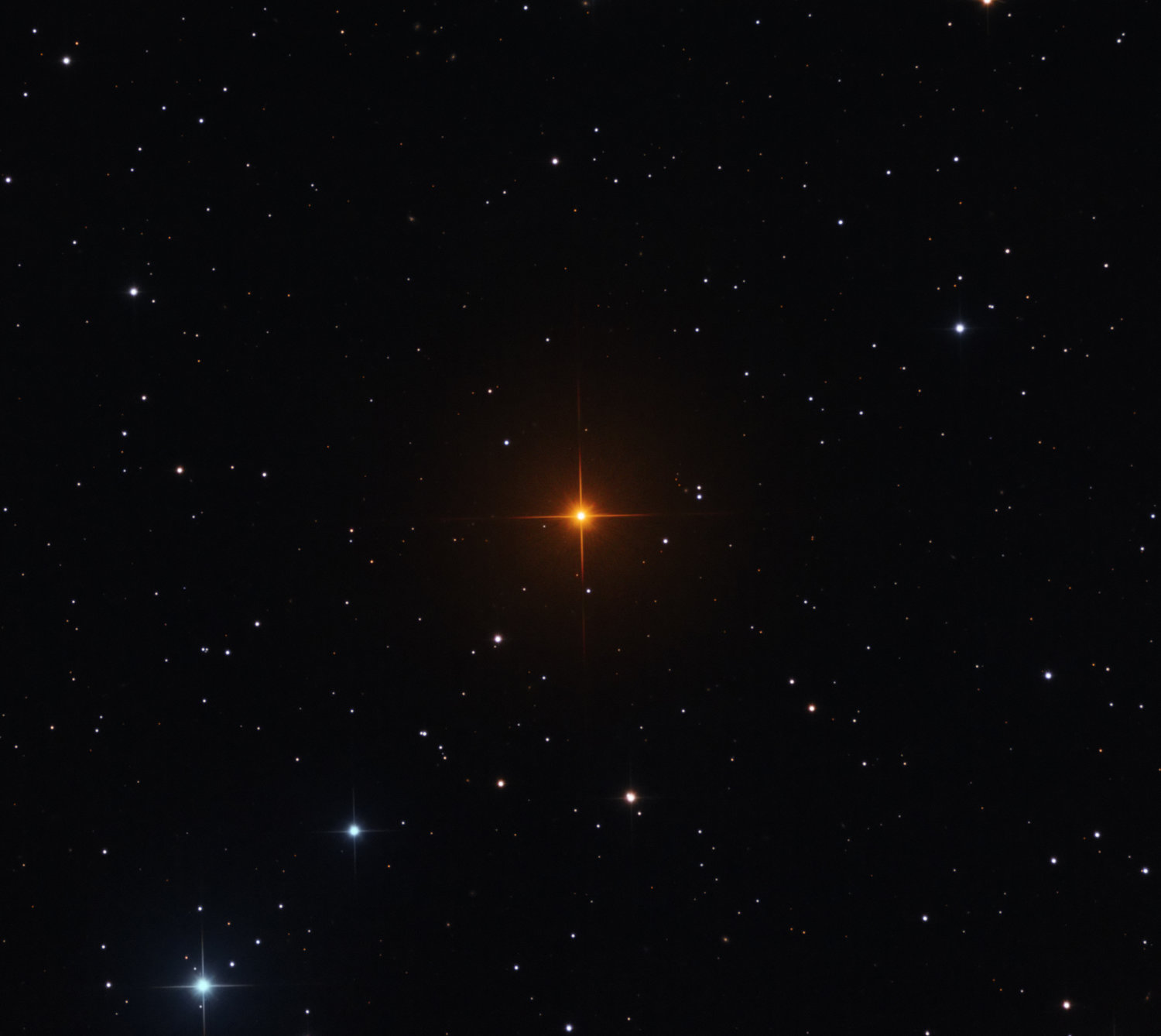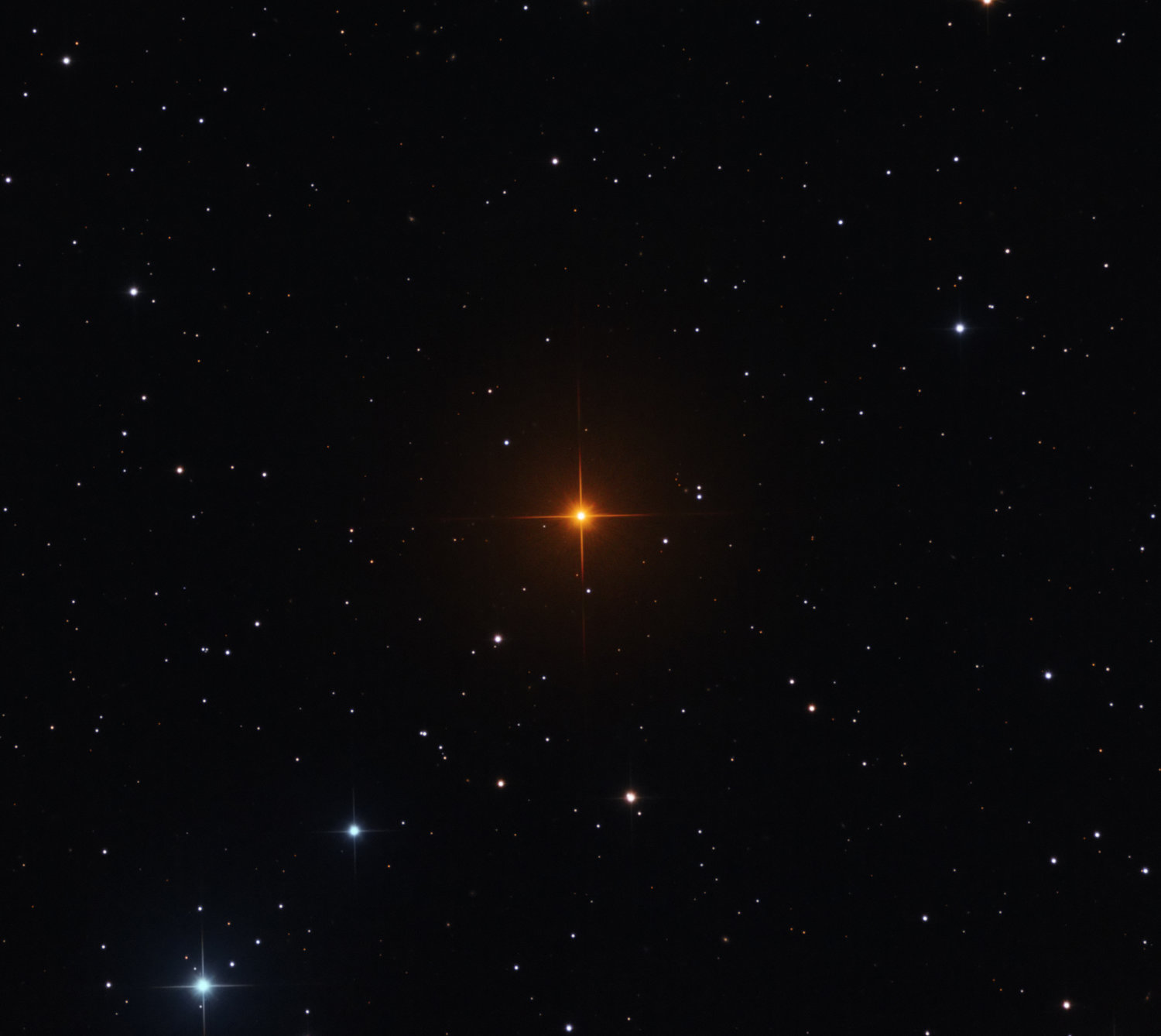
Better known as Hind's Crimson Star, R Leporis is a rare star in planet Earth's night sky. It's also a shocking shade of red. The star's discoverer, 19th century English astronomer John Russell Hind, reported that it appeared in a telescope "... like a drop of blood on a black field." Located 1,360 light-years away in the constellation Lepus the star is a Mira-type variable, changing its brightness over a period of about 14 months. R Leporis is now recognized as a carbon star, a very cool and highly evolved red giant with an extreme abundance of carbon. Extra carbon in carbon stars is created by helium fusion near the dying stellar core and dredged up into the stars' outer layers. The dredge-up results in an overabundance of simple carbon molecules, like CO, CH, CN, and C2. While it's true that cool stars radiate most of their energy in red and infrared light, the carbon molecules strongly absorb what little blue light is left and give carbon stars an exceptionally deep red color. R Leporis is losing its carbon-rich atmosphere into the surrounding interstellar material through a strong stellar wind though, and could be near the transition to a planetary nebula. Oh, and Happy Halloween from the folks at APOD.
Más conocida como la Estrella Carmesí de Hind, R Leporis es una estrella rara en el cielo nocturno de la Tierra. También tiene un intenso tono rojo. Su descubridor, el astrónomo inglés del siglo XIX John Russell Hind, informó que en el telescopio aparecía "como una gota de sangre sobre un fondo negro." Ubicada a 1.360 años luz de distancia en la constelación de Lepus, la estrella es una variable de tipo Mira, cuya brillantez cambia con un período de aproximadamente 14 meses. R Leporis se reconoce ahora como una estrella de carbono, una gigante roja muy fría y altamente evolucionada con una abundancia extremadamente alta de carbono. El exceso de carbono en las estrellas de carbono se crea por la fusión de helio cerca del núcleo estelar moribundo y es arrastrado hacia las capas externas de la estrella. Este arrastre produce un exceso de moléculas simples de carbono, como CO, CH, CN y C2. Aunque es cierto que las estrellas frías irradian la mayor parte de su energía en luz roja e infrarroja, las moléculas de carbono absorben con fuerza la poca luz azul restante y le dan a las estrellas de carbono un color rojo profundamente intenso. R Leporis está perdiendo su atmósfera rica en carbono hacia el material interestelar circundante a través de un fuerte viento estelar, y podría estar cerca de la transición hacia una nebulosa planetaria.