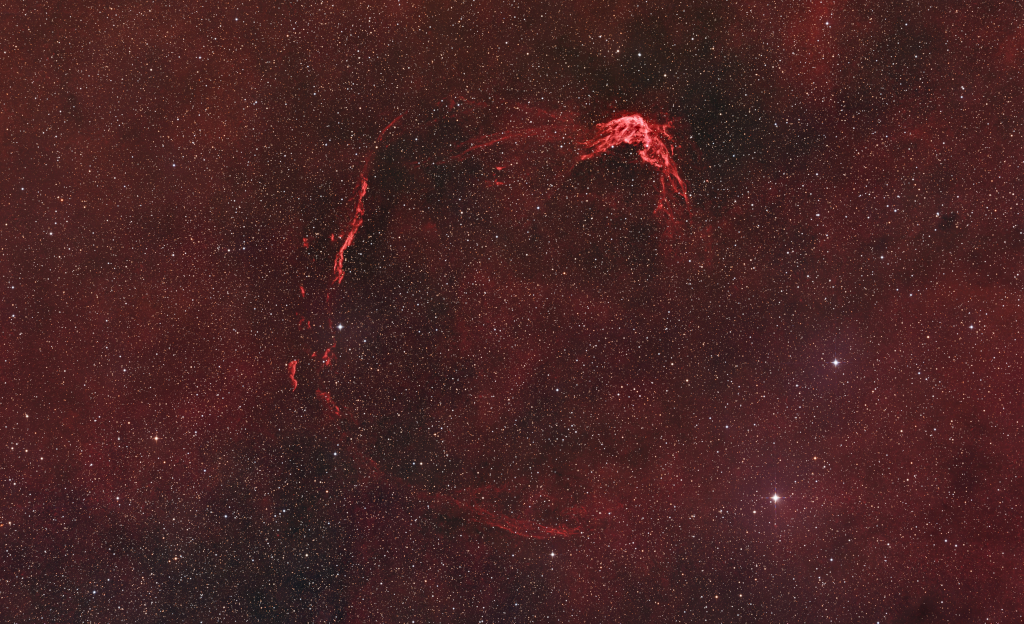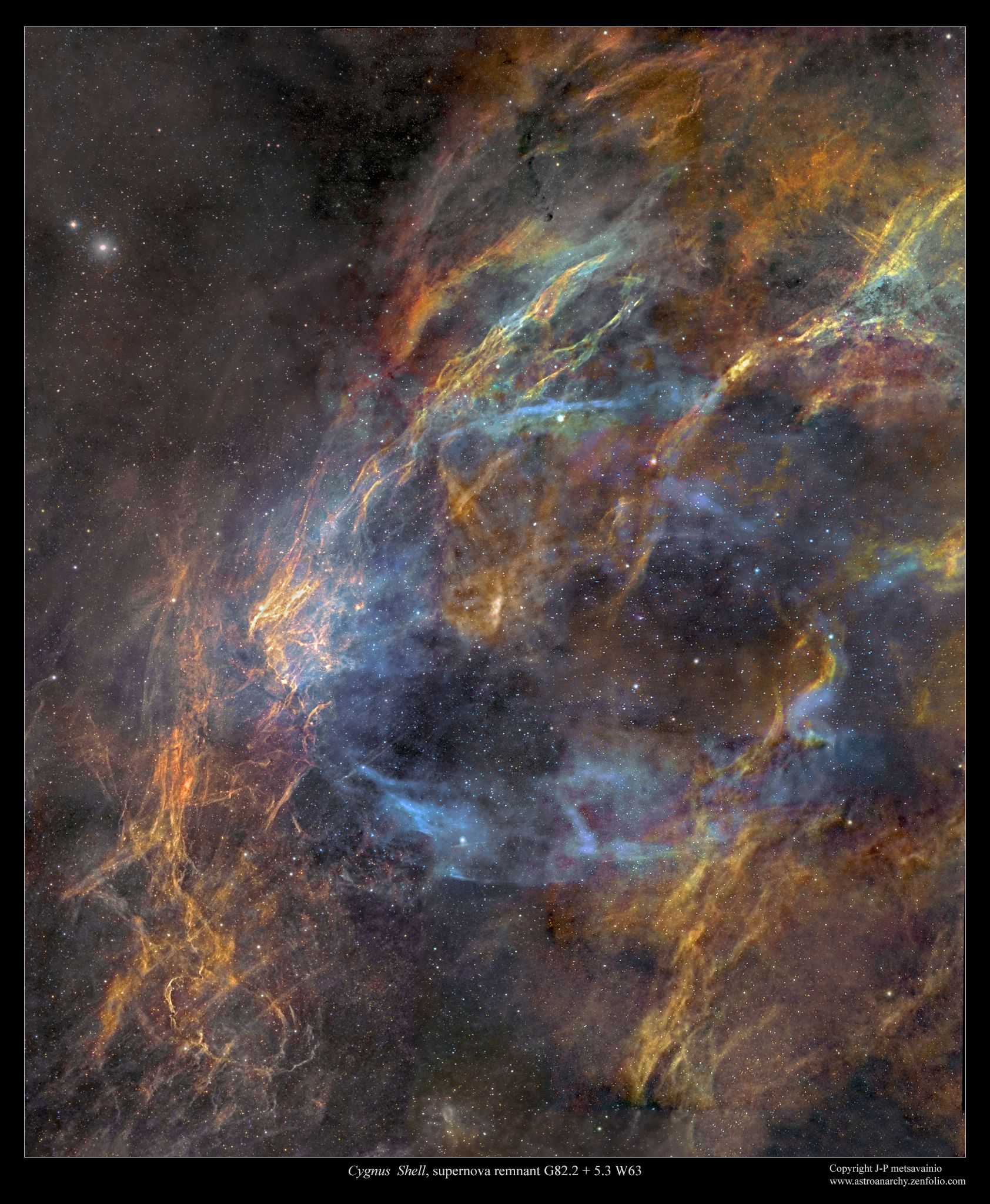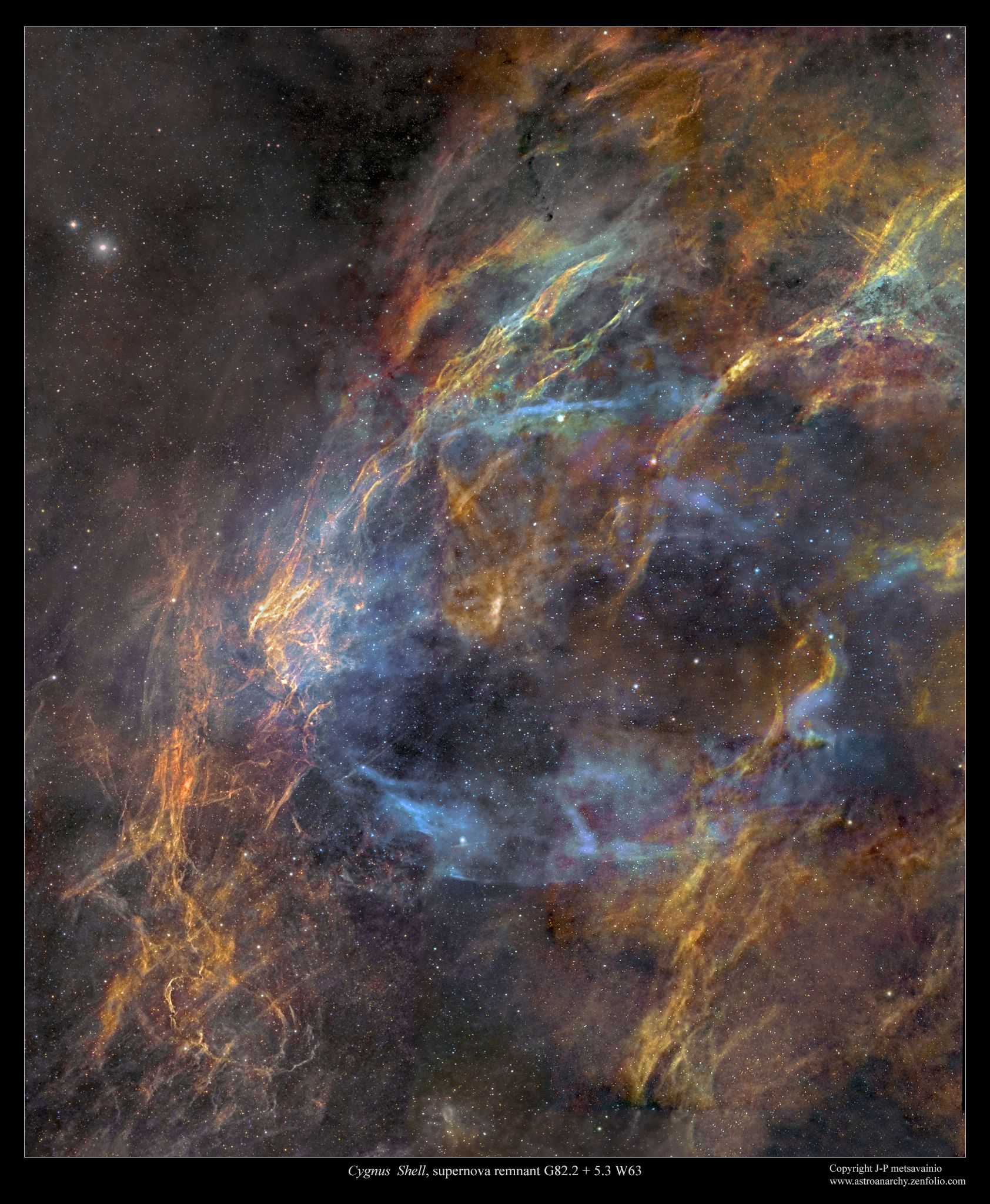
The ghost of a long-dead star, the W63 supernova remnant shines like a faint cosmic smoke-ring along the plane of the Milky Way galaxy toward the northern constellation Cygnus the swan. Its wraithlike appearance is traced against the region's rich complex of interstellar clouds and dust by an eerie blue glow. Spanning over four full moons on the sky, the beautiful image is a telescopic mosaic in twelve panels that combines 100 hours of exposure time using narrow band filters. It shows characteristic light from ionized atoms of sulfur, hydrogen and oxygen in red, green, and blue hues. Likely over 5,000 light-years away, the visible part of the still expanding shell supernova remnant is around 150 light-years in diameter. So far no source has been identified as with the remains of W63's original star. Light from the star's supernova explosion would have reached Earth over 15,000 years ago.
El fantasma de una estrella muerta hace mucho tiempo, el resto de la supernova W63 brilla como un tenue anillo de humo cósmico a lo largo del plano de la galaxia Vía Láctea hacia la constelación norteña de Cygnus, el cisne. Su apariencia espectral se dibuja contra la rica complejidad de las nubes y el polvo interestelar con un brillo azul siniestro. Con un tamaño de más de cuatro lunas llenas en el cielo, la hermosa imagen es un mosaico telescópico de doce paneles que combina 100 horas de tiempo de exposición usando filtros de banda estrecha. Muestra la luz característica de átomos ionizados de azufre, hidrógeno y oxígeno en tonos rojo, verde y azul. Probablemente a más de 5.000 años luz de distancia, la parte visible del resto de la supernova en expansión tiene un diámetro de unos 150 años luz. Hasta ahora, no se ha identificado ninguna fuente como los restos de la estrella original de W63. La luz de la explosión de supernova de la estrella habría llegado a la Tierra hace más de 15.000 años.