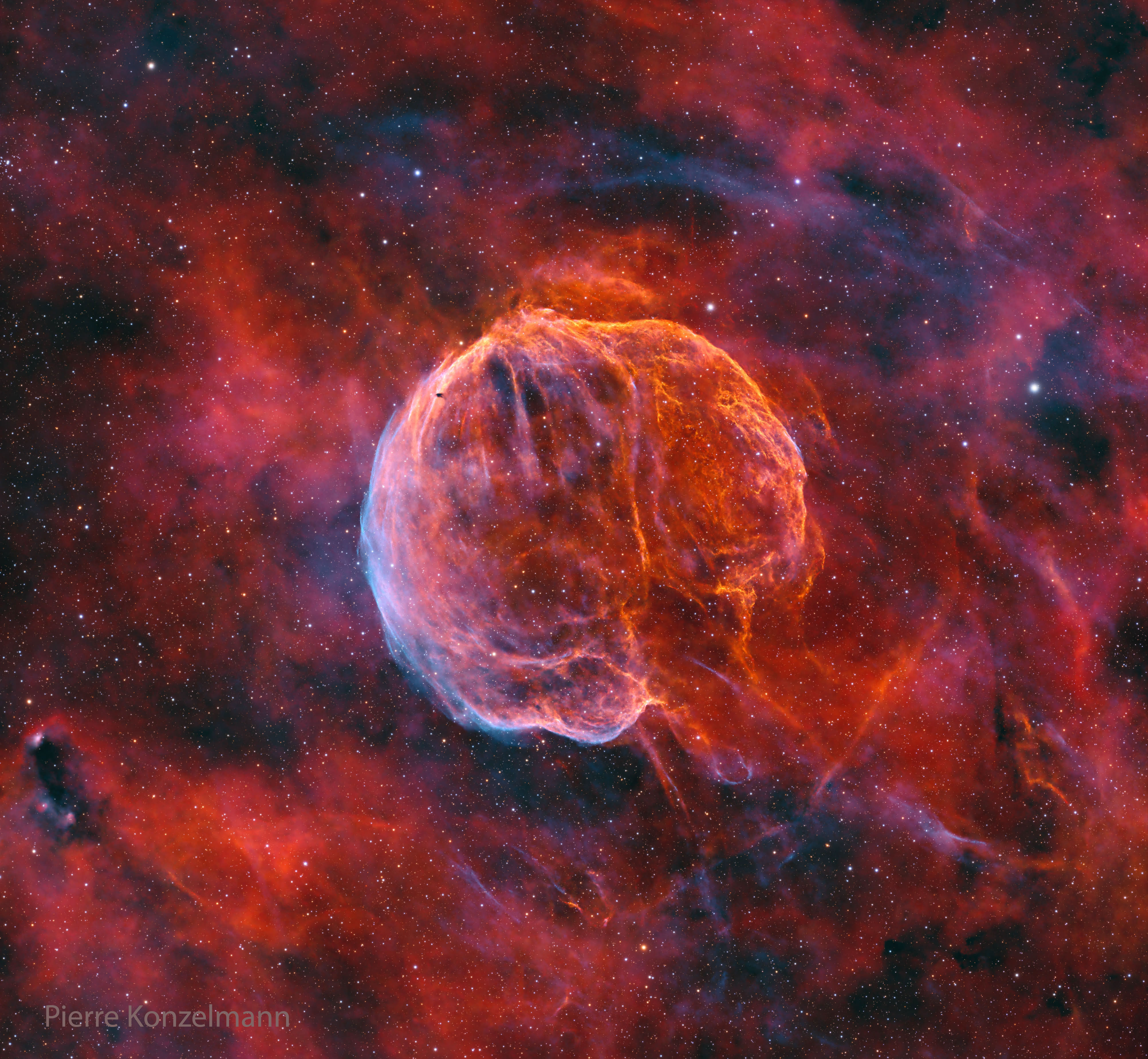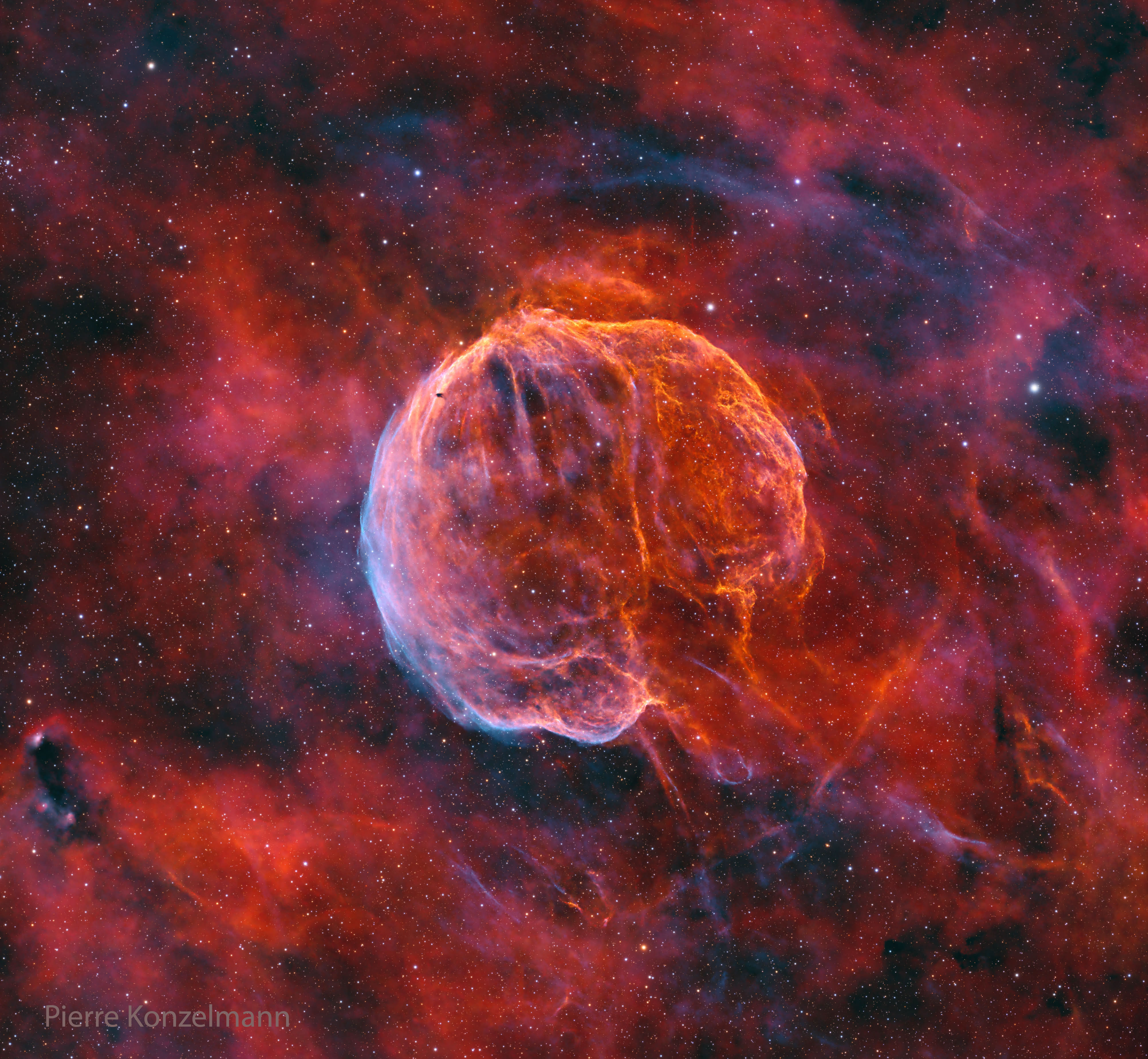
What powers this unusual nebula? CTB 1 is the expanding gas shell that was left when a massive star toward the constellation of Cassiopeia exploded about 10,000 years ago. The star likely detonated when it ran out of elements, near its core, that could create stabilizing pressure with nuclear fusion. The resulting supernova remnant, nicknamed the Medulla Nebula for its brain-like shape, still glows in visible light because of the heat generated by its collision with confining interstellar gas. Why the nebula also glows in X-ray light, though, remains a topic of research. One hypothesis holds that an energetic pulsar was created and powers the nebula with a fast outwardly moving wind. Following this lead, a pulsar was found in radio waves that appears to have been expelled by the supernova explosion at over 1000 kilometers per second. Although the Medulla Nebula appears as large as a full moon, it is so faint that it took 84-hours of exposure with a small telescope in Texas, USA, to create the featured image.
¿Qué alimenta esta inusual nebulosa? CTB 1 es la envoltura gaseosa en expansión que quedó cuando una estrella masiva en dirección a la constelación de Casiopea explotó hace aproximadamente 10.000 años. La estrella probablemente detonó cuando agotó los elementos cercanos a su núcleo que podían generar presión estabilizadora mediante fusión nuclear. El remanente de supernova resultante, apodado Nebulosa Médula por su forma similar a un cerebro, aún brilla en luz visible debido al calor generado por su colisión con el gas interestelar circundante. Sin embargo, la razón por la que la nebulosa también emite luz en rayos X sigue siendo un tema de investigación. Una hipótesis sostiene que se creó un púlsar energético que alimenta la nebulosa mediante un viento que se desplaza rápidamente hacia el exterior. Siguiendo esta pista, se detectó un púlsar en ondas de radio que parece haber sido expulsado por la explosión de supernova a más de 1.000 kilómetros por segundo. Aunque la Nebulosa Médula aparece con un tamaño similar al de la Luna llena, es tan tenue que fue necesario un tiempo de exposición de 84 horas con un pequeño telescopio en Texas, EE. UU., para crear la imagen destacada.