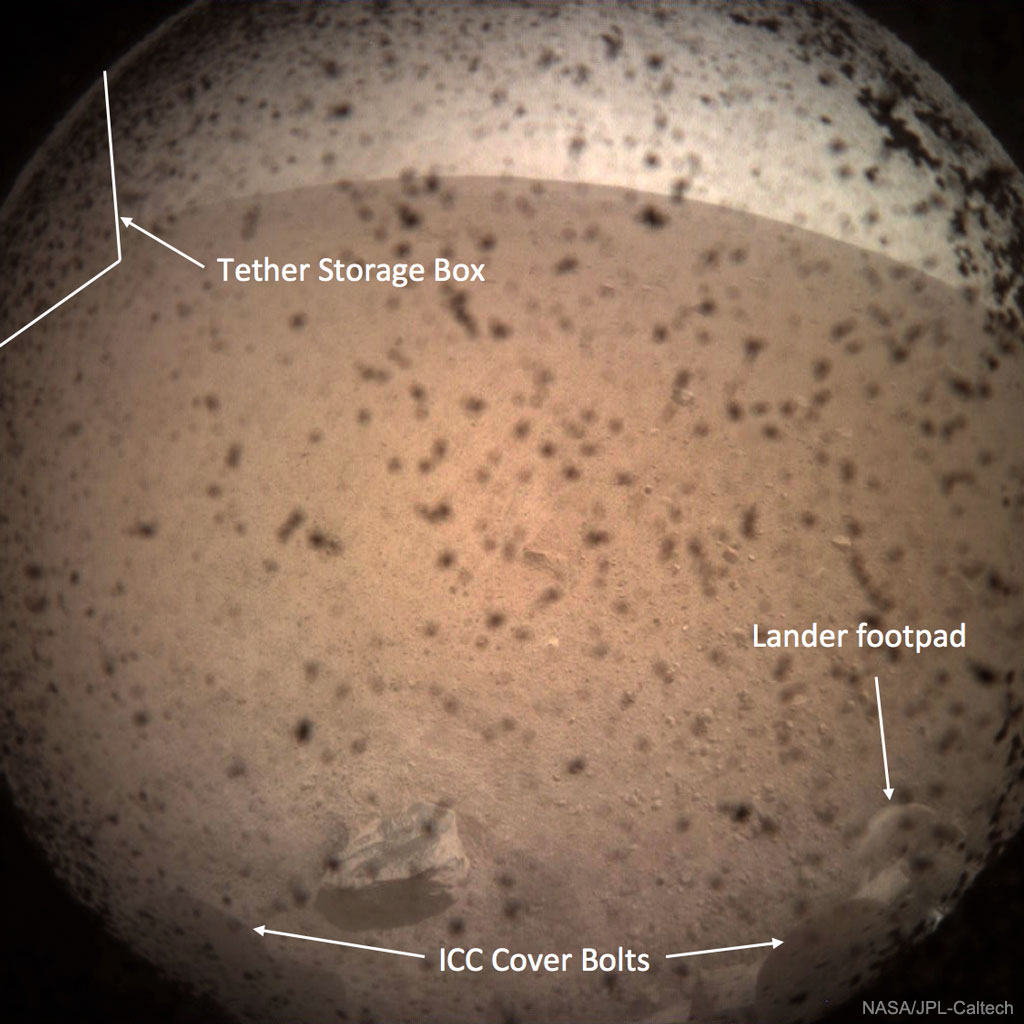
Welcome to Mars, NASA Insight. Yesterday NASA's robotic spacecraft InSight made a dramatic landing on Mars after a six-month trek across the inner Solar System. Needing to brake from 20,000 km per hour to zero in about seven minutes, Insight decelerated by as much as 8 g's and heated up to 1500 degrees Celsius as it deployed a heat shield, a parachute, and at the end, rockets. The featured image was the first taken by InSight on Mars, and welcome proof that the spacecraft had shed enough speed to land softly and function on the red planet. During its final descent, InSight's rockets kicked up dust which can be seen stuck to the lens cap of the Instrument Context Camera. Past the spotty dirt, parts of the lander that are visible include cover bolts at the bottom and a lander footpad on the lower right. Small rocks are visible across the rusty red soil, while the arc across the top of the image is the Martian horizon dividing land and sky. Over the next few weeks InSight will deploy several scientific instruments, including a rumble-detecting seismometer. These instruments are expected to give humanity unprecedented data involving the interior of Mars, a region thought to harbor formation clues not only about Mars, but Earth.
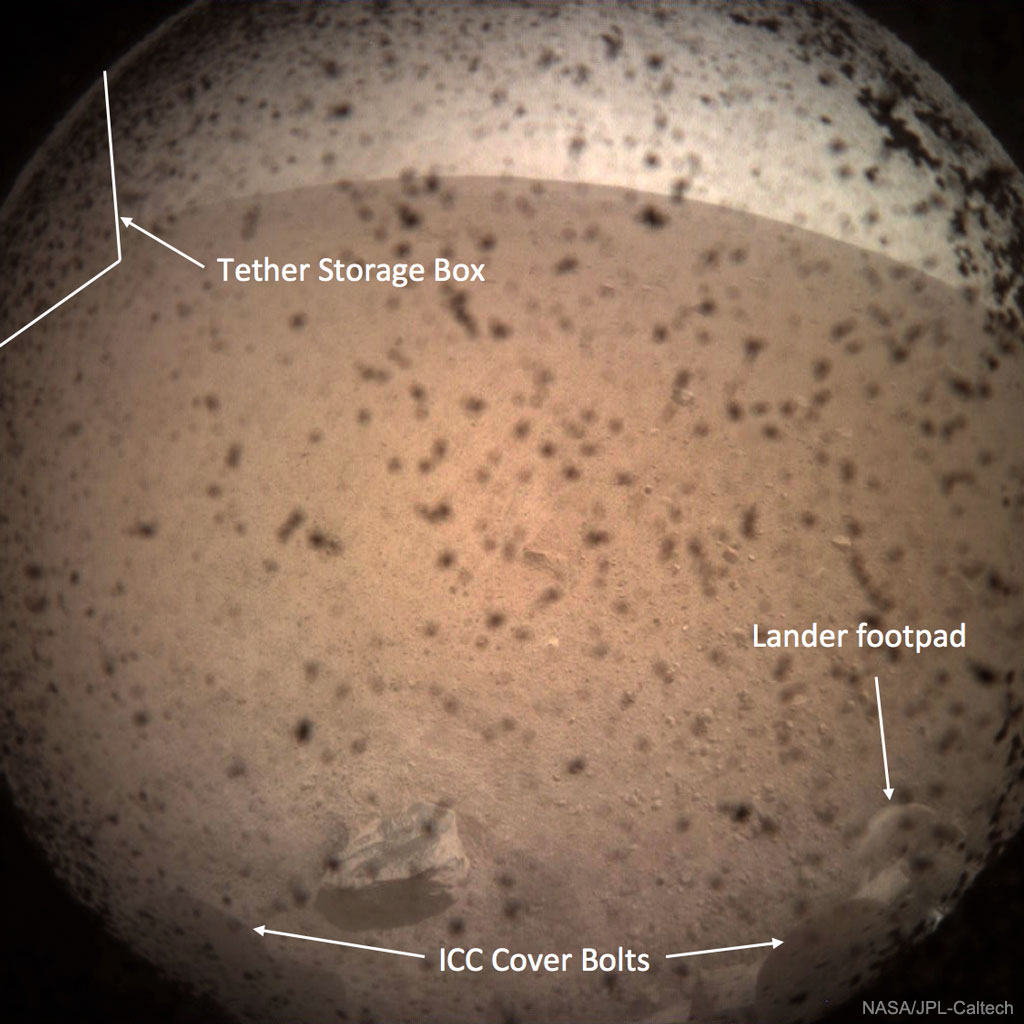
Bienvenido a Marte, NASA InSight. Ayer, la nave espacial robótica de la NASA, InSight, realizó un aterrizaje espectacular en Marte tras un viaje de seis meses a través del sistema solar interior. Para frenar desde 20.000 km por hora hasta cero en unos siete minutos, InSight se desaceleró hasta 8 g y se calentó a 1500 grados Celsius al desplegar un escudo térmico, un paracaídas y, finalmente, cohetes. La imagen destacada fue la primera tomada por InSight en Marte, prueba de que la nave espacial redujo suficientemente su velocidad para aterrizar suavemente y funcionar en el planeta rojo. Durante su descenso final, los cohetes de InSight levantaron polvo, que se ve adherido a la tapa del lente de la Cámara de Contexto del Instrumento. Más allá del polvo disperso, se pueden ver partes del aterrizador, incluyendo tornillos de la cubierta en la parte inferior y una placa de aterrizaje en la esquina inferior derecha. Se ven pequeñas rocas sobre el suelo rojizo, mientras que el arco que cruza la parte superior de la imagen es el horizonte marciano que separa tierra y cielo. En las próximas semanas, InSight desplegará varios instrumentos científicos, incluyendo un sismómetro para detectar movimientos. Estos instrumentos se espera que proporcionen a la humanidad datos sin precedentes sobre el interior de Marte, una región que se cree alberga pistas sobre su formación, no solo de Marte, sino también de la Tierra.